Antminer BM1760 Chip Tin Tool - D3 Hashboard ASIC Repair
Couldn't load pickup availability
Have questions about this product? Our team is here to help — just reach out on WhatsApp.
💬 Contact Us on WhatsAppAbout the Product
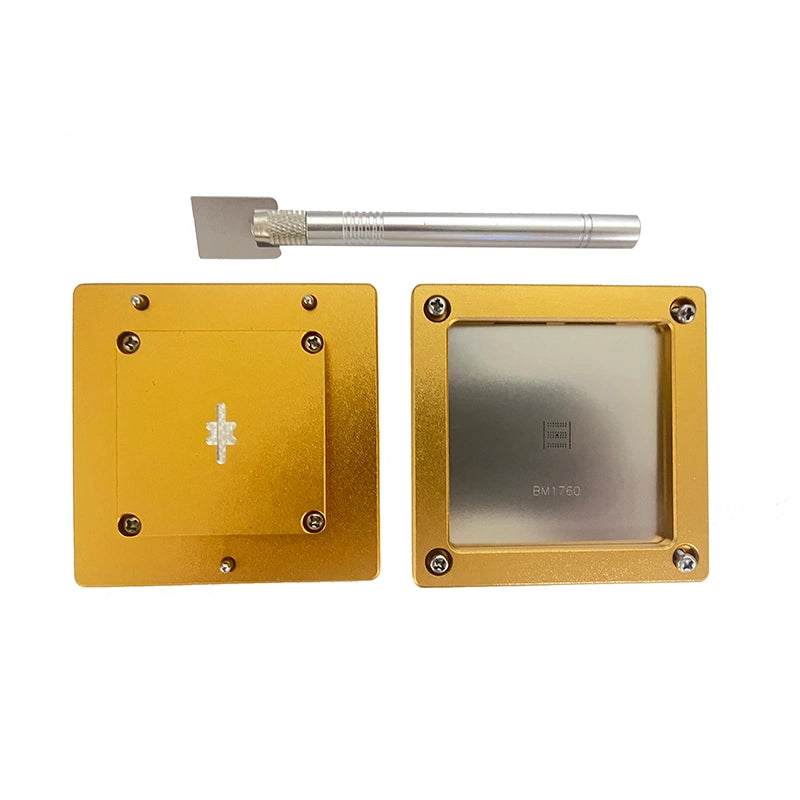
Antminer BM1760 Chip Tin Tool Kit | D3 Hashboard ASIC Repair Set with Stencil and Holder
The Antminer BM1760 chip tin tool kit is a professional-grade reballing fixture for Antminer D3 hashboard repair. Each D3 hashboard hosts 60 BM1760 ASIC chips arranged in 10 voltage domains of 6 chips each — when one chip fails, the whole domain typically drops out, and the standard recovery path is BGA-level reballing with proper tooling. This kit ships with both the stainless steel stencil plate AND the chip holder, giving repair benches everything needed for clean, repeatable tin implantation on the BM1760 BGA footprint.
Reballing without a proper tin tool fixture is the single most common cause of failed hashboard repairs. Misaligned solder balls, bridging across adjacent pads, and inconsistent reflow all trace back to improvised tooling. The BM1760 fixture eliminates those failure modes by clamping the chip in fixed orientation while the stencil deposits a precise solder-ball pattern matching the OEM pad layout. Per Zeus Mining's D3 repair documentation, the BM1760 has a built-in buck diode — meaning the chip itself integrates the rail-side rectification — which makes reballing precision even more critical because a single bridged pad on the buck-output side propagates into rail instability across the domain.
Where the BM1760 Tin Tool Fits in D3 Repair
- Domain-level recovery — when one of the 10 voltage domains drops out, reball the 6 chips in that domain.
- Chip-level recovery — recover salvageable BM1760 chips from failed boards for reuse.
- Hashrate-drop diagnosis — D3 rated at 15-19.3 GH/s X11; significant drop usually traces to chip failure on one domain.
- Repair-bench production work — consistent reballing yield across multiple boards per day.
- Field-decommissioned D3 fleet rebuild — bring legacy D3 miners back online for low-difficulty mining.
Construction and Materials
- High-grade carbon steel stencil — outperforms standard alloy stencils in wear resistance and dimensional stability.
- Chip holder included — clamps the BM1760 in fixed orientation during paste application.
- Anti-static protection — safeguards the BM1760's CMOS gate structures during handling.
- High-temperature resistance up to 300°C continuous — survives standard SAC305 reflow profiles.
- Precision hole alignment — matches OEM BM1760 BGA pad pitch and footprint.
- Stable paste flow — uniform solder distribution across all pads.
BM1760 Chip Tin Tool Kit Specifications
| Feature | Specification |
|---|---|
| Chip Compatibility | BM1760 ASIC chip |
| Hashboard Compatibility | Antminer D3 hash boards |
| Stencil Material | High-grade carbon steel |
| Included Components | Tin tool, stencil plate, chip holder |
| Temperature Resistance | Up to 300°C continuous use |
| Anti-Static Protection | Yes |
| Pad Alignment | 1:1 OEM-spec BM1760 BGA pitch |
| Solder Paste Compatibility | SAC305 / SAC405 reballing paste |
| Primary Use | ASIC chip replacement & soldering |
FAQ — BM1760 Chip Tin Tool Kit
Q: How many BM1760 chips per D3 hashboard?
A: 60 chips per hashboard, arranged in 10 voltage domains of 6 chips each. When one domain drops, you typically need to inspect and potentially reball all 6 chips in that domain.
Q: How do I diagnose which chips failed?
A: Use a D3 hashboard test fixture to scan the chain — it identifies the failing chip position(s) by domain. Combine with thermal imaging during a controlled startup: a cold spot on a chip that should be hashing indicates failure.
Q: What's the reballing workflow with this kit?
A: (1) Lift the failed BM1760 chip with hot-air rework; (2) Clean the pads on the chip and PCB with flux + IPA; (3) Clamp the chip in the holder, lay the stencil over it; (4) Apply solder paste with squeegee; (5) Lift the stencil straight up; (6) Reflow in oven or hot-air station to form balls; (7) Place the reballed chip on the cleaned PCB pads; (8) Reflow the board.
Q: Is the BM1760 the same chip used on other Antminer models?
A: No — the BM1760 is specifically the D3 X11 hashing ASIC. Other Antminer models use different BM-series chips. Per Bitmain documentation, some D3 miners shipped after November 2017 have larger hashboards but use the same BM1760 chip.
Q: Bulk pricing for repair shops?
A: Yes — email contact@lys-sz.com for volume pricing on full D3 repair tool kits.
Related products
- Antminer BM1760 Stencil Plate (D3 — stencil only)
- BM1764AB ASIC Chip (Antminer D7)
- Avalon A3205 Chip Tin Tool Fixture
- Antminer BM1764 Tin Tool (D7)
Repair benches rebuilding legacy Antminer D3 fleets and stocking BM1760 reballing kits? Email contact@lys-sz.com for bulk pricing. Worldwide shipping from our Shenzhen warehouse.
Shipping & Customs
🇺🇸🇪🇺 USA & European Union (DDP):
Orders are delivered DDP (Delivered Duty Paid). All customs duties, import taxes, and fees are included — no additional charges on delivery.
🌍 Rest of world:
Orders ship from China. Depending on your country, local customs authorities may apply import duties or taxes. Any such fees are set by your local authorities and are not included in the product price.
Buying in bulk for a mining farm or repair shop?
Get dedicated B2B pricing on this part and across our full catalog — quote response within 24 hours, payment by T/T USD bank wire, and DDP delivery available for US & EU customers (and other lanes on request).