Antminer Hashboard Repair in 2026: The Spare Parts Sourcing Guide
Every conversation about hashboard failure follows the same script. The dashboard lights up at 3 a.m., one chain drops out, the owner spends the morning reading repair tutorials, then realises that what they actually need is not a tutorial — it is parts. Where do the chips come from? Which stencil fits an S21 XP versus an S21 Hydro? What does an EEPROM programmer actually cost, and is the test fixture the same one used for the S19 family? The guides explain the process. They rarely list the bill of materials.
This guide closes that gap. It walks through what physically fails on an Antminer hashboard, what part you need to replace it, and what to ask for when you order. It is written for repair shops, fleet operators, and home miners who have decided to fix rather than scrap, and who would rather buy the part directly from a warehouse in Shenzhen than wait six weeks for a warranty RMA window.
What actually fails on an Antminer hashboard
The Antminer hashboard is a multi-layer PCB carrying a long signal chain of ASIC chips, a voltage tree split into domains, an EEPROM that stores per-board calibration data, and a clock oscillator. The S19 hashboard runs 114 chips per board (342 per miner). The S21 XP hashboard runs 108 chips per board (324 per miner). When something goes wrong, it is almost always in one of five places.
The first is the ASIC chip itself. BM1368 on the S21 / T21, BM1366 on the S19 XP / S19K Pro, BM1398 on the S19 / S19 Pro / S19j Pro, and BM1373CC on the S23 Hydro all use the same BGA package family. A failed chip blocks the signal from propagating to its neighbours and the board reports a chip count below the expected total. Single-chip failures are the most common ASIC failure on the S19 / S21 generations and the standard fix is a chip-level replacement.
The second is the voltage regulator tree. A healthy S21 XP hashboard shows approximately 1.2 V across each of its 12 voltage domains. When a domain reads zero, an LDO regulator has shorted or the boost converter feeding it has failed. The boost circuits on domains 11 and 12 of the S21 family are the documented hot spots: they use the MP2019 boost IC pair and they fail more often than the rest of the tree.
The third is the EEPROM. Every Antminer hashboard carries a PIC16F1704 microcontroller that stores the factory calibration profile (voltage, frequency, clock domain). When this EEPROM is corrupted, the control board cannot read the board and reports it as unrecognised. The fix is to reflash with the correct factory HEX file using a PICkit3 programmer.
The fourth is the clock signal. A 25 MHz crystal oscillator (Y1) generates the master clock that propagates from chip BM1 to the last chip on the chain. A cracked or drifted oscillator breaks the chain before the first chip, so the board reports zero chips detected even though every ASIC is physically intact.
The fifth is the passive line. Damaged capacitors, blown fuses, short-circuited resistors, and lifted pads from repeated thermal cycling. These rarely show on a quick diagnostic but they cluster around the boost circuits and they account for a meaningful share of "this board fails on PT2 but passes PT1" cases.
Diagnosing before ordering parts
The fastest way to waste money on a repair is to order a chip before you know it is a chip. The Antminer web interface gives three pieces of information that together identify the failure mode in under a minute.
The chain status line tells you which hashboard is down. If one chain reads zero and two are healthy, the problem is on that chain. If two or three chains report errors simultaneously, the problem is almost certainly upstream — control board, PSU, or data cables — not the hashboards. Two hashboards rarely fail in the same week.
The chip count per chain tells you whether chips are responding. A chain reporting 0 chips usually means a signal-chain break (clock oscillator, first chip, or a damaged trace at the start of the chain). A chain reporting a partial count (60 of 108, for example) means the chain breaks at a specific chip; that chip is the failed one.
The domain voltage readings (visible with debug-enabled firmware) tell you whether the power tree is intact. A domain reading 0 V or significantly below 1.2 V points to the voltage regulator or boost circuit feeding that domain. A 1.2 V reading across the whole board with chip failures still showing means the silicon is the problem, not the power.
Two more pre-order checks save a surprising amount of money. Reseat the data cables between the control board and the hashboards before assuming a hashboard fault — loose data cables are the most common false positive for "chain missing" errors. Check the PSU output voltage at the hashboard input with a multimeter — a sagging PSU can produce hashboard-style errors without any actual hashboard damage.
The spare parts BOM, by component
What follows is the parts list keyed to the failure modes above. We carry these as spare parts and ship them worldwide from our warehouses in Shenzhen. Pricing depends on quantity and current chip availability — message us with your miner model and the exact symptom, and we will quote within 24 hours.
ASIC replacement chips
Replacement BGA chips are sold per unit, typically packaged in trays of 50 for repair shops. We carry the four most-used generations: BM1398 (S19, S19 Pro, S19j Pro, S19a, S19j XP), BM1366 (S19 XP, S19K Pro), BM1368 (S21, T21, S21 Pro, S21+, S21 XP), and BM1373CC (S23 Hydro). The newest Whatsminer generations use a different chip family supplied by MicroBT — covered in our control board and hashboard guides.
Two practical notes. First, the same generation may use slightly different chip bins (typically labelled A, B, or C on the chip surface) depending on the factory week. The control board reads the EEPROM and adjusts voltage and frequency to the bin recorded there, which means a replacement chip from a different bin can work but may run slightly hotter or cooler than its neighbours. For a single-chip replacement this is normally fine. For a board where you are replacing five or more chips, request the same bin or accept that you will need to update the EEPROM profile after the repair.
Second, the BM1368 used on the S21 XP and S21 Hydro is tighter on supply than the older BM1398 and BM1366. Lead times on BM1368 tray orders are typically longer than on the S19 family chips. If you operate a fleet of S21 XP or Hydro miners, the right move is to keep one tray on the shelf rather than wait for it when a board comes off the rack.
Internal link : BM1373CC ASIC chip — S23 Hydro hashboard replacement.
Voltage regulators and boost ICs
LDO regulators feeding domains 1 through 10 on the S21 family are standard surface-mount parts, sold per unit or per reel. The boost ICs for domains 11 and 12 — the documented S21 hot spot — are MP2019 in a small QFN package. When these fail they almost always take an adjacent capacitor with them, so the practical fix is to replace the boost IC and the two nearest input capacitors together.
For the S19 generation, the boost topology is simpler and the most common discrete failures are on the input filter capacitors near the connector. These are inexpensive parts, sold in bulk, and we ship them by quantity rather than per unit. If you operate at scale and you re-paste boards on a quarterly cycle, replacing the input caps preventatively during the same operation reduces failure rates measurably.
EEPROM programming hardware
Reading and writing the PIC16F1704 EEPROM on an Antminer hashboard requires a PICkit3 programmer, MPLAB IPE software (free from the chip manufacturer), and the correct factory HEX file for the board variant you are working on. The PICkit3 is a one-time hardware purchase; the HEX files are circulated within the repair community by board generation and bin code.
What we sell on the LYS side is the PICkit3 plus a fixture that maps the programming pins on the hashboard. The fixture matters: probing the EEPROM in-circuit on a multi-layer PCB without a fixture is feasible but error-prone, and a shop running more than five EEPROM operations per month will save its fixture cost back in time within a quarter.
Crystal oscillators
The Y1 25 MHz crystal is small, cheap, and rarely fails — but when it does, the entire signal chain reports zero chips and the board looks dead. A board that fails PT1 with all chips invisible, but shows correct domain voltages, is a Y1 candidate. We sell Y1 replacements per reel for shops that batch-repair S19 / S21 boards.
Thermal grease stencils and pastes
Repaste is not a repair part in the strict sense, but it is a parts-related operation that determines how long the next chip you solder will live. The S21+, S21 XP, and S21 Hydro hashboards each have their own stencil geometry. Reusing a generic stencil leaves gaps or applies grease over chip edges. We carry the S21+ stencil (3-layer steel mesh), the S21 XP stencil with 1:1 OEM hole positions, and the S21 Hydro stencil with stainless steel positioning frame as separate SKUs.
Internal links : Antminer S21+ Hydro grease stencil, Antminer S21 XP Hydro silicone stencil, Antminer S21+ thermal grease 3-layer steel mesh kit.
Test fixtures
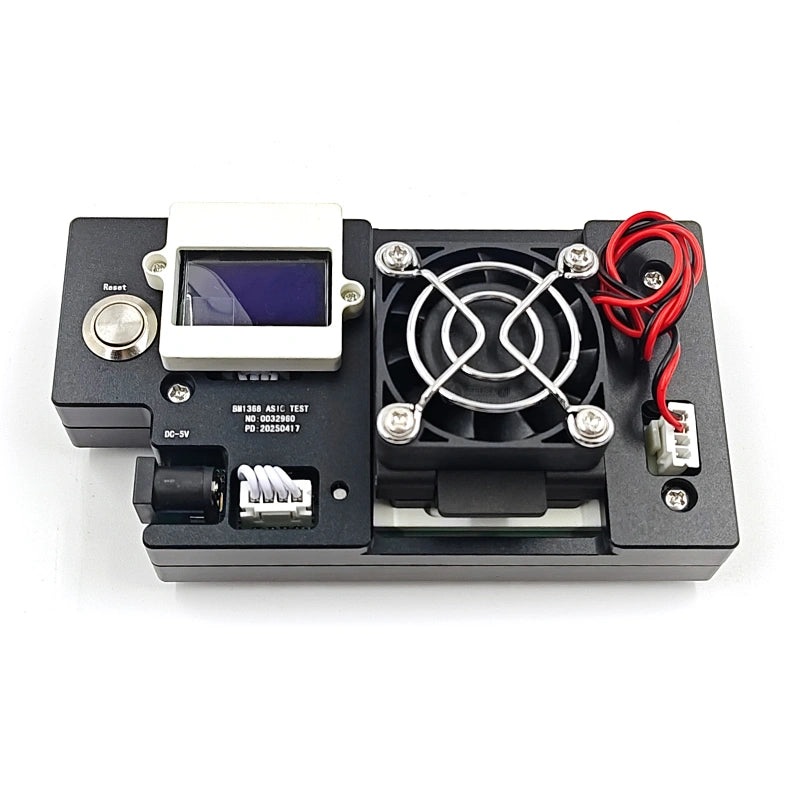
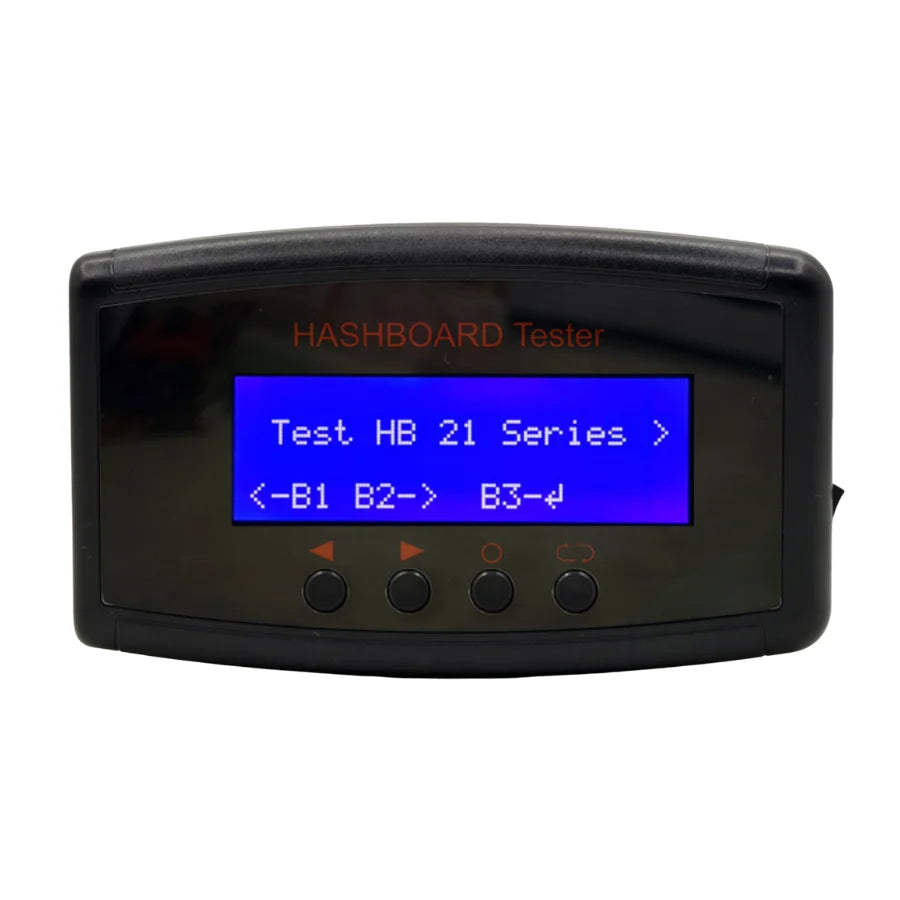
A hashboard test fixture connects the board under test to a diagnostic control board running Bitmain test firmware. The fixture is what runs PT1 (chip detection) and PT2 (function test under load). PT2 is the gating step before a repair is called complete — a reputable shop requires two consecutive PT2 passes before the board ships back.
Test fixtures are generation-matched. An S19 fixture will not run a PT2 on an S21 board. We carry test fixtures for the S19 family, the S21 family, and the Whatsminer M30 / M50 / M60 lines, plus the multi-function K3L tester for shops that work across several generations and want a single bench tool.
Internal link : K3L multi-function hashboard tester.
Control board spares
A hashboard fault that turns out to be a control board fault is not rare, and a shop that diagnoses it correctly saves the customer a wasted chip replacement. Bitmain Antminer C-series control boards (C49, C53, C56, C59, C89) and Whatsminer CB2 / CB4 / CB6 control boards each run a different SoC and firmware. We carry the C59 / C89 Hydro control board as a unified spare for the S23 Hydro, S21e Hydro, S21 XP+ Hydro, S21+ Hydro, S19e Hydro, S19 XP+ Hydro, S19 Pro+ Hydro and T19 Hydro lines, with the 8-in-1 firmware preloaded.
Internal link : Antminer C59 / C89 Hydro control board (8-in-1 firmware).
Cost benchmarks and when to repair versus replace
The total cost of a single-board repair, when you source the parts directly, breaks down roughly like this. ASIC chips run from a few dollars per unit on the older BM1398 generation up to substantially more per unit on the newest BM1368 and BM1373CC, with bulk pricing dropping the per-unit cost meaningfully when you order in trays. LDO regulators, boost ICs, capacitors, crystals, and other discrete passives total a few dollars per board in incidental parts. EEPROM programming hardware is a one-time investment in the few-hundred-dollar range. Thermal grease and stencils are a few dollars per board on a re-paste cycle.
The chip cost is the dominant variable. A board that needs one chip is a much cheaper repair than a board that needs five. A board with burn damage spreading across multiple domains is usually not economically repairable at any chip count — the labour to identify, replace, and retest every failed component exceeds the cost of a replacement board.
| Failure pattern | Typical parts required | Repair feasibility |
|---|---|---|
| Single chip failure, all domains healthy | 1 BGA chip, flux, solder, possible re-paste | Standard repair, high success rate |
| 2–3 chip failures, all domains healthy | 2–3 BGA chips, flux, solder, full re-paste | Standard repair, slightly lower success rate |
| Domain reads 0 V, chips physically intact | LDO or MP2019 boost IC + adjacent capacitors | Standard repair, fast turnaround |
| Board fails PT1 with all chips invisible | Y1 crystal or first-chip signal trace check | Cheap part, easy fix once diagnosed |
| Board reports unrecognised by control board | EEPROM reflash with correct HEX file | Requires PICkit3 + HEX, no chip change needed |
| 5+ chip failures or burn damage across domains | Full board replacement usually cheaper than repair | Replace board or scrap unit |
| Liquid damage or PCB delamination | — | Not economically repairable |
One pattern is worth flagging because it confuses operators. A board that boots, hashes for a few minutes, and then drops a chain is almost never a hashboard fault. It is thermal protection kicking in because a fan is failing, the heatsink is clogged with dust, or the ambient temperature is above spec. Fix the cooling first and the apparent "hashboard fault" disappears.
Sourcing logistics : what to ask for when you order parts
Three pieces of information turn a vague parts request into a fast quote. The first is the miner model and the exact suffix — S19j Pro is not the same as S19j XP, and an S21 board is not the same as an S21 Hydro board. The second is the failure mode — chip count, voltage reading, dashboard error — because it tells us which parts you actually need rather than a generic list. The third is the quantity and target shipping country, because it changes the freight option we quote.
On freight, we ship by DHL, FedEx, or UPS as the default for parts orders, with sea freight available for bulk shipments where the timeline allows. DDP is offered as the primary shipping option for buyers in the US and EU, which removes the customs friction at destination. For other regions — Latam, SE Asia, Middle East, CIS — we quote shipping case by case, factoring in carrier coverage and local import handling. Most parts orders dispatch within a few business days; high-volume chip orders involving newer generations may require a longer lead time depending on stock.
For shops outside the US and EU, two practical points. First, antistatic packaging is mandatory on chip shipments and we include ESD bags as standard. Second, if your local customs clearance involves repeated documentation, request our commercial invoice in your local language at quote time — we can issue invoices in Spanish, Russian, and Chinese in addition to English.
Preventive parts strategy for fleet operators
A fleet running 20 or more Antminers will see a predictable annual failure profile. Roughly one hashboard repair per ten miners per year is a reasonable baseline at moderate ambient temperatures and stable power. The maths shift quickly with humidity, dust, voltage instability, and aggressive custom firmware — fleets in tropical climates routinely report higher failure rates, and fleets running underclocked stock firmware in dry climate-controlled rooms report lower.
The single most cost-effective preventive parts strategy at this scale is a small standing stock of the four highest-failure-rate components on your fleet. For an S21 fleet, that is a tray of BM1368 chips, a roll of MP2019 boost ICs, a set of generation-matched stencils, and one spare PSU per ten miners. For an S19 fleet, the BM1398 tray and the input filter capacitor stock are the priority. Keeping this stock on a shelf next to the repair bench compresses board-out-of-rack downtime from days to hours and stops a single shipping delay from putting a meaningful percentage of your fleet offline.
The second preventive operation is a quarterly re-paste plus heatsink cleaning on the highest-use machines. Dust accumulation in the heatsink fins is the single most common precursor to chip-level failures, because it raises the chip junction temperature for months before the failure shows on the dashboard. The cost of a thermal kit and an hour of bench time is an order of magnitude lower than the cost of the chip replacement it prevents.
FAQ
How do I know whether I need one chip or five?
Run a PT1 chip detection test if you have access to a fixture. If you do not, read the chip count on the control board interface : a chain reporting 113 of 114 chips on an S19 means one chip is failed and the failed chip is the one immediately downstream of the last-detected chip. A chain reporting 60 of 114 means the chain breaks at chip 61 in the sequence. The first failure is the one you replace ; if a second chip is failed further down the chain, it will only show on the test fixture after the first chip is fixed.
Can I ship a hashboard from outside China and have it repaired here?
Yes. We accept hashboard-only inbound shipments for repair, packaged in antistatic bags inside a foam-lined box. Inbound shipping is on the customer ; we quote return shipping at the same time as the repair. Turnaround on a single-board repair is typically a few business days once the board reaches our bench.
Do I need original chips or are aftermarket chips acceptable?
The BM1368, BM1366, BM1398, and BM1373CC are manufactured exclusively by the OEM. There is no separate aftermarket source — when shops talk about "OEM" versus "non-OEM" they typically mean "trayed from factory line versus desoldered from scrap boards". Desoldered chips can work but their reliability is lower because the chip has already been through one reflow cycle. We supply trayed chips from the factory line as the default. Desoldered stock is available at lower cost where supply is constrained.
What HEX file do I need for the EEPROM reflash?
The HEX file is specific to the board model and the bin code. The bin code is printed on the chip surface or stored in the original EEPROM. If you send us the board model and a clear photograph of a chip surface from the board, we can identify the correct HEX from our internal library. For a single repair this is included with the chip order. For batch repairs, the HEX file is a separate file deliverable.
Can I repair an S21 Hydro hashboard without the special stencil?
You can, but the result is poor. The S21 Hydro hot plate geometry is specific and a generic stencil applies grease over chip edges, leaves cold spots in the centre of the board, and shortens the chip life of the boards you repair. The stencil is a few dollars and pays itself back within a single repair.
Related guides
For the prior step in the workflow — recognising the symptoms of a failing PSU before you suspect the hashboards — see our guide on how to diagnose a failing Antminer PSU. For the deep dive on the bench tool that gates every repair we ship, see our guide to the K3L multi-function hashboard tester. For Whatsminer fleet operators dealing with the equivalent question on the M30 / M50 / M60 family, see our Whatsminer control board identification and replacement guide. For the step that follows the chip replacement — applying thermal grease correctly so the repaired board lives a long second life — see our S21 series thermal paste and stencil application guide.
Order parts or request a quote
Tell us the miner model, the symptom, and the quantity you need, and we will quote within 24 hours.
Email : contact@lys-sz.com
Direct from our warehouses in Shenzhen. Worldwide shipping. DDP available for buyers in the US and the EU.