Building a 12-Month Mining Parts Standing Stock for Your Fleet: A Budget Template for 2026
Most fleet operators discover the parts budget the same way. A hashboard fails in week six. The technician orders a chip. The chip ships from Shenzhen, lands in customs four days later, clears another two days after that, and arrives on the bench day nine. The board is back in the rack day eleven. The unit produces zero revenue for eleven days, and the operator has just lived through their first uncosted parts event.
The operators who avoid living through that scenario every quarter share one operational habit : they treat spare parts as a planned line item in the annual budget, not as an emergency expenditure. They build a standing stock against the predictable failure profile of their fleet, they refresh that stock on a known cadence, and they hold enough of the right components to keep the bench moving without waiting on an international freight cycle.
This article is the budget template for that approach. We walk through the failure baseline by generation, the standing-stock priority tiers, the reorder cycle calendar, and three real fleet-size scenarios — 10, 50, and 200 machines — with a parts list that covers a full year of expected operations. The goal is not to convince you to hold every part for every contingency. The goal is to make the parts spend predictable and defensible, so the annual budget conversation with the CFO becomes a calculation rather than an argument.
The failure baseline by generation
Start with the number that anchors the budget : the expected annualised hashboard failure rate per miner. At moderate ambient temperature, stable power, and stock firmware, a reasonable working assumption is roughly one hashboard repair per ten miners per year on the S19 family and one repair per twelve miners per year on the S21 family. PSU failures run at approximately one per fifteen to twenty miners per year across both generations. Fan failures run at approximately one to two per miner per year on aggressively-used units and lower on lightly-cycled units.
These baselines shift quickly with three variables : ambient temperature and humidity, power quality, and firmware. A tropical-climate fleet without active cooling can run failure rates two to three times the baseline. A grid-stress location with frequent brownouts can run PSU failures at twice the baseline. A fleet on aggressive custom firmware can run chip failures at 1.5 to 2 times the baseline. The right starting place is the baseline ; the right adjustment is climate-and-power-aware.
The companion piece on the hidden variable in mining ROI walks through how the failure baseline maps to revenue impact across operator scales. This article picks up where that one ends and turns the failure profile into a procurement schedule.
The standing-stock priority tiers
Not every part deserves a standing-stock slot. The components that earn their carrying cost are the ones whose failure mode produces the largest revenue gap if the part is not immediately available. The components that do not earn their carrying cost are the ones with long lifetimes, predictable failure modes, and short lead times — those parts can be ordered just-in-time without missing a meaningful operating window.
Tier 1: bench-critical, hold against any fleet size
These are the components that block the repair workflow itself. Without them on the bench, the technician cannot diagnose, swap, or test. The Tier 1 list per fleet generation is short.
For an S19-class fleet : a small tray of BM1398 replacement chips, a stock of input filter capacitors for the APW12 PSU, a set of S19-family stencils for thermal grease application, fan replacements sized to the unit, and the PIC16F1704 EEPROM programming setup with HEX file library.
For an S21-class fleet : a small tray of BM1368 (or BM1370 for the XP generation) replacement chips, a reel of MP2019 boost ICs for the documented S21 domain 11/12 hot spot, input filter capacitors for the APW17 PSU, generation-matched stencils (separate SKUs for S21+, S21 XP, S21 Hydro), fan replacements, and the same PIC16F1704 programming setup. Companion piece on Antminer hashboard repair parts sourcing covers the Tier 1 bill of materials per generation in detail.
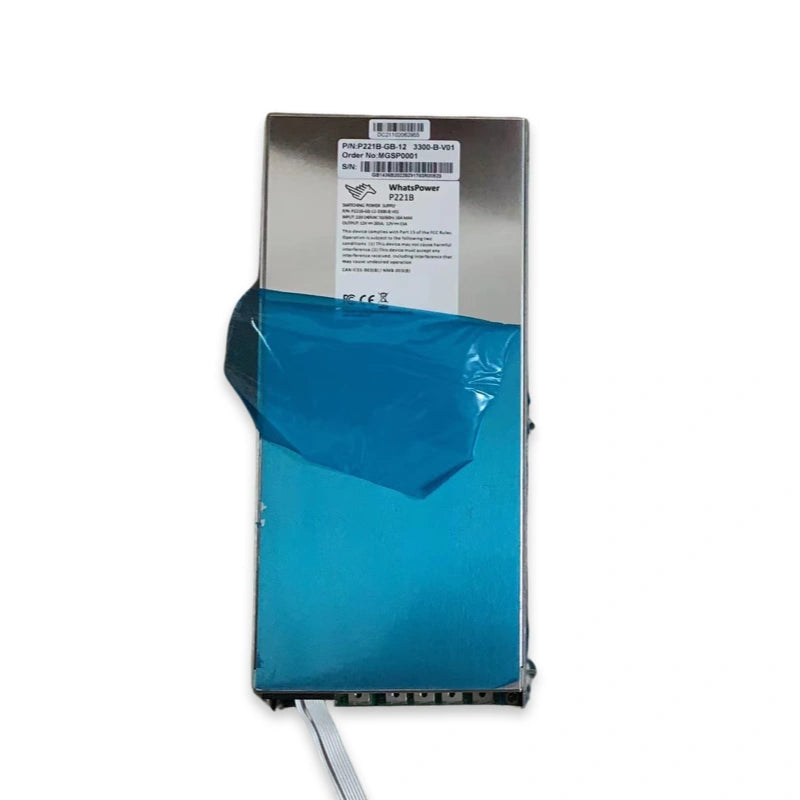
For a Whatsminer fleet : MicroBT chip stock (concentrated supplier network — quantities matter more than at the same scale for Bitmain), Whatspower P-series PSU spare units (P21 / P221 / P222 for air-cooled, P566Z for hydro), CB2 / CB4 / CB6 control board spares, and the firmware management toolkit for SD-card recovery flashes — covered in our Whatsminer control board identification and replacement guide.
Tier 2: high-impact, hold above 50-machine fleets
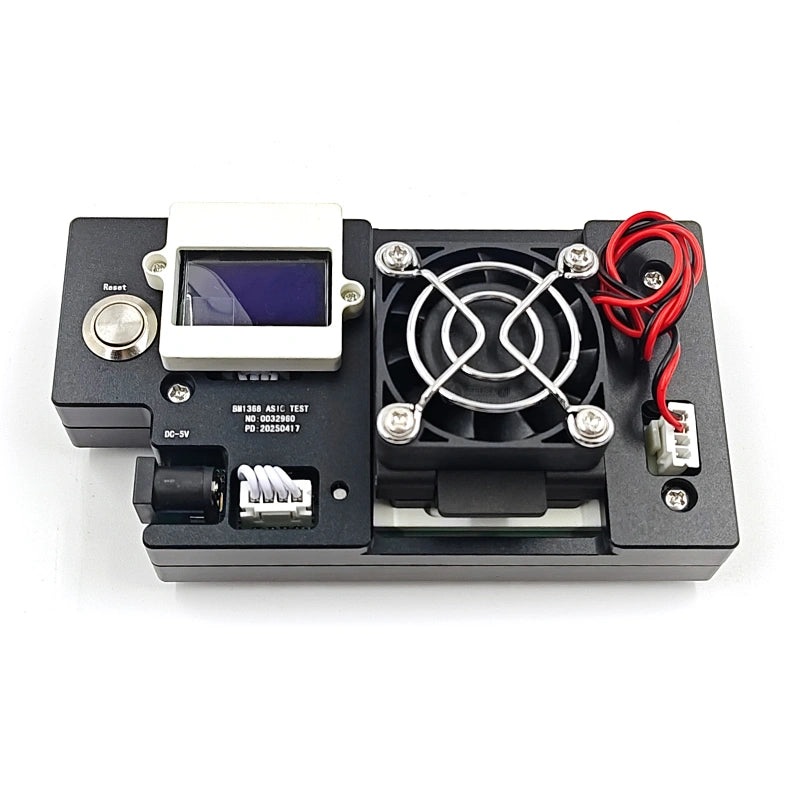
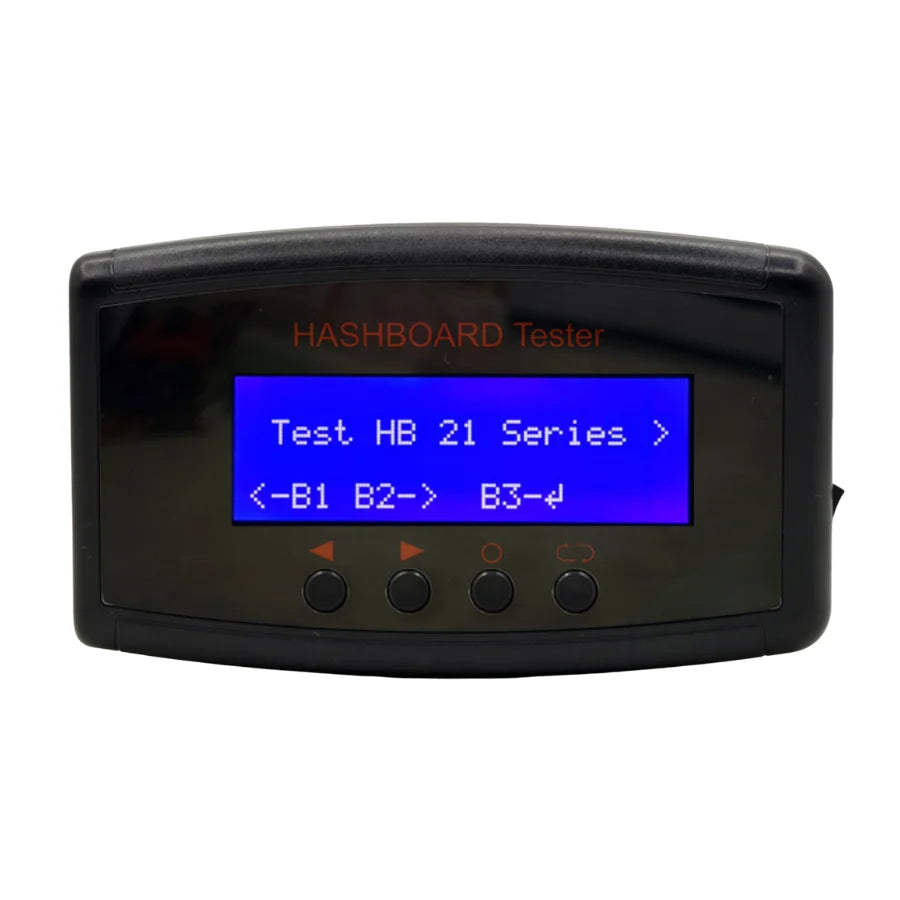
Components that produce extended downtime when missing, but where the failure rate is moderate enough that 10-machine fleets can typically wait for freight. The Tier 2 list adds a small inventory of test fixture spares, dedicated PSU rotation stock (rather than just repair components), thermal grease in higher-volume containers, and antistatic packaging for handling.
Tier 3: planning-critical, hold above 200-machine fleets
Components that earn their carrying cost only at scale. Full PSU spare units (rather than just repair components), control-board spare units, complete hashboard replacement units for irrecoverable burn-damage events, and the deeper end of the chip catalogue covering both common and edge-case generations the fleet runs.
Tier 4: just-in-time, never standing
Components with long lifetimes, predictable failure modes, and short lead times. Examples include the steel-mesh stencils for less-used generations, replacement chassis-level parts (covers, brackets), and consumables like solder paste that have shelf-life considerations.
Three fleet scenarios, full 12-month budget
Scenario A: 10-unit fleet (home operator, small farm)
A 10-unit fleet at baseline expects roughly one hashboard repair across the year, possibly one PSU repair, and 10 to 20 fan replacements. The standing-stock budget is concentrated on Tier 1 components matched to the dominant generation, with everything Tier 2 and above ordered just-in-time when needed.
Practical implication : the operator holds 5 to 10 of the most-likely-failed chip in their dominant generation, a small bag of fans, one or two spare PSUs as direct-swap rotation stock, and a set of generation-matched stencils. The PIC16F1704 programming hardware is a one-time investment ; the HEX file library expands as needed. Total annual parts spend is small in absolute terms ; the carrying cost of holding inventory is similarly small.
The right framing at this scale is preventive : the fleet does not have the scale to amortise larger standing stock, so the operator's job is to extend hardware life through dust-and-grease cycles, thermal monitoring, and fan-replacement discipline. Parts come from express courier when an event occurs, not from a standing inventory.
Scenario B: 50-unit fleet (small operation, regional repair shop)
A 50-unit fleet at baseline expects approximately 4 to 5 hashboard repairs across the year, 2 to 3 PSU repairs, and 50 to 100 fan replacements. The fleet has enough scale to make Tier 1 + Tier 2 standing stock pay back.
Practical implication : the operator holds a meaningful tray of replacement chips for the dominant generation, a full reel of common discretes (input filter capacitors, MP2019 boost ICs if running S21-class hardware, LDOs for both families), 5 to 8 fan units per machine model, two to four spare PSU units across the relevant sub-versions, and a complete set of generation-matched stencils. The annual parts budget at this scale is meaningful — typically a small percentage of fleet annual revenue — and the carrying cost of the standing stock is recovered through reduced downtime within the first two or three repair events of the year.
The 50-unit operator also typically commits to a quarterly preventive maintenance schedule across the fleet, with rolling re-paste and dust-cleaning operations that catch problems before they produce hard faults. The parts list for the preventive operations — thermal grease, antistatic supplies, replacement fans — is a separate line in the budget from the reactive repair stock.
Scenario C: 200-unit fleet (mid-size operation)
A 200-unit fleet at baseline expects approximately 16 to 20 hashboard repairs across the year, 10 to 14 PSU repairs, and 200 to 400 fan replacements. At this scale, the standing-stock budget expands into Tier 3, and the operator typically standardises on a known repair-bench workflow — either in-house or contracted through a regional repair partner.
Practical implication : the operator holds multiple trays of replacement chips covering the fleet's generation mix, complete reels of all common discretes, a deep fan inventory, 10 to 20 spare PSU units across all sub-versions in the fleet, 3 to 5 spare control boards per generation, and at least one complete hashboard replacement unit per generation for irrecoverable burn-damage events. The annual parts budget at this scale becomes a defined line item in the annual operating plan, typically managed against a quarterly reorder cycle.
The 200-unit operator typically also makes the in-house repair-bench investment — BGA rework station, oscilloscope, test fixtures, antistatic workstation — and amortises that capital across three years. The breakeven for in-house repair versus contracted third-party repair sits around this fleet size, depending on the local repair-shop coverage and the in-house technician skill availability.
The 12-month reorder cycle calendar
Standing stock is not a one-time order. It depletes as the year progresses, and it has to be refreshed against expected consumption rather than against actual depletion — by the time the bin is empty, the next failure event has already happened. The right cadence is quarterly review and reorder, with month-end snapshots feeding the procurement calendar.
| Quarter | Operations | Reorder priorities |
|---|---|---|
| Q1 (Jan–Mar) | Annual budget approval; deep preventive maintenance cycle on highest-runtime units; full bench audit | Replenish Tier 1 chips, capacitors, fans against Q4 consumption |
| Q2 (Apr–Jun) | Pre-summer climate prep (cooling system audit, dust cleaning); preventive PSU refresh on highest-use units | Reorder PSU spares against expected summer failure rate; top up Tier 1 |
| Q3 (Jul–Sep) | Peak heat operations; demand response participation if applicable; reactive repair cadence | Express-freight chip orders against unplanned events; top up consumed Tier 1 |
| Q4 (Oct–Dec) | Annual maintenance cycle; end-of-year inventory audit; procurement planning for next year | Replenish Tier 2 + Tier 3 against full-year consumption baseline |
The pattern across the year is that the heaviest standing-stock consumption happens in Q3 (summer heat events on Northern Hemisphere fleets, monsoon humidity events on Asian fleets), and the heaviest reorder activity happens in Q4 against next-year's expected consumption. Operators who run their reorder calendar this way avoid the worst freight surcharges of just-in-time emergency procurement.
Treasury management of standing stock
Standing stock ties up working capital. For a 200-unit operator, the standing-stock inventory at any point in the year typically represents a small but non-trivial share of annual revenue — meaningful enough to warrant its own treasury management decisions.
Three operational considerations shape the treasury approach.
Inventory turnover ratio. A standing stock that depletes and refreshes once per year ties up less working capital than one that holds against irrecoverable failures and never depletes. The right ratio depends on fleet scale and risk tolerance ; most operators target something close to 1 to 2 turns per year on Tier 1 components and lower turnover on Tier 3 items held for catastrophic events.
Currency exposure. Parts from Shenzhen invoice in USD, CNY, or local currency depending on the supplier relationship. Operators in non-USD-denominated economies often hedge the major procurement events through forward contracts or by holding USD working balances ; small operators typically absorb the currency risk as a business cost.
Lead-time absorption. Parts that ship by express courier from Shenzhen typically arrive in a few business days to most major markets. Parts that ship by sea LCL or FCL take weeks but cost meaningfully less per unit. Operators with stable consumption forecasts can move the high-volume Tier 1 components onto sea freight schedules and absorb the lead time within the standing-stock buffer, capturing freight savings. Operators with variable consumption stay on express freight as the default. Our air vs sea vs LCL freight piece covers the freight optimisation in depth.
What this means for the annual budget conversation
The output of this article is a defensible spreadsheet line. The operator walks into the annual budget conversation with a fleet-size-matched parts budget, an expected consumption profile broken down by tier, a reorder calendar mapped to the operating year, and a treasury-aware view of the working capital tied up in standing stock. The CFO sees a planned line item rather than an emergency cost ; the operations team sees a predictable workflow rather than a series of fire drills.
The fleets that capture published-baseline ROI year after year are the ones that have built this discipline. The fleets that quietly bleed margin to preventable downtime are the ones that have not. The parts budget is one of the smallest operating expenses in the mining stack, and it is one of the highest-leverage operational decisions an operator makes.
FAQ
What percentage of annual revenue should the parts budget be?
The number varies meaningfully by fleet generation and climate. A modern S21-class fleet in a temperate climate on stock firmware typically runs a parts budget that is a small single-digit percentage of fleet annual gross revenue. An older S19 fleet in a tropical climate on aggressive custom firmware can run double the percentage. The right number for any specific operator is the one that maps to their fleet's actual failure profile, not the industry average.
How often should I refresh the standing stock?
Quarterly review on Tier 1 components with reorder against expected next-quarter consumption. Annual review on Tier 2 and Tier 3 components with reorder against full-year baseline. Just-in-time on Tier 4. The quarterly cadence catches consumption surprises while they are still manageable ; the annual cadence is enough for slower-turning inventory.
Should I hold spare units of the miner itself, or just spare parts?
It depends on fleet scale. Above roughly 100 units, holding one complete spare unit per major generation in the fleet pays back within months on the first irrecoverable failure event. Below that scale, the carrying cost of a complete spare unit is high relative to the failure rate, and the right model is parts-only standing stock with a defined relationship with a refurbished-unit supplier for catastrophic replacement events.
What's the right model if my fleet is split across multiple sites?
Centralise the standing stock at the largest site, hold a smaller satellite stock at each other site, and run express freight between sites for events that exceed the satellite stock's capacity. The centralisation discipline avoids holding redundant inventory at every site ; the satellite stock avoids losing high-revenue operating hours waiting on inter-site shipments.
How do I handle parts I rarely use but absolutely need for catastrophic failures?
Hold a small amount of Tier 3 catastrophic-event stock per generation, accept that the carrying cost is essentially an insurance premium, and pre-arrange a supplier relationship for fast restock when a Tier 3 event triggers. The right framing is not "is this inventory cost-effective" but "is the catastrophic event cost-effective without this inventory" — for most fleets above 100 units, the answer is no.
Related reading
For the parts catalogue that maps to Tier 1 stocking on the S21 family, see our Antminer hashboard repair parts sourcing guide. For the ROI framing that motivates the standing-stock investment, see the hidden variable in mining ROI. For the PSU family choice that shapes the PSU spare inventory, see our APW17 vs APW12 PSU choice guide. For the freight optimisation that determines whether Tier 1 stays on express or moves to sea LCL, see our air vs sea vs LCL freight piece. For the regional cost stack that adjusts the parts logistics baseline by site, see real mining cost by region in 2026.
Source your 12-month parts package
Tell us your fleet size, the generations you operate, your climate, and your operating profile (base-load, demand-response cycling, mixed). We will quote a 12-month standing-stock package with Q1 / Q2 / Q3 / Q4 reorder cadence built in.
Email : contact@lys-sz.com
Direct from our warehouses in Shenzhen. Worldwide shipping. DDP available for buyers in the US and the EU. Latam, SE Asia, Middle East, CIS, Africa quoted case by case with local-currency invoices and Spanish, Russian, or Chinese documentation on request.