Tropical Mining Survival Guide: Beating Humidity-Driven Failures in SE Asia, LATAM and Africa (2026)
Most Antminer and Whatsminer engineering documentation assumes a temperate-climate operating environment. Ambient between 5°C and 40°C. Relative humidity below 65%. Stable mains voltage. Mild seasonal variation. For operators in Jakarta, Manaus, Lagos, San Pedro Sula, or Ho Chi Minh City, that assumption is wrong on every variable. Ambient routinely sits above 32°C for months at a time. Relative humidity exceeds 80% for half the year. Mains voltage swings five to ten percent on any given day. And the rainy season is not a brief disruption — it is the operating environment for the entire wet half of the year.
Tropical operators run different fleets from the temperate-climate reference, whether they want to or not. Failure rates are higher. Maintenance cadence is tighter. The parts catalogue is concentrated on the components that humidity, heat, and electrical instability damage fastest. This guide is for the operator working with that reality — and looking for the survival playbook that the manufacturer documentation does not cover.
We walk through the four dominant tropical failure modes, the climate-specific preventive maintenance schedule, the parts standing stock that matters most in tropical deployments, and the site-design choices that meaningfully extend hardware life. We close with the procurement and freight logistics for tropical destinations from Shenzhen.
The four dominant tropical failure modes
1. Humidity-driven corrosion on exposed conductors
The single largest source of accelerated hardware degradation in tropical climates is humidity-driven corrosion on exposed metal surfaces. Copper PCB traces oxidise faster. Connector contacts develop a film that increases contact resistance and produces intermittent connections. Capacitor lead wires tarnish at the solder joint. Fan motor bearings absorb moisture and bind. None of these failures appears overnight — they accumulate over months and produce intermittent faults that look like other failure modes until a technician traces the actual root cause.
The mitigation is operational : desiccant management inside every enclosed unit, dehumidification of the miner room down to below 60% relative humidity where the site supports it, and quarterly visual inspection of connectors and fan bearings rather than the annual cadence sufficient for temperate climates.
2. Condensation during thermal cycling
Any miner that cycles between operating temperature and ambient temperature in high-humidity air produces condensation inside the enclosure. The condensation appears on the coolest surfaces first — usually the heat sink fins and the chassis ceiling — and accumulates over multiple cycles until it produces a measurable moisture event. The standard scenario is a miner that powers off during a brownout or curtailment event, sits at high humidity for an hour, and powers back on with moisture present on the hashboard surface. The resulting current path through the moisture film damages the silicon over multiple cycles.
The mitigation is twofold : minimise power-cycling events in high-humidity windows, and run dehumidification with enough capacity to keep the indoor humidity below the dew-point of the coldest fleet surface. Sites that cycle frequently for demand response participation — see our companion piece on demand response and cycling economics — face this trade-off acutely in tropical climates and budget the moisture-control investment accordingly.
3. Heat-stressed silicon and accelerated thermal grease degradation
Tropical ambient temperatures push chip junction temperatures upward by 10°C to 15°C compared with temperate-climate operation, even with the same cooling configuration. The result is a measurable acceleration of two distinct degradation paths : the silicon itself ages faster at the higher junction temperature, and the thermal grease between the chip and the heat sink loses its conductive properties faster at the elevated continuous operating temperature.
The mitigation is on the thermal-management side. Tropical operators run quarterly re-paste cycles rather than the annual cadence common in temperate climates. The companion piece on S21 series thermal paste and stencil application covers the operation in detail ; the tropical-specific implication is the cadence, not the workflow.
4. Voltage instability on developing-market grids
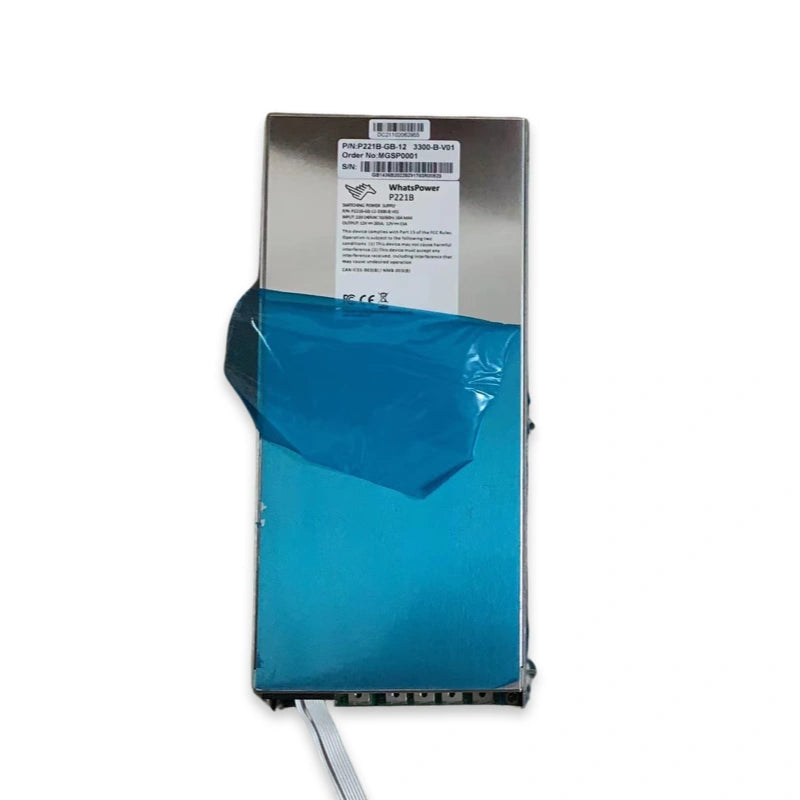
Many tropical operating regions sit on national grids that experience meaningful voltage fluctuation : brownouts during peak hours, voltage spikes when grid frequency stabilises, and load-shedding events that disconnect entire neighbourhoods. The Bitmain APW12, APW17, and APW11 power supplies, and the equivalent Whatspower P-series units, tolerate moderate voltage variation by design — but sustained operation at the edges of the tolerance window degrades the input EMI filter components, the PFC stage capacitors, and the synchronous rectifier MOSFETs measurably faster than at nominal voltage.
The mitigation is upstream : an industrial-grade voltage stabiliser between the grid and the miner load, sized for the total fleet draw, with dedicated overvoltage and undervoltage protection. Sites with frequent voltage events also benefit from automatic transfer switches and short-duration UPS coverage to bridge the worst of the load-shedding cycle.
The tropical preventive maintenance schedule
| Operation | Temperate-climate cadence | Tropical-climate cadence | Reasoning |
|---|---|---|---|
| Heatsink dust and blow-out | Quarterly | Monthly (dry season) / weekly (wet season) | Dust accumulation accelerates with humidity-bound particulates |
| Thermal grease refresh | Annual | Quarterly | Grease degrades faster at elevated continuous junction temperatures |
| Fan replacement (calendar) | 18-24 months | 12 months | Bearing wear accelerates in humid air |
| Connector and contact inspection | Annual | Quarterly | Oxidation and contact-film build up faster |
| PSU output voltage audit | Annual | Quarterly | Voltage instability accelerates PSU drift |
| Dehumidifier filter and pump check | — | Monthly | Tropical-specific operation |
| Voltage stabiliser audit | — | Quarterly | Tropical-specific operation |
| Full unit deep-clean | Annual | Semi-annual | Higher dust and moisture exposure |
The tropical schedule sounds expensive on paper. In aggregate it is a small percentage above the temperate baseline — and a vanishingly small percentage compared with the cost of the failures it prevents. Operators who run the tropical schedule report failure rates that approach the temperate baseline ; operators who run the temperate schedule in tropical climates report failure rates that are two to three times the baseline.
The tropical-specific standing parts stock
The tropical parts list overlaps with the standard fleet parts list — the same chips, the same regulators, the same fans — but the quantities and the prioritisation differ. Three tropical-specific additions matter beyond the standard list covered in our Antminer hashboard repair parts sourcing guide.
Industrial-grade desiccant packs. Reusable rechargeable desiccant capsules go inside every enclosed power supply, every spare hashboard sitting in stock, and every parts shipment from Shenzhen. The cost per unit is small. The mitigation against moisture-driven shipping damage and standing-inventory degradation is meaningful.
Higher-flow fans. The replacement fans used in tropical climates run a higher airflow profile than the temperate equivalents. The standard Antminer and Whatsminer factory fans cope with temperate ambient ; tropical operators routinely swap to higher-flow variants on the units they run hardest, with the trade-off of slightly higher acoustic output. Our catalogue lists tropical-grade fan variants explicitly.
Voltage stabiliser spares and consumables. The voltage stabiliser between the grid and the fleet is itself a piece of hardware that fails. Tropical operators typically hold a backup stabiliser sized for at least a portion of the fleet, plus the fuses and surge components that wear out fastest on the stabiliser itself.
Site-design choices that extend hardware life
Three site-design decisions consistently produce the largest improvements in tropical-fleet survival. None of them is exotic.
Dedicated mining room with active climate control. The single most consequential investment is a dedicated room with active dehumidification and cooling, sized for the full fleet thermal output plus a margin. Operators who run miners in a general-purpose space (warehouse, garage, basement) absorb the ambient conditions of that space ; operators who carve out a dedicated room can keep their conditions within the engineering envelope the manufacturer assumed.
Vapour barrier on the walls and ceiling. A correctly installed vapour barrier substantially reduces moisture infiltration from the surrounding building structure. The cost is small relative to the moisture-driven failure savings, and the operation is one-time during initial site construction.
Elevated-floor cable management. Cables running across a concrete floor in a humid climate absorb moisture from the floor surface and from condensation that forms during cool overnight hours. An elevated cable tray system keeps the cabling clear of the floor and dramatically reduces moisture-related cable degradation. The same principle applies to PSU and miner placement — units stacked directly on the floor pick up more moisture than units on rack shelving 30 cm above the floor.
The regional procurement and freight reality
Tropical destinations from Shenzhen sit on three different freight profiles depending on the region.
SE Asia is the fastest-served region globally. Air express courier from Shenzhen to Jakarta, Bangkok, Manila, Kuala Lumpur, or Ho Chi Minh City typically arrives in a few business days. The customs clearance varies by country — Indonesia and the Philippines have country-specific documentation requirements that we handle with our SE Asia freight network. Sea LCL options are available for high-volume preventive maintenance stock at meaningfully lower per-unit freight cost, with the trade-off of longer transit time.
LATAM sees longer transit times because the routes are longer. Air express to Buenos Aires, São Paulo, Bogotá, Mexico City, San Pedro Sula, or Lima typically arrives in roughly a week to ten days. We issue commercial invoices in Spanish by default for LATAM customers, and we quote in local currency where the operator prefers to invoice in their domestic accounting unit. DDP coverage is available case-by-case ; for most LATAM destinations, the optimal route is air express with local broker handling at destination.
Africa has the most variable transit profile. Air express to Lagos, Nairobi, Johannesburg, or Cairo is well-served and arrives within roughly a week ; lower-volume destinations (smaller airports, inland cities) add days to the timeline. We quote each African destination case-by-case and issue commercial invoices in the language the local customs authority prefers — typically English, French, or Arabic depending on the country.
For all three regions, the practical procurement implication is that preventive maintenance stock orders absorb the freight cost most efficiently when consolidated. A monthly or quarterly order shipped by air express covers the standing maintenance requirements cleanly ; emergency single-part orders pay a meaningful per-shipment premium.
FAQ
How much shorter is the useful life of a miner in a tropical climate?
Without the tropical-specific preventive maintenance schedule, expect two to three times the failure rate of the temperate-climate baseline and a meaningfully shorter useful life. With the tropical-specific schedule applied consistently, the failure rate moves close to the temperate baseline and the useful life approaches the manufacturer's expected range. Climate is destiny only for operators who do not adjust their practice to the climate.
Is air conditioning enough, or do I need dehumidification too?
Air conditioning lowers ambient temperature and reduces relative humidity as a side effect, but it is not optimised for dehumidification specifically. Many tropical mining rooms run an air conditioning unit alongside a dedicated dehumidifier, with the dehumidifier handling the moisture load and the air conditioning handling the thermal load. The combination is more energy-efficient than running air conditioning hard enough to handle both.
What humidity range should I target inside the mining room?
The general engineering target is below 60% relative humidity. Below 50% is better for hardware longevity but harder to maintain in a tropical climate and produces diminishing returns on the energy investment. Above 65% is where the failure-rate acceleration becomes consistently visible in field data.
Are immersion-cooled miners better for tropical climates?
Substantially, yes. Immersion-cooled deployments isolate the silicon from the ambient atmosphere entirely, which removes humidity-driven corrosion and condensation from the failure equation. The trade-off is on the capital investment side : an immersion deployment requires the dielectric fluid, the heat exchanger, the cooling loop infrastructure, and the immersion-rated hardware (or air-cooled hardware adapted for immersion). For operators with capacity to make the investment, immersion is the most direct answer to the tropical-climate question.
What about earthquake and flood resilience in some tropical regions?
Operators in seismically active areas (Indonesia, Philippines, parts of Central and South America) and flood-prone areas typically run additional site-resilience measures : seismic anchoring of racks, flood-watch monitoring, elevated electrical infrastructure, and emergency-shutdown procedures. These are site-design questions rather than hardware-survival questions, and they sit outside the scope of this guide ; we are happy to discuss the specifics on a per-site basis if your deployment faces these conditions.
Related reading
For the foundational parts-sourcing companion, see our Antminer hashboard repair parts sourcing guide. For the regional cost stack that includes the tropical-climate cost adjustments, see real mining cost by region in 2026. For the SE Asia frontier in more detail, see our Indonesia and SE Asia mining frontier. For the standing-stock budget framework that incorporates the tropical-specific quantities, see our 12-month standing stock budget template. For the demand-response cycling that interacts with tropical condensation risk, see demand response and cycling economics.
Source your tropical-climate parts package
Tell us where you operate, the humidity and ambient temperature profile of your site, and your fleet generation. We will quote a tropical-grade parts package — humidity-resistant fans, desiccant management kits, voltage stabiliser spares, plus the standard chip and PSU standing stock sized for your fleet.
Email : contact@lys-sz.com
Direct from our warehouses in Shenzhen. Worldwide shipping. DDP available for buyers in the US and the EU. Latam, SE Asia, Middle East, CIS, Africa quoted case by case with local-currency invoices and Spanish, Russian, Chinese, French, or Arabic documentation on request.