Bitmain BM1370 ASIC Deep Dive: Inside the 3 nm Chip Powering the S21 XP and S21 XP Hydro
Every mining hardware generation is defined by one number : the joules per terahash the silicon delivers at rated frequency. The Bitmain BM1370 takes that number to 13.5 J/TH in the air-cooled Antminer S21 XP (270 Th/s, 3,645 W, released September 2024) and to 12 J/TH in the S21 XP Hydro (473 Th/s, 5,676 W, released November 2024) — and it does so by moving to a 3 nm process node, marking the first Bitcoin ASIC in volume production at that geometry. When the S21 XP shipped, it was the most efficient air-cooled miner on the market, and the S21 XP Hydro sat at the top of every efficiency chart. As of mid-2026 the picture has shifted : Bitmain's next-generation S23 line (BM1373-family silicon, released January 2026) has pushed efficiency down to 9.5 J/TH on the S23 Hydro (580 Th/s, 5,510 W), and the BM1370 has moved from top-of-line to volume workhorse. That does not diminish its relevance — the BM1370 remains the most-deployed 3 nm mining silicon in the field, and the S21 XP line is the reference deployment for operators building new capacity through 2026.
What that story leaves out is the operational side. A more efficient chip is also a more thermally constrained chip. A finer process node has different failure modes. A tighter voltage tree needs a different power supply and a different repair workflow. The BM1370 is a step forward on the headline number — and it is a different piece of hardware to run, repair, and stock spares for than its predecessors.
This guide is the operator-level monograph on the BM1370. We cover the process-node economics, the die layout and signal chain, the voltage tree and cooling envelope, the failure modes that have surfaced in early field experience, the repair workflow specifics, and the parts standing-stock implications for operators running S21 XP or S21 XP Hydro fleets. We close with the practical decision framework : who should be on BM1370 today, who should wait, and how the BM1370 changes the parts logistics conversation.
The 3 nm process node : what changes and why it matters
The BM1370 is manufactured on a 3 nm process node — a substantial shrink from the 5 nm used for the BM1368 (S21 / S21 Pro / S21+ / S21 Hydro) and a much larger shrink from the 7 nm used for the BM1398 (S19 family) and BM1366 (S19 XP / S19K Pro). The move from 5 nm to 3 nm delivers roughly the efficiency gain the industry expected — around 15 to 25 percent per-chip efficiency improvement at equivalent workload — plus a smaller die area per unit of hashrate, which lets Bitmain fit more compute density into the same physical hashboard footprint.
The trade-offs are the ones that come with any advanced-node silicon. Transistor leakage is higher per unit area, which means the chip's idle-state power draw is a larger share of its full-load draw than on older nodes. Thermal density is higher because the same heat is dissipating from a smaller physical area, which tightens the cooling envelope. And the manufacturing process is more capital-intensive per wafer, which is one of the reasons BM1370 units have been in supply-constrained availability for the S21 XP and S21 XP Hydro through much of 2025 and into 2026.
The operational implication is straightforward. The BM1370 delivers more terahash per watt, but it needs cleaner cooling and cleaner power to hold that efficiency across the useful life of the hashboard. Operators who deploy S21 XP hardware in tropical or dust-loaded environments without upgrading their cooling and voltage-stabilisation infrastructure see the headline efficiency slip over months as thermal degradation compounds. The chip does what the datasheet says. The environment has to support it.
Die layout and signal chain
The BM1370 inherits the fundamental architecture family of its predecessors : a BGA-packaged chip laid out on a hashboard signal chain, with each chip receiving a clock signal, processing SHA-256 hashes at its assigned frequency, and passing the signal to the next chip in the chain. The S21 XP hashboard runs approximately 108 chips per board (three boards per unit for the standard S21 XP configuration), and the S21 XP Hydro runs a higher chip count per board tuned to the hydro cooling envelope.
Two die-level differences matter for the operator. First, the BM1370's smaller die footprint means the BGA solder-ball pitch is finer than on the BM1368, which raises the difficulty of BGA rework operations during repair. A repair shop that handles BM1368 replacements cleanly does not automatically handle BM1370 replacements at the same success rate — the reflow profile is tighter and the risk of adjacent-pad shorts is higher. Second, the on-die thermal sensor placement is optimised for the 3 nm die geometry, which changes the effective throttling curve the control board applies during high-ambient events.
The signal chain layout is otherwise recognisable to any technician who has worked the BM1368 : a 25 MHz crystal oscillator (Y1) generates the master clock, the signal propagates through the chain from chip BM1 to the last chip, and each chip's TX / RX / RST / BO signals maintain the sync. The diagnostic workflow — PT1 for chip detection, PT2 for function under load — is the same, with the caveat that the PT2 fixture calibration for BM1370 hashboards is generation-specific and does not substitute across from a BM1368 fixture without recalibration.
Voltage tree and cooling envelope
The BM1370 hashboard runs a voltage tree comparable to the BM1368 architecture but tuned to the higher chip density and lower per-chip voltage. Domains are laid out along the board with LDO regulators feeding the middle-range domains and boost circuits feeding the domains at the ends of the chain. The MP2019 boost IC family that Bitmain uses on the S21 line continues on the S21 XP, with slightly different loading profiles per domain.
The cooling envelope on the S21 XP air-cooled variant is tighter than on the S21 standard because the higher hashrate per chassis produces more heat in the same physical enclosure. The rated ambient is nominally the same (5°C to 40°C), but the effective operating margin at the top of that range is smaller. Operators running S21 XP hardware at 35°C ambient see chip junction temperatures closer to the throttling threshold than they would with S21 hardware at the same ambient. Operators running S21 XP Hydro face the opposite question : the hydro loop takes the ambient dependency largely out of the equation, but the loop hardware, dielectric fluid quality, and heat exchanger sizing become the constraint instead.
The APW17 PSU family covers the S21 XP power envelope in its higher-output sub-versions ; the S21 XP Hydro uses a dedicated hydro-matched PSU package sized for the higher rated output. Cross-references : our APW17 vs APW12 PSU choice guide covers the PSU sub-version conventions, and our Antminer hashboard repair parts sourcing guide covers the standing-stock implications.
Early field-failure profile
The BM1370 has been in volume field deployment since 2025, with the S21 XP and S21 XP Hydro reaching statistically meaningful field populations through late 2025 and into 2026. The failure profile is still maturing, but three patterns have emerged from operator-reported data and repair-bench observation.
Pattern one : the silicon itself has been reliable. Per-chip failure rates on the BM1370 in temperate-climate stock-firmware deployments have tracked at or below the BM1368 baseline through the first year of large-scale field operation. The 3 nm process's higher per-chip cost has not translated into a higher per-chip failure rate, which is the outcome operators hoped for and the outcome the field data supports.
Pattern two : boost circuit failures cluster in the same domains as on the BM1368. The MP2019 boost IC failure pattern on the S21 XP mirrors the pattern on the S21 family — domains at the ends of the voltage chain fail more often than the middle domains, and the failure typically takes an adjacent input capacitor with it. Repair workflow is unchanged from the S21 family : boost IC plus two nearest capacitors, replaced together.
Pattern three : cooling-related throttling is more consequential. The tighter cooling envelope on the S21 XP air-cooled means that fleets running in ambient conditions above roughly 30°C see more frequent throttling events than the same operators saw on their prior S21 or S19 XP hardware. Throttling itself does not damage the silicon — it protects it — but the cumulative effect on realised hashrate and revenue is measurable, and operators budgeting for S21 XP deployments in warm-climate sites need to plan the cooling infrastructure accordingly. The tropical mining survival guide covers the climate-side operational response in depth.
Repair workflow specifics for BM1370 hashboards
The BM1370 hashboard repair workflow inherits the seven-step process from the S21 family (visual inspection, impedance and voltage domain testing, PT1 chip detection, PT2 function testing, signal chain tracing, chip replacement, EEPROM reflashing, final load testing). The workflow differences are on the tooling and technique side, not the diagnostic logic.
BGA rework at 3 nm. The finer solder-ball pitch on the BM1370 raises the required precision on the BGA rework station. Shops working BM1370 hashboards routinely tighten their reflow profile (lower peak temperature, longer soak time), use finer-tip vacuum tweezers, and inspect adjacent pads with higher-magnification optics after every chip replacement. The failure rate on the chip-replacement step for new-to-BM1370 technicians is measurably higher than for the same technicians on BM1368 boards — the operation is not fundamentally different, but the tolerance for error is smaller.
EEPROM reflashing. The BM1370 hashboards continue to use the PIC16F1704 EEPROM family for per-board calibration storage, with the same PICkit3 programming workflow used on prior generations. The HEX files themselves are generation-specific — a BM1368 HEX will not calibrate a BM1370 board correctly — but the physical programming operation is unchanged.
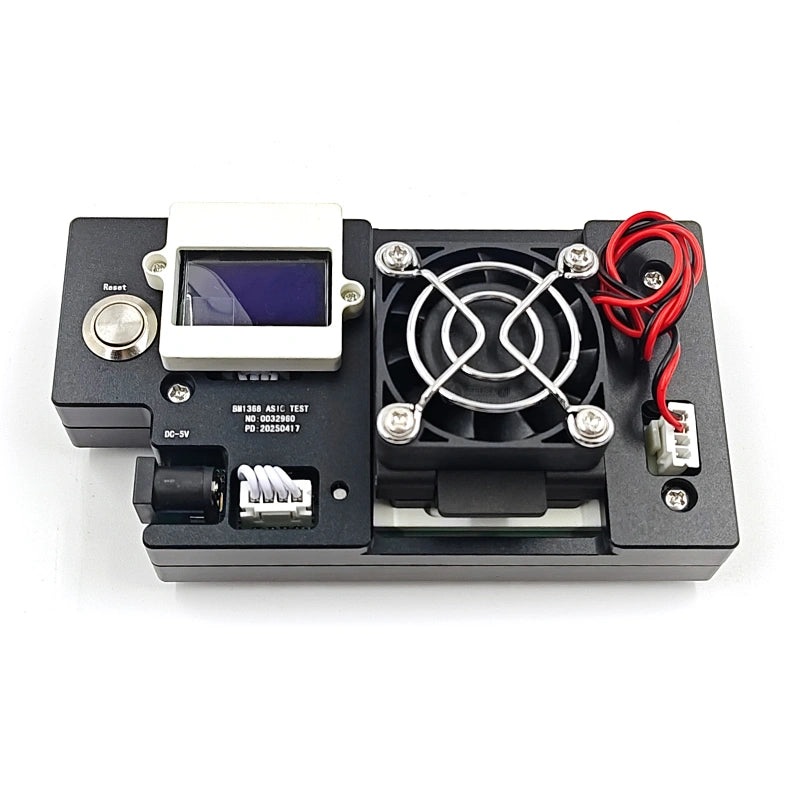
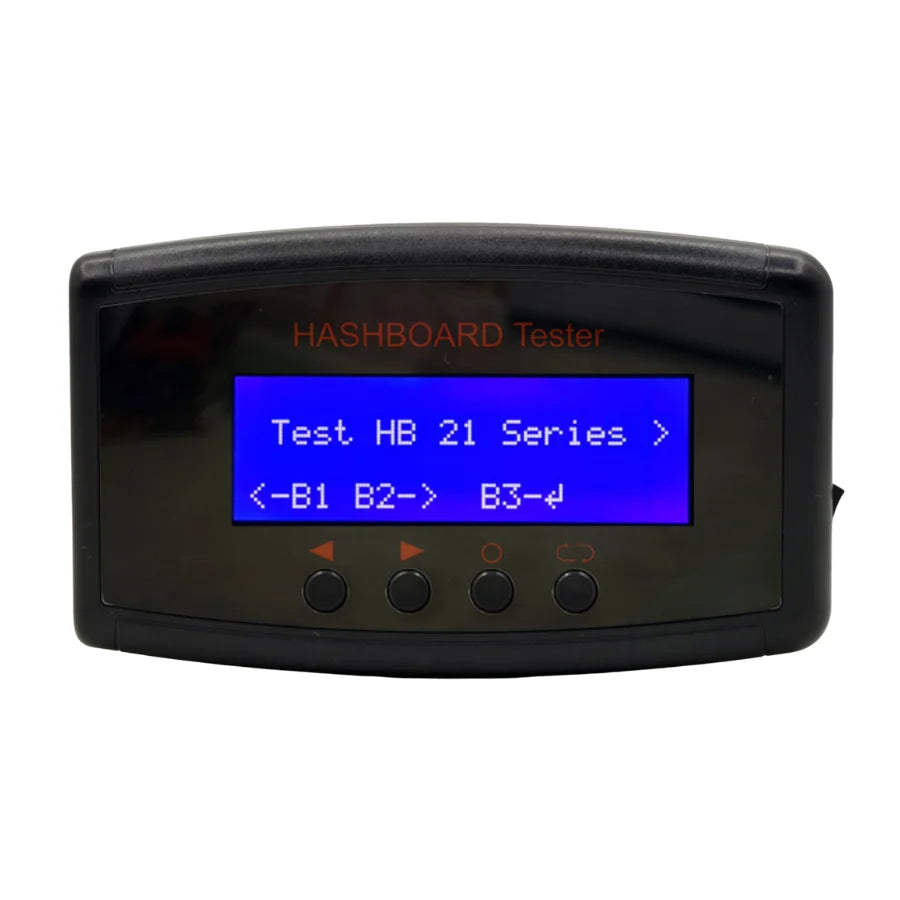
Test fixtures. S21 XP hashboards require a BM1370-calibrated test fixture for PT2 testing. An S21 fixture calibrated for BM1368 boards will run PT1 chip detection on a BM1370 board but will not produce a valid PT2 load test, because the frequency and voltage profile the fixture applies is generation-specific. Shops adding S21 XP to their repair capability need to add a BM1370-matched fixture, not rely on the S21 fixture they already own.
Thermal grease stencils. The S21 XP hashboard footprint differs from the S21 standard, and the stencil for thermal grease application is generation-specific. The S21 XP Hydro adds its own stencil geometry for the hydro cooling loop interface. Standing-stock implication : shops repairing S21 XP or S21 XP Hydro boards hold generation-matched stencils as separate SKUs from the S21 standard stencils.
Standing-stock implications for BM1370 fleet operators
The BM1370 changes the standing-stock calculation in three ways relative to a pure S19 or S21 standard fleet.
First, the chip supply is tighter. BM1370 wafer allocation from the manufacturer has been the constrained variable on S21 XP production through much of 2025 and 2026, and the downstream effect is that BM1370 chip trays for repair use are in tighter supply than BM1368 or BM1398 trays. Operators running significant S21 XP fleets typically hold a larger standing stock of BM1370 chips than they would proportionally hold of BM1368 chips, because the lead time to restock is measurably longer.
Second, the test fixture inventory is generation-specific. Any shop expecting to service BM1370 boards holds a BM1370-calibrated fixture alongside their BM1368 and older fixtures. The fixture is a one-time capital investment, not a consumable, but it needs to be in place before the fleet reaches the size where in-house repair economics justify the buy.
Third, the preventive-maintenance cadence tightens. The tighter thermal envelope means that dust cleaning, thermal grease refresh, and fan replacement cycles all pay back faster on S21 XP hardware than on prior-generation fleets. Operators running S21 XP in temperate-climate sites can hold to a similar cadence as their prior fleet. Operators running in warm-climate sites need to accelerate the cadence and stock accordingly. Our 12-month standing stock budget template covers the cadence-adjusted quantity implications by fleet scale.
The decision framework : who should be on BM1370 today
| Operator profile | BM1370 fit | Reasoning |
|---|---|---|
| New-capacity deployment on a temperate-climate site with cheap power | Strong fit — S21 XP or S21 XP Hydro | Best efficiency in volume production ; margin advantage compounds across useful life |
| New-capacity deployment in a warm-climate site | Strong fit if cooling infrastructure planned around the tighter envelope | The efficiency edge holds if the cooling is right ; slips if it is not |
| Fleet upgrade from S19 XP or S19K Pro | Consider phased upgrade rather than full swap | Refurbished S21 hardware market is thick ; S21 XP premium is meaningful ; upgrade the highest-runtime units first |
| Fleet upgrade from S21 or S21 Pro | Wait unless power is expensive enough to justify the swap | Marginal efficiency gain from BM1368 → BM1370 is smaller than the S19 → S21 jump ; secondary-market S21 pricing is stable |
| Small operator (under 10 machines) on residential power | Skip unless power rate is at the low end | Capital cost per unit does not amortise cleanly at small scale ; refurbished S21 delivers most of the practical benefit |
| Demand-response-active fleet | Strong fit | Newer silicon handles thermal cycling better ; the cycling economics piece covers the wear differential |
| Immersion or hydro deployment | Strong fit — S21 XP Hydro is the mainstream hydro spec | 12 J/TH is the reference hydro spec across most 2026 deployments ; the S23 Hydro at 9.5 J/TH is the frontier alternative for operators paying a premium for the newest silicon ; parts economics still favour BM1370 at scale |
FAQ
Is the S21 XP really 20 percent more efficient than the S21?
At the datasheet level, roughly yes. The S21 rates at 17.5 J/TH air-cooled ; the S21 XP rates at 13.5 J/TH air-cooled. That is a meaningful efficiency edge, and it holds in field operation for fleets running in the engineering envelope the datasheet assumed. In tropical or dust-loaded sites without cooling upgrades, the realised efficiency slips over months and closes some of the datasheet gap.
How does the S21 XP Hydro compare with the M63S+ / M65S+ hydro?
On efficiency, S21 XP Hydro leads within the Bitmain-vs-Whatsminer BM1370-generation comparison (12 J/TH vs approximately 17.5 J/TH on the Whatsminer hydro line). On raw output per chassis, M63S+ / M65S+ lead. The buyer's-guide framing sits in our S21 vs M60 buyer's guide, and the choice usually comes down to fleet standardisation on Bitmain vs MicroBT tooling more than the specification differential itself.
Should I wait for the S23 instead of buying an S21 XP now?
Depends on capital availability and site readiness. The S23 line (BM1373-family silicon, released January 2026) delivers approximately 9.5 J/TH on the S23 Hydro and 11 J/TH on the air-cooled S23 — a further step down from the BM1370's 12 J/TH and 13.5 J/TH respectively. The S23 also carries a meaningful capital premium and shorter installed-base track record. For operators building new capacity in mid-2026 with power costs at the low end, the S21 XP line remains the volume workhorse with the deepest parts market. For operators paying premium power rates where the incremental efficiency clears the incremental capital cost within twelve months, the S23 is worth the wait. Our S23 Hydro / BM1373CC deep dive covers the fleet-level decision framework.
Can I repair a BM1370 board with the same tools I use for BM1368?
Mostly yes on the diagnostic side, partially no on the physical rework side. The oscilloscope, multimeter, and antistatic setup all carry over. The BGA rework station carries over but requires tighter profile calibration for the finer 3 nm solder-ball pitch. The test fixture does not carry over — BM1370 hashboards need a generation-matched PT2 fixture. The HEX file library needs a BM1370 update.
What is the current market availability for BM1370 replacement chips?
Tighter than BM1368 or BM1398, and dependent on Bitmain's wafer allocation to third-party parts channels. Fleet operators holding a standing stock of BM1370 chips buy against expected consumption plus a buffer, and we quote lead times per order rather than off a spot inventory. For current availability and pricing, message us with your fleet generation and quantity requirement.
Does BM1370 have the same voltage domain hot-spot as the BM1368?
The MP2019 boost circuit failure pattern on the S21 XP mirrors the S21 pattern, with domains at the ends of the voltage chain failing more often than the middle. The absolute failure rate has been consistent with the BM1368 baseline through early field experience. Standing-stock implication : hold MP2019 boost ICs and adjacent input capacitors as a paired standing stock, sized to the fleet.
Related reading
For the parts-sourcing companion that covers the BM1370 standing-stock implications, see our Antminer hashboard repair parts sourcing guide. For the PSU family match on S21 XP deployments, see our APW17 vs APW12 PSU choice guide. For the S21 vs Whatsminer M60 head-to-head that puts the BM1370 in context against the MicroBT line, see our S21 vs M60 buyer's guide. For the annual parts budget framework that captures BM1370's tighter supply, see our 12-month standing stock budget template. For the earlier survey of Bitmain chip generations that provides the historical context, see our Bitmain ASIC chip generations : BM1397 → BM1370.
Source your BM1370 spare parts package
Tell us your S21 XP or S21 XP Hydro fleet size, your site climate, and your current bench capability. We will quote a BM1370-specific parts package (chips + MP2019 boost ICs + input filter capacitors + generation-matched stencils + test fixture options) sized to your fleet.
Email : contact@lys-sz.com
Direct from our warehouses in Shenzhen. Worldwide shipping. DDP available for buyers in the US and the EU. Latam, SE Asia, Middle East, CIS, Africa quoted case by case.