The M50 and M53 Move Onto the Repair Bench
Three years after launch, the Whatsminer M50 family has entered the phase of its lifecycle we all know well: the machines are changing hands, leaving hosted sites for smaller farms and home setups, and showing up at the repair shop with the kind of wear that comes from 24/7 duty in less-than-ideal conditions. The hydro-cooled M53 is on the same curve, a few months behind. For any repair operation already running a steady flow of M30S units — the subject of our M30S common failures guide — the M50/M53 generation now deserves its own bench process.
These machines are not simply "bigger M30s." MicroBT switched chip process nodes, changed the control board family, introduced a new PSU platform for the air-cooled units, and in the M53's case, redesigned the entire thermal and power architecture around liquid cooling. This guide walks through what is architecturally different, which chips go on which boards, what tooling you actually need, and how to stock for a mixed M30/M50/M53 fleet.
The M50 Family at a Glance
| Model | Hashrate | Wall Power | Efficiency | Cooling |
|---|---|---|---|---|
| M50 | ~114 TH/s | ~3,306 W | ~29 J/TH | Air |
| M50S | ~128 TH/s | ~3,276 W | ~26 J/TH | Air |
| M50S++ | ~160 TH/s | ~3,520 W | ~22 J/TH | Air |
| M53 | ~226 TH/s | ~6,554 W | ~29 J/TH (25 °C inlet) | Hydro (liquid) |
The entire M50 generation moved from the older Samsung process node used for the M30 KF1950 chips to a Samsung 5 nm process. MicroBT positioned the family as roughly 15% more efficient than M30-era hardware, which matches what we see on the bench: an M50S at 26 J/TH has a meaningfully wider margin than an M30S+ at 34 J/TH, and that margin is why these units are still attractive on secondary markets despite being three years old.
Architectural Differences From the M30
Before troubleshooting an M50 hashboard, it is worth internalizing what actually changed versus the M30 platform, because several repair instincts carried over from the M30 will steer you wrong.
New chip process, new chip families
The M30 and M30S+ use the KF1950. The M30S++, M50, M50S and M53 share the KF1968 and KF1968E chip family. The M50 has also been produced in variants carrying the KF1969 and, on higher-binning runs, the KF1978E. That gives you four chip part numbers in regular rotation on a single product line, and it is the single most important thing to verify before you order replacement chips — a board pulled from an "M50" unit can carry any of them depending on the production batch.
Quick mapping:
| Chip | Used on | Notes |
|---|---|---|
| KF1950 | M30, M30S, M30S+ | Older generation — covered in our M30S guide |
| KF1968 / KF1968E | M30S++, M50, M50S, M53 | The workhorse chip of this generation — most M50 boards you'll see |
| KF1969 | M50 variants | Introduced on later M50 runs; confirm marking before replacement |
| KF1978E | Higher-spec M50 variants | Found on select M50S / M50S+ production batches |
Practical rule: always read the chip package marking on the board itself before sourcing replacements. The model label on the outside of the miner does not uniquely determine the chip inside the hashboard.
New control board family
The M30 generation ran on the CB4v10 H6 control board. The M50 moves to the CB6 V10. The two are not interchangeable — different connectors, different firmware, different hashboard interface protocol. If you keep M30 and M50 units in the same operation, you need both control board SKUs in stock, and you need to label them clearly on the shelf.
New air-cooled PSU platform
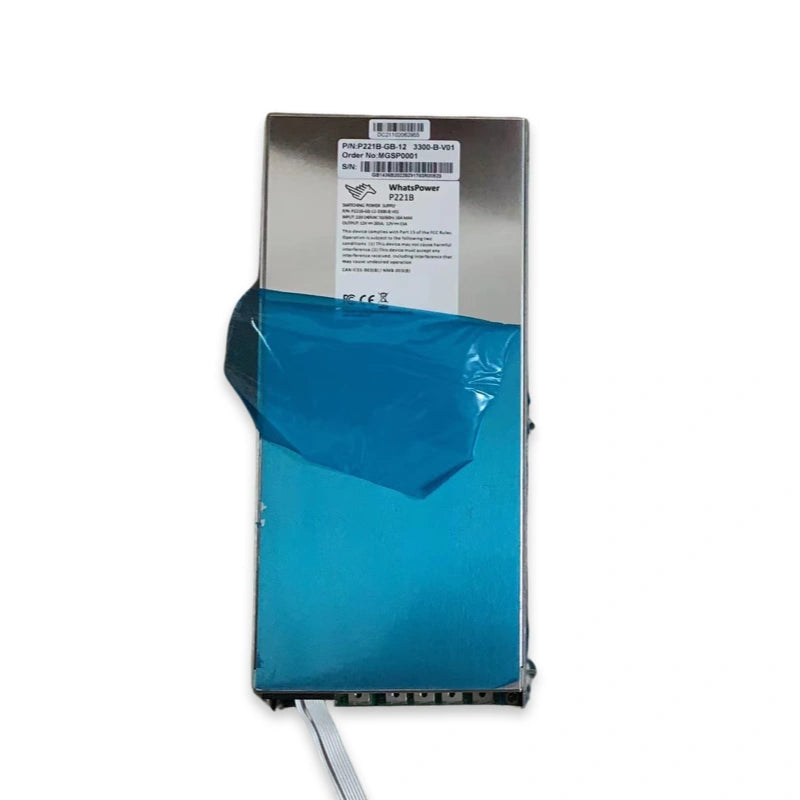
On the air-cooled side (M50, M50S, M50S++), MicroBT moved to the P222B PSU family and related models, replacing the older M30-era units. Output voltage ranges and mechanical connectors were revised, and the M50S++ at 3,520 W draws meaningfully more than an M30S++ — which means a PSU you might have been getting away with on a late-life M30 will fault on an M50S++ under load.
The error codes themselves (the 236 / 255 / 268 family covered in the M30S guide) behave similarly on M50 units. The diagnostic sequence is the same — measure the 12 V bus at idle, swap in a known-good PSU, isolate hashboard vs PSU — but the donor PSU has to be a P222B-class unit, not a legacy M30 supply.
The M53 is a different animal
The hydro-cooled M53 shares the KF1968/1968E chip family with the air-cooled M50 line, but almost everything else is different. It is a 2U rack-mount unit designed for a 19-inch liquid-cooled cabinet, runs on AC 380–480 V three-phase input at roughly 10 kW, and uses a liquid cooling plate instead of fans. Inlet water has to be controlled at 20–50 °C with ±2 °C precision, so a fault that looks like throttling on the bench may actually be a cooling-loop problem at the facility, not a hashboard problem.
Practical consequence for the repair bench: you cannot bring an M53 up on a normal three-phase single-unit test rig unless you have the cooling loop and the AC input to match. Most M53 hashboard work therefore happens at the board level on a dedicated fixture, not at the assembled-miner level.
Hashboard Repair Workflow — What Carries Over From the M30
The core bench workflow from the M30S guide still applies. Chips fail the same way — a short on the internal 1.8 V rail drags down the chip group's domain voltage. The same formula applies when you measure:
And an oscilloscope remains strongly preferred over a multimeter for the reasons we covered in the M30S post — the DMM averages high-frequency components and you will misread healthy boards as faulty.
What changes on the M50/M53:
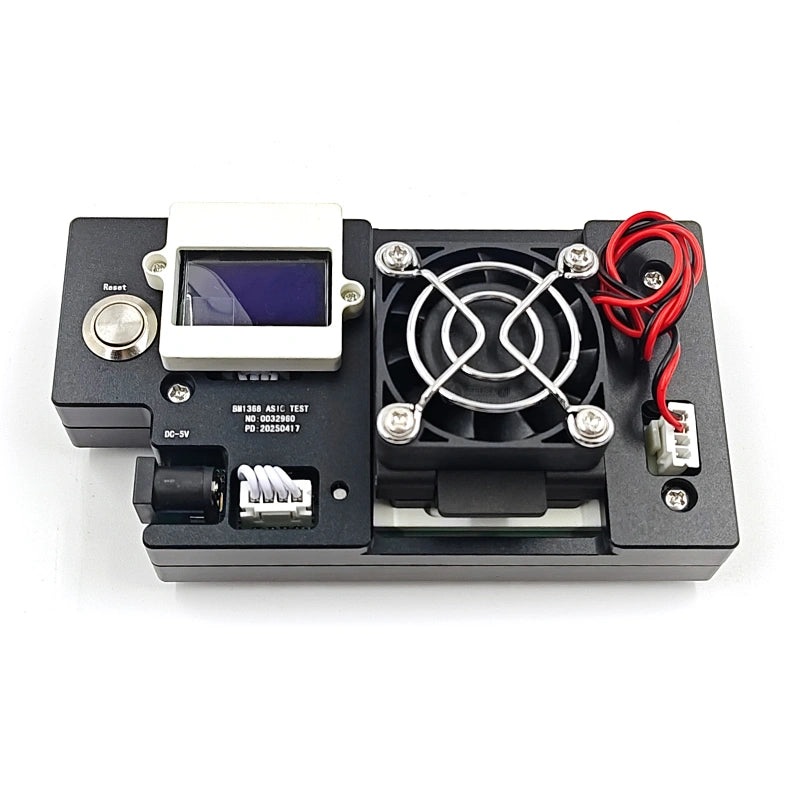
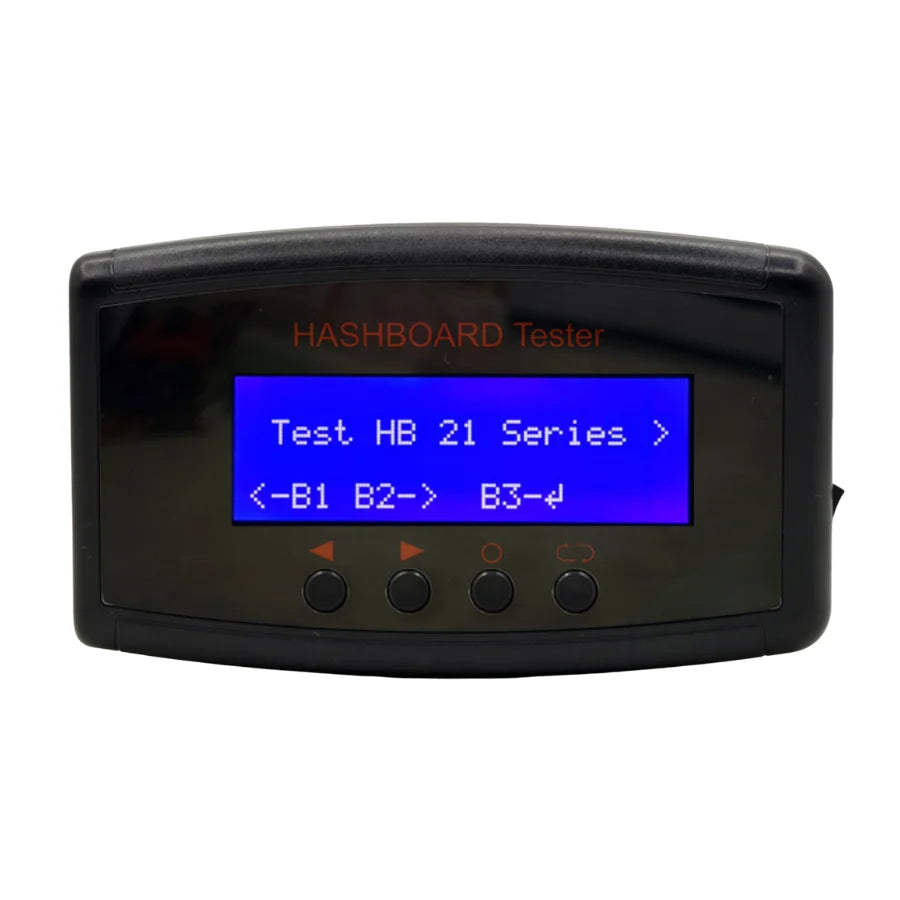
- Use the right fixture. The older M30-era fixture will not talk correctly to an M50 hashboard. Use the M50/M60 series test fixture for scanning and chip count verification. The earlier M30/M50 combined fixture also works for many M50 boards, but the M50/M60-specific fixture gives cleaner results on the newer variants.
- Confirm chip part number before sourcing. This is worth repeating. A "replace failed chip on an M50 board" job can land on KF1968, KF1968E, KF1969, or KF1978E — four different SKUs, not interchangeable.
- Expect tighter thermal tolerance. At 5 nm and 22 J/TH on the M50S++, the thermal margin on these boards is smaller than on the KF1950 generation. A marginal thermal interface that an M30S tolerated will show up as intermittent hashrate loss on an M50S++. Budget for a fresh reapplication of thermal gel on any board you reflow.
Parts Availability Outlook
The M50 parts market in mid-2026 looks a lot like the M30 parts market in late 2023 — chips and control boards are available but require active sourcing, and the fixture/tooling ecosystem is now mature enough that bench-level repair is straightforward if you have the right SKUs on hand. KF1968/KF1968E is the easiest of the four M50-era chips to find, which is unsurprising given it is shared with the M30S++.
The M53 is a thinner market. Because the unit is less common than the air-cooled M50 line and the installed base is concentrated in larger hydro-capable farms, the secondary supply of M53-specific parts (chassis components, cooling plates, three-phase-input PSU units) is smaller. At the chip and hashboard level, however, the commonality with M50 means chip and fixture supply is not really the bottleneck.
Parts to Keep in Stock for an M50/M53 Repair Bench
Based on the SKUs we ship week after week for M50-family repairs, the list looks like this:
- KF1968 / KF1968E chips (the workhorse — shared with M30S++)
- KF1969 chips (for the M50 variants that use them)
- KF1978E chips (higher-spec M50 variants)
- M50/M60 series test fixture
- CB6 V10 control board
- P222B PSU
- Thermal gel for post-repair heatsink reseating
- For any bench that services M53 units: a liquid cooling plate on the shelf as a swap-in for suspected cold-plate faults
One final note: if you are already stocking for M30S repair, the KF1968/KF1968E chips you keep for the M30S++ cover the majority of M50 chip replacements at no additional inventory cost. That overlap is the single best reason to add M50 service to an existing M30 bench, and it's the main reason we built the M50/M53 catalog around the chips and fixtures that share tooling with the M30 generation rather than treating them as a separate product line.
The LYS Technical Team is based in Shenzhen, China, where we operate a dedicated ASIC mining hardware repair workshop. With over a decade of hands-on experience repairing Antminer, Whatsminer, and Avalon mining equipment, our team supplies spare parts and repair services to mining operators in over 40 countries. Every article we publish is written and reviewed by working repair technicians.
Source Parts for Your M50 and M53 Fleet
We stock the full M50 and M53 repair catalog — chips, control boards, PSUs, fixtures, and the hydro-side components needed for M53 service — all bench-tested before shipping.
→ Browse Whatsminer Repair Parts
For bulk pricing, board-revision identification, or help matching chip part numbers to a specific batch of M50 boards you're working through, contact us at contact@lys-sz.com or via WhatsApp.