Whatsminer M50 Series Hashboard Repair Guide & Components List (2026 Update)
The Whatsminer M50 series is MicroBT's mainstream BTC mining workhorse — built around the KF1968 ASIC chip family on Samsung 5nm, delivering 108 to 126 TH/s per unit at roughly 23.9 to 28 J/TH efficiency depending on bin. The M50 platform shares its hashboard repair playbook with the M50S, M50S+, M50S++, M53 series, and M30S++ — meaning a single chip inventory and a single repair workflow covers the bulk of MicroBT's deployed fleet. This guide covers the KF1968 / KF1968E / KF1969 chip family, the Whatsminer-specific power and signalling architecture, and the full components list with direct sourcing links for every part on the board.
Why M50 Series Hashboard Repair Matters in 2026
The M50 series remains the workhorse of MicroBT's deployed fleet — efficient enough to stay profitable post-halving in low-cost-power environments, durable enough to keep producing in industrial farms five years after launch. With full hashboard replacements priced at multiples of component-level repair cost and the KF1968 chip family widely available on the secondary market, chip-level and component-level repair is the most economical way to keep these miners running. The repair playbook differs from Bitmain hashboards — different chip naming convention (KF-prefix vs BM-prefix), different IO interface (18-pin Whatsminer vs Antminer signal ribbon), different PSU family (P21 vs APW) — so a Whatsminer-specific bench inventory is required for fleet operators.
Whatsminer M50 Series Hashboard Architecture at a Glance
The M50 hashboard is built around the KF1968 ASIC chip family — MicroBT's Samsung 5nm SHA-256 hash engine of this generation. Multiple silicon revisions are in service: KF1968, KF1968E, and KF1969. All three are cross-compatible across the M50 family hashboards and serve as repair stock for the broader MicroBT lineup — including the M50, M50S, M50S+, M50S++, M53 hydro series, and the late-generation M30S++ (which migrated from BM-style to KF-style chips for its final production runs).
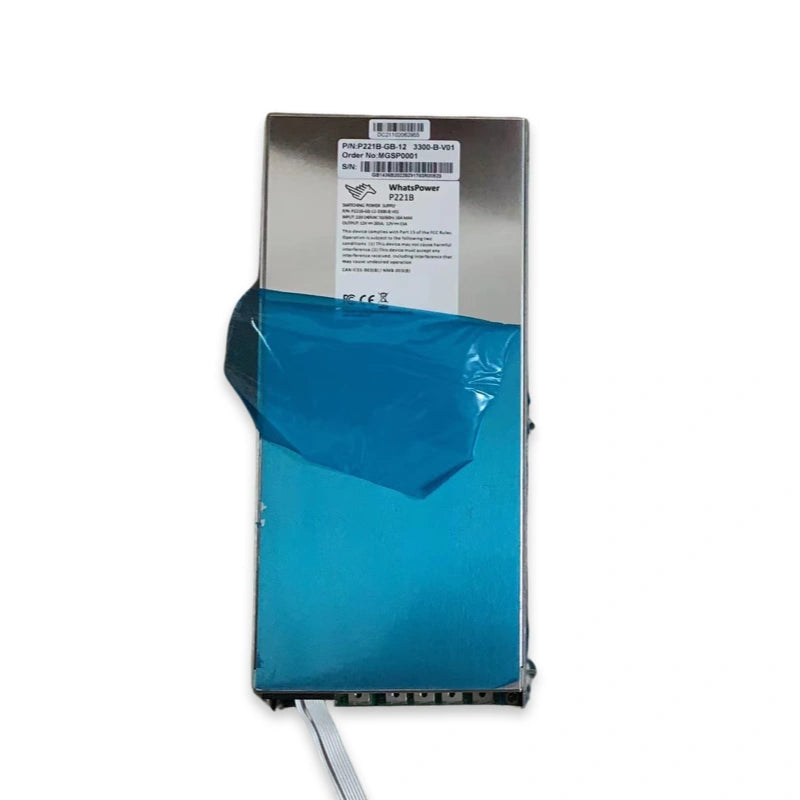
The M50 series is supported by the Whatsminer P21 series PSU family, with the P21 transformer and surrounding variants (P221B, P231B / P232B) used across the platform depending on hashrate bin and production batch.
Hashboard-to-control-board communication uses the Whatsminer 18-pin IO interface (2.54 mm pitch, dual-in-line) — a different connector and signalling standard from Antminer hashboards. This means Antminer test fixtures cannot be used on M50 boards even when the underlying chip-level diagnostics are conceptually similar.
Most Common M50 Series Hashboard Failure Modes
- Missing chips at boot scan — the chain reports fewer chips than expected, usually caused by a dead KF1968 ASIC, a failed bus transceiver upstream, or a cold solder joint on the signal path.
- Cold spots on thermal imaging — one or more chip positions stay cool while neighbours run hot, indicating a non-hashing chip or a localised LDO failure on that domain.
- Hashboard not detected at boot — usually a corrupted BL24C02F EEPROM or a failed AIP74LVC1T45 (CX2J / CX26) bus transceiver blocking the chain's first-stage signalling.
- Hashrate drop with implausible temperature — failing S75 temperature sensor triggering thermal throttling. Check the 3.3V supply and surrounding passive components before replacing the sensor IC.
- Hard short on the boost stage — a failed B628 (HX3608 / LN3608) power boost chip drops the elevated rail and presents as 0 chips detected, with the boost output reading well below its target.
- Diode / transistor failure on the protection stage — burnt DS26W Schottky diode or MMBT3906 PNP transistor, usually after a power supply transient.
- Single domain dropout — failed LDO (LN1134A182MR-G (4VK4) or SGM2036-ADJ (SQ7JK)) takes the local chip group offline.
Critical Components — Function & Failure Behaviour
ASIC Hash Engine (KF1968 family)
The KF1968 / KF1968E ASIC chips are the SHA-256 hash engine of the M50 hashboard. Samsung 5nm process. The same chip family is used on M50, M50S, M50S+, M50S++, M53 series, and the late-production M30S++ hashboards — meaning one chip inventory covers a significant share of MicroBT's fleet. ESD damage during handling and sustained thermal stress from dried thermal paste are the most common failure causes. The KF1968 tin tool (different from the Antminer BM-series tin tools) is required for proper reballing.
EEPROM (BL24C02F)
The BL24C02F EEPROM stores calibration and chain identification data. A corrupted EEPROM produces a hashboard the control board cannot enumerate at boot. The BL24C02F is a high-speed low-power variant specifically used on Whatsminer hashboards — it is not interchangeable with the AT24C02D / GT24C02A series used on Antminer.
Bus Transceiver (AIP74LVC1T45)
The AIP74LVC1T45 (CX2J / CX26) bus transceiver handles bidirectional level conversion between the control board signalling and the KF1968 chip logic. A failed transceiver usually causes the hashboard to either not enumerate at all or to drop the chain at a specific position downstream of the failure.
IO Interface Connector
The Whatsminer 18-pin IO interface (2.54 mm dual-in-line) is the data and power-sense link between the hashboard and the control board. Pin oxidation, lifted contacts after repeated install/remove cycles, or wave-soldering defects on the connector pins are common causes of intermittent chain dropouts.
Power Boost (B628 / HX3608 / LN3608)
The B628 power boost chip (HX3608 / LN3608 marking) is a step-up regulator that generates the elevated rail required for the chip core stage. A failed boost typically presents as 0 chips detected with the boost output reading well below its target voltage.
Protection Diodes & Transistors
The DS26W Schottky diode (1206 SMD) handles freewheeling and reverse-polarity protection. The MMBT3906 PNP transistor (40V / 200 mA, 300 MHz) serves as a small-signal switch on the protection and signalling stages.
Voltage Regulators (LDOs)
The M50 hashboard uses two LDO families: LN1134A182MR-G (4VK4) as a fixed 1.8V SOT23-5 regulator, and SGM2036-ADJ (SQ7JK) as an adjustable variant. A failed LDO takes its local chip group offline.
Temperature Sensor (S75)
The S75 digital temperature sensor monitors hashboard temperature. The same sensor is used across some Antminer and Whatsminer hashboards, simplifying repair stock for mixed-fleet operators.
Passive (4R7 inductor)
The 4R7 inductor handles energy storage on the power-delivery stage. Common spare passive inventory for M50 repair includes 0402 resistors and 0402 capacitors at standard values (0R, 33Ω, 10K resistor; 0.1µF, 1µF capacitor).
Whatsminer M50 Series Hashboard Repair Components List
The table below lists every component LYS Shenzhen stocks for Whatsminer M50 series hashboard repair. Each entry links directly to the corresponding part page — contact us at contact@lys-sz.com for bulk pricing, for the 4R7 inductor, or for KF1968 chip variants in volume.
| Part Number | Component Type | Typical Position / Role |
|---|---|---|
| BL24C02F | EEPROM | Calibration / chain ID storage |
| AIP74LVC1T45 (CX2J / CX26) | Bus transceiver | Bidirectional level conversion control-to-chip |
| Whatsminer 18-pin IO interface | Connector | 2.54mm dual-in-line data link to control board |
| B628 (HX3608 / LN3608) | Power boost chip | Step-up regulator for chip core stage |
| DS26W (S26) | Schottky diode | 1206 SMD freewheeling / protection |
| MMBT3906 | PNP transistor | 40V / 200 mA small-signal switching |
| KF1968 / KF1968E | ASIC hash engine | Samsung 5nm SHA-256, compatible M50/M50S/M53/M30S++ |
| LN1134A182MR-G (4VK4) | LDO regulator | SOT23-5, 1.8V fixed output |
| SGM2036-ADJ (SQ7JK) | LDO regulator | Adjustable variant for cross-platform repair |
| 4R7 inductor | Inductor | Power-delivery stage energy storage — contact us for stock check |
| S75 | Temperature sensor | Digital hashboard temperature monitoring |
Required Repair Tools & Consumables
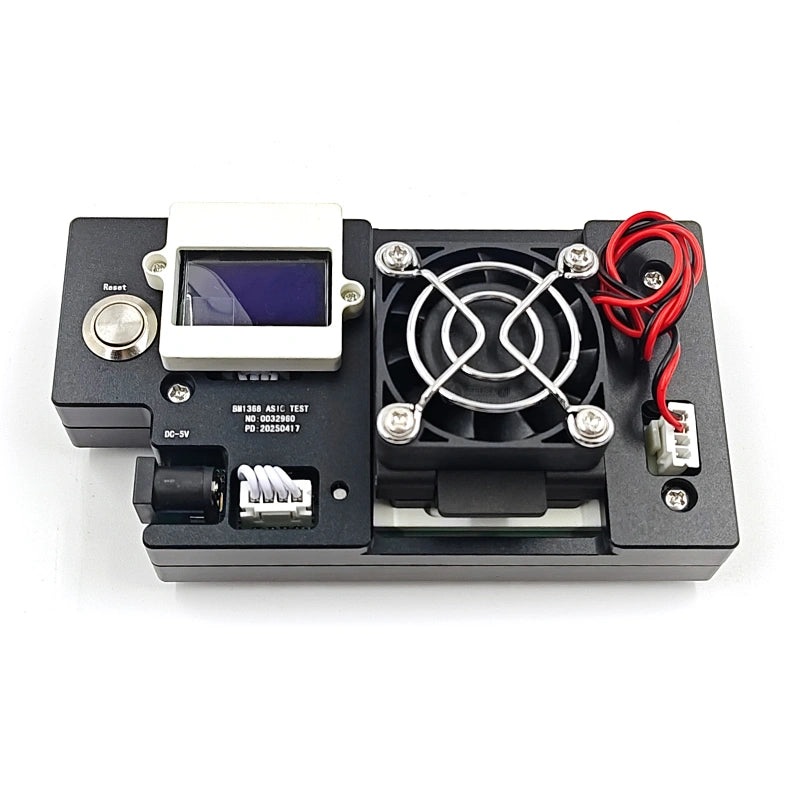
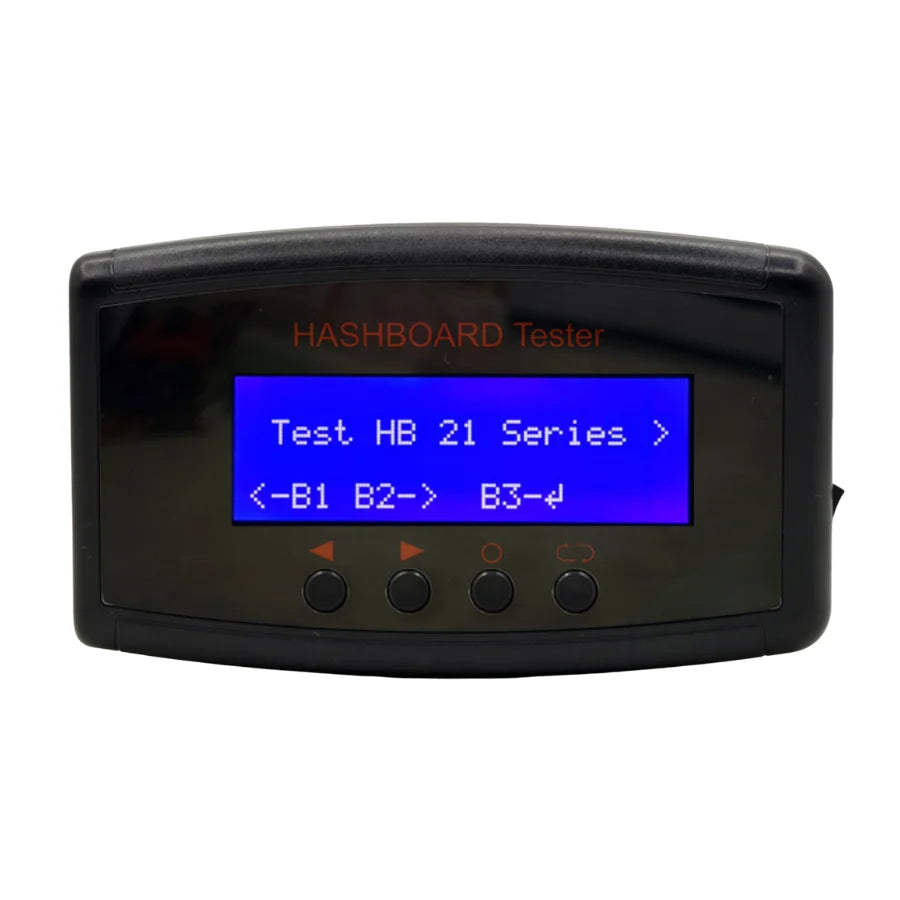
- Whatsminer M60 / M50 / M30 series hashboard tester — bench-side diagnostic for the M3x / M5x / M6x platforms, available in 3 hardware variants tuned to specific hashboard families (M60/M50 Hydro, M60/M50 air-cooled, M50/M30 air-cooled).
- KF1968 LGA tin tool — dedicated reballing stencil for the KF1968 chip footprint (distinct from the BM-series stencils used on Antminer).
- Constant-temperature soldering iron at 350-380°C with a pointed tip for SMT work.
- Hot-air rework station rated 350-400°C for BGA / QFN chip removal and placement.
- Solder paste M705 grade, no-clean flux, board washing fluid with anhydrous alcohol.
- Tin balls 0.4 mm diameter for chip ball reattach work.
- Multimeter (Fluke recommended) with welded steel probe needles and heat-shrink sleeves.
- Thermal compound rated 5W/mK or higher — required for 24/7 mining loads.
- Common spare 0402 resistors (0R, 33Ω, 10K) and 0402 capacitors (0.1µF, 1µF).
- 4 AWG copper wire (under 60 cm) for bench-power leads from the P21 series PSU to the hashboard.
Diagnostic and Repair Workflow
- Power off and remove the suspect hashboard from the miner — never work on a powered board.
- Visual inspection — look for scorched components, lifted pads, PCB deformation, or impact damage.
- Identify hashboard variant — read the silkscreen part number on the PCB to confirm it is an M50 series board, not an M30S+ Hydro or M60 series variant. The KF1968 chip family is shared but supporting passives may differ.
- Impedance / short-circuit check on every voltage domain before powering. Any rail short must be cleared before applying power, or healthy chips will burn at startup.
- Connect to the P21 series PSU using 4 AWG copper leads under 60 cm. Connect the negative lead first, then the positive lead, and finally the 18-pin IO signal cable. Reverse this sequence to disconnect.
- Bench-test on the Whatsminer M60 / M50 / M30 hashboard tester — runs the chip detect sequence on the correct fixture variant for the M50 family.
- If 0 chips reported, walk the power chain: PSU output → boost stage at the B628 → per-domain LDO outputs → chip signal voltages.
- If chain not enumerated at boot, check the BL24C02F EEPROM soldering and the AIP74LVC1T45 bus transceiver — these are the most common single-point causes of total enumeration failure.
- Thermal imaging under bench load — confirms cold spots match the missing-chip positions reported by the tester.
- Binary-search fault isolation for incomplete chip detection: short the local rail to the appropriate test point between candidate chip boundaries and re-run the chip-find program.
- For KF1968 chip replacement: use the KF1968 LGA tin tool to pre-tin the chip pins with M705 paste before placing on the PCBA.
- Re-test on the tester twice — let the board cool to ambient between runs.
- Re-paste the heatsink with 5W/mK or higher thermal compound before reassembly.
- Reinstall and monitor for 24 hours — confirms the board holds full hashrate without temperature anomalies.
When Chip-Level Repair Makes More Sense Than Board Replacement
A full M50 hashboard replacement, when available, typically costs an order of magnitude more than the components needed for a chip-level repair. For farm operators running fleets of M50 series units, a small inventory of KF1968 chips, the BL24C02F EEPROM, the AIP74LVC1T45 bus transceiver, the standard LDOs (LN1134A182MR-G, SGM2036-ADJ), and the protection components covers the majority of bench-repair scenarios. Paired with the Whatsminer M60 / M50 / M30 tester and the right P21 series PSU, most dead boards return to full output in under an hour.
Compatible PSU
The M50 series is supported by the Whatsminer P21 series PSU family. LYS Shenzhen stocks the P21 transformer, the P221B PSU, the P231B / P232B air-cooled PSUs, plus replacement 18-pin data cables and the EU C19 power cord for European deployments.
M50 PSU troubleshooting — Whatsminer-specific checks
Power supply faults on the M50 series usually present as failure to start, hashrate fluctuations, or specific error codes. Run through the following Whatsminer-specific checks before swapping the PSU:
- Cables and conductive copper strips: Whatsminer hashboards connect to the PSU via flat conductive copper strips rather than the Antminer-style cable harness. Verify the copper strips are seated cleanly against both the PSU output terminals and the hashboard power-in pads. The washers on the fixing screws should sit parallel-aligned with the edges of the copper strips — a misaligned washer points to a poor electrical contact. Inspect strips for breakage, rust, or oxidation; replace if damaged.
- Data ribbon cable: confirm the 18-pin IO cable is fully seated on the control board with no looseness.
- PSU case integrity: visually inspect the PSU case for overheating discolouration, deformation, or signs of internal damage. Gently shake the unit and listen for loose components rattling inside — internal damage requires opening the PSU for inspection.
- PSU lock state: M50 PSUs can enter a protective lock state when internal temperature is too high or when fan speed is excessively elevated. Power-cycle the PSU and let it cool before re-testing. Verify the PSU fan is operational and within its specified speed range; replace the PSU fan if degraded.
- PSU version compatibility: confirm the PSU model and firmware version match the M50 variant being powered. Mismatched PSU versions can produce intermittent shutdowns even when the unit appears healthy on basic tests.
- Output voltage measurement: measure the PSU output with a multimeter and compare against the M50 specification range. Adjustable PSUs that have drifted out of range should be re-trimmed or replaced.
M50 error codes commonly linked to the PSU
The Whatsminer firmware exposes a set of error codes that often trace back to power-supply issues. If the miner reports any of the following codes, prioritise PSU inspection over hashboard diagnostics:
- Codes in the 208 to 275 range — typically PSU output voltage / current anomalies.
- Codes 326 and 329 — PSU communication or protection faults.
- Code 8700 — PSU lock / protection state engaged.
- Any error code starting with 0x (hexadecimal) — usually a low-level PSU or PSU-to-control-board signalling issue.
Hashboard-side faults typically produce different error code patterns; if the miner reports a hashboard chip count error instead of one of the above PSU codes, focus on chip-level diagnostics from the components list above.
FAQ — Whatsminer M50 Series Hashboard Repair
What chip family does the Whatsminer M50 use?
The M50 series uses the MicroBT KF1968 ASIC family — specifically the KF1968, KF1968E, and KF1969 silicon revisions. All three are Samsung 5nm SHA-256 chips and are cross-compatible across the M50, M50S, M50S+, M50S++, M53 series, and late-production M30S++ hashboards.
What hashrate does the M50 series deliver?
The M50 platform ships in hashrate bins ranging from approximately 108 to 126 TH/s, depending on silicon bin and firmware. Power consumption is typically around 3000W, giving roughly 23.9 to 28 J/TH efficiency.
Can I use Antminer test fixtures on Whatsminer M50 hashboards?
No. Whatsminer hashboards use an 18-pin 2.54mm IO interface that is electrically and mechanically different from Antminer signal ribbons. Use the dedicated Whatsminer M60 / M50 / M30 series hashboard tester for chip-level diagnostics.
What is the correct power-on sequence for an M50 hashboard on the bench?
Connect the negative copper supply lead from the P21 series PSU first, then the positive copper lead, and finally plug in the 18-pin IO signal cable. Reverse the sequence to disconnect. Wrong order can damage the AIP74LVC1T45 bus transceiver and the surrounding signalling chips.
What thermal paste should I use on an M50 hashboard?
Use thermal compound rated 5W/mK or higher. M50 hashboards generate significant continuous heat under 24/7 mining loads, and consumer-grade pastes dry out within months. Re-paste interval depends on environment — 12-18 months in standard hosted facilities, 6-12 months in dusty or hot installations.
Sourcing M50 Series Hashboard Parts
LYS Shenzhen stocks every component listed above for the Whatsminer M50 series hashboard. For KF1968 chips in any silicon revision (KF1968 / KF1968E / KF1969), the KF1968 LGA stencil tool, the 4R7 inductor, the M60 / M50 / M30 hashboard tester, or for bulk farm-scale orders on Whatsminer repair parts, contact our team at contact@lys-sz.com — we operate an on-demand sourcing channel for repair components across the full MicroBT line, including M30, M50, M53, and M60 series.
Worldwide shipping from our Shenzhen warehouse via DHL, FedEx, UPS, and sea freight. DDP shipping available for US and EU customers; case-by-case for other lanes — request a quote with your shipping country for confirmation.