Antminer S19k Pro Hashboard Repair Guide & Components List (2026 Update)
The Antminer S19k Pro entered service in 2024 as Bitmain's mid-cycle refresh of the S19 series — pairing the BM1366 ASIC chip family with a tighter power-efficiency profile (~23 W/TH) and a 110–120 TH/s output range. Two years on, the S19k Pro fleet is large enough that hashboard-level repair is a routine workshop task, and most failures trace back to a small set of vulnerable components covered in this guide. Every part listed below links directly to its corresponding LYS Shenzhen sourcing page.
Why S19k Pro Hashboard Repair Matters in 2026
S19k Pro hashboards are mechanically similar to the rest of the S19 series but use a different ASIC generation, which means S19j Pro repair parts are not directly interchangeable. Operators carrying mixed fleets need to stock the BM1366 family alongside the BM1362 family. With post-halving margins still tight and full hashboard replacements limited in supply, a properly equipped bench can return a dead S19k Pro chain to full output in under an hour using the parts list below.
Antminer S19k Pro Hashboard Architecture at a Glance
The S19k Pro hashboard is built around the BM1366 ASIC chip family — Bitmain's SHA-256 hash engine for this generation. Multiple silicon revisions have shipped across the fleet: BM1366BS, BM1366BP, BM1366AL, and BM1366AG (the AG variant appears primarily on S19xp hashboards rather than S19k Pro). Variants differ by silicon revision and binning rather than topology, and the same repair workflow applies across them.
S19k Pro ships in three nameplate hashrate bins: 110, 115, and 120 TH/s. A complete miner carries 3 hashboards totalling approximately 328 ASIC chips (≈109 chips per hashboard). S19k Pro hashboards are commonly identified by the BHB56902 board model number, supported by the standard APW12 series PSU and an AMLogic / C76 / A113D control board in production units.
Most Common S19k Pro Hashboard Failure Modes
- Missing chips at boot scan — the chain reports fewer than the expected count, usually caused by a dead BM1366 ASIC or a failed level translator upstream of the missing string segment.
- Cold spots on thermal imaging — one or more chip positions stay cool while neighbours run hot, indicating a non-hashing chip or a localised power-delivery failure.
- Hashboard not detected at all — usually a corrupted AT24C02C EEPROM, a dead supporting IC, or a missing rail at the connector.
- Hashrate drop without missing chips — frequently a failing S75 temperature sensor triggering thermal throttling, or a degraded LDO under-supplying part of the chain.
- Hard short on a rail — a shorted LDO or boost converter typically presents as a hard short across its output stage, easily found with a multimeter.
- Signal cable failures — the 18-pin right-angle PHB 2.00mm connector can lose contact integrity from repeated install/remove cycles, producing intermittent chain dropouts.
Critical Components — Function & Failure Behaviour
ASIC Hash Engines (BM1366 family)
The BM1366 chips are the hash engine of the S19k Pro hashboard. A dead BM1366 typically takes out the chips downstream in the same domain because the chain protocol requires every chip to forward correctly. The most common cause of a dead ASIC is ESD damage during handling, followed by sustained thermal stress from dried thermal paste or a clogged heatsink. When ordering replacements, match the silicon revision printed on the chip (BS, BP, or AL) — mixing revisions on the same chain typically causes hashrate inconsistency.
Voltage Regulators (LDOs)
Multiple LDOs feed the various rail voltages required by the BM1366 chips and supporting logic. The S19k Pro hashboard uses SGM2036-1.2YN5G (1.2V rail), SGM2036-0.8YN5G/TR (0.8V rail for the chip core), MP2019K8884431 / MPSK44 (1.8V rail), LM317MBSTT3G (adjustable 500 mA), and NCP114ASN120T1G in various positions. A failed LDO typically takes an entire local string of chips offline because the chips downstream lose their voltage supply.
Boost Converter & Switching Stage
The MPSK391517DR boost converter provides the elevated rail needed to drive the chip core stage. A failed boost converter typically presents as a chain that fails to start under load or a PSU that trips during the chain initialisation phase.
Level Translators & Signalling
The SN74AUP1T34DCKR (U2E) level translator bridges the 3.3 V control board signalling and the BM1366 chip logic. A failed translator usually causes a block of downstream chips to drop offline simultaneously — a useful signature when scanning with thermal imaging.
EEPROM & On-Board Identification
The AT24C02C EEPROM stores calibration and chain identification data. A corrupted EEPROM usually presents as a hashboard that the control board does not enumerate at boot, even when the chips themselves are healthy.
Temperature Sensor & Amplifier
The S75 digital temperature sensor reports hashboard temperature back to the control board. A failed sensor either produces false-high readings (triggering thermal throttling and apparent hashrate loss) or false-low readings (allowing the chain to run unsafely hot). The SGM8304YTS14 amplifier conditions the temperature signal — a failed amplifier typically presents as missing or implausible temperature data rather than a thermal shutdown.
Passive Components
The 330µF 30V SMD capacitors, the 10µH HPC1050 inductors, and the 1R80 1206 SMD resistors handle the bulk filtering, energy storage, and current sensing on the power-delivery stage. A degraded bulk capacitor commonly produces random reboots or PSU shutdowns under load when the rail can no longer hold voltage under transient current draw.
Antminer S19k Pro Hashboard Repair Components List
The table below lists every component LYS Shenzhen stocks for S19k Pro hashboard repair. Each entry links directly to the corresponding part page — contact us at contact@lys-sz.com for bulk pricing, for the BM1366AL variant, or for sourcing of items not currently in our public catalogue.
| Part Number | Component Type | Typical Position / Role |
|---|---|---|
| BM1366BS / BM1366BP | ASIC hash engine | Main SHA-256 chip, one per hash position |
| AT24C02C | EEPROM | Calibration / chain ID storage |
| SN74AUP1T34DCKR U2E | Voltage level translator | Control-to-chip signalling bridge |
| 330µF 30V SMD | Capacitor | Bulk filtering on power-delivery stage |
| MPSK391517DR | Boost converter | Elevated rail for chip core stage |
| 10µH (100) 6×6mm | Inductor | HPC1050 SMD power inductor |
| 1R80 SMD 1206 | Resistor | Current-sense / shunt resistor |
| LM317MBSTT3G | Positive regulator | 500 mA adjustable output |
| MP2019K8884431 / MPSK44 | LDO regulator | 1.8V rail supply |
| SGM2036-1.2YN5G | LDO regulator | 1.2V rail supply |
| SGM2036-0.8YN5G/TR | LDO regulator | 0.8V chip core rail — contact us for stock check |
| S75 | Temperature sensor | Hashboard digital temp sensor |
| SGM8304YTS14 | Amplifier IC | 100 MHz high-voltage output amplifier |
| 18P right-angle PHB 2.00mm | Signal connector | Hashboard-to-control-board data link |
Required Repair Tools & Consumables
A properly equipped S19k Pro repair bench should carry the following tools, all available from LYS Shenzhen:
- S19k Pro thermal paste stencil — model-specific stencil that cuts re-paste application time and ensures uniform coverage across all chip positions.
- S19k Pro copper sheet — replacement heat-spreader between the chips and the main heatsink.
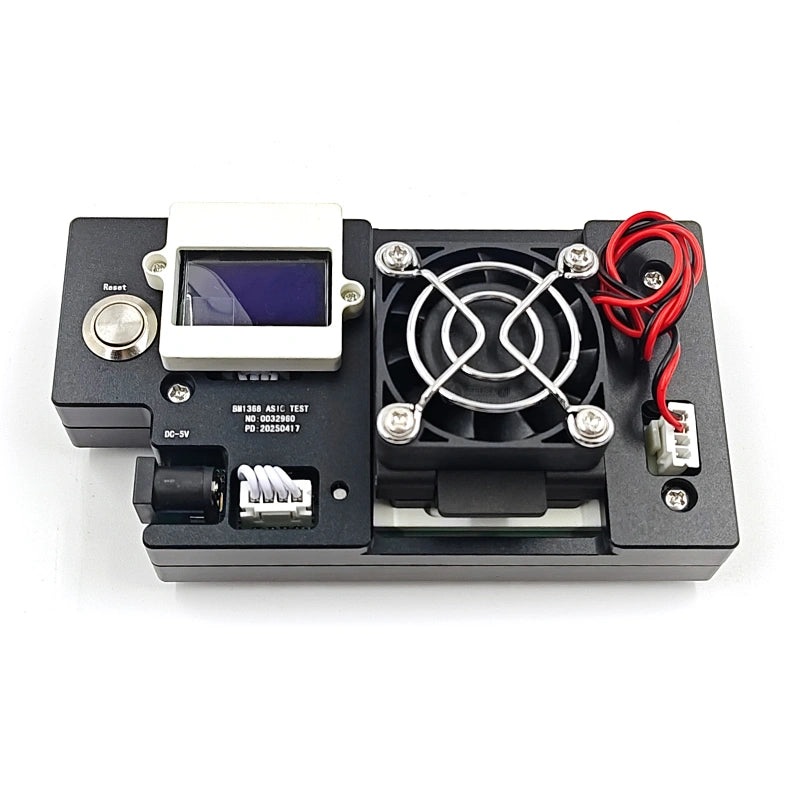
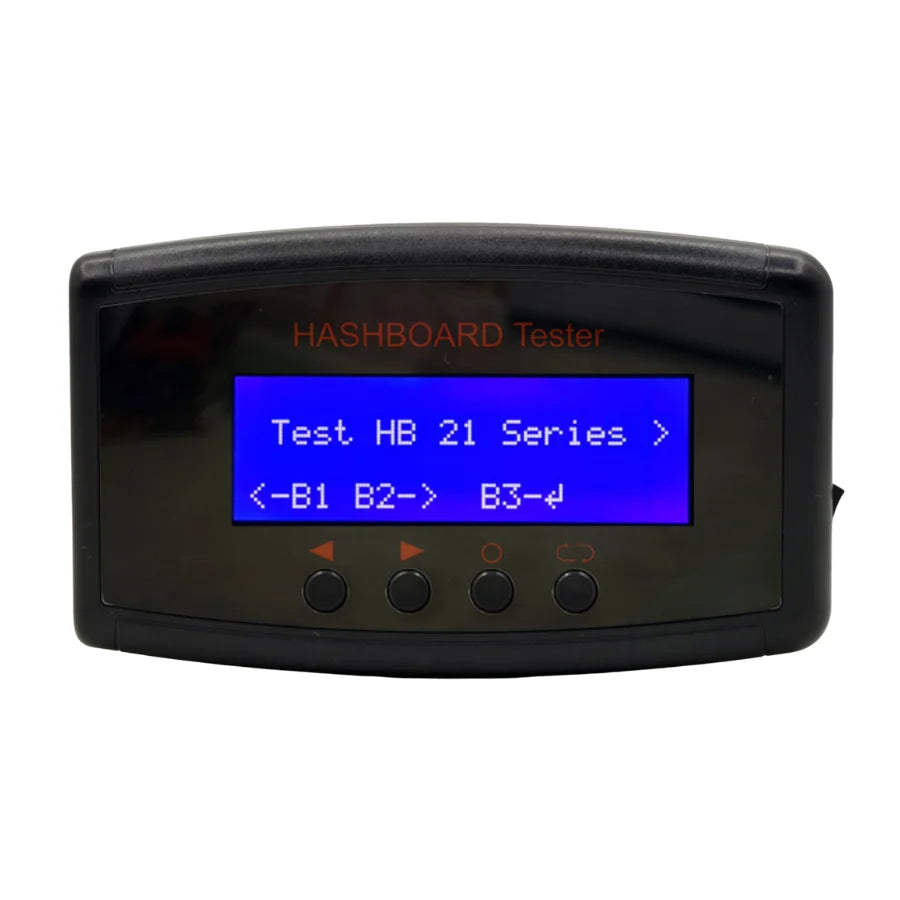
- Universal hashboard test fixture with LCD — runs a full chain scan on a removed hashboard and identifies missing chips by position.
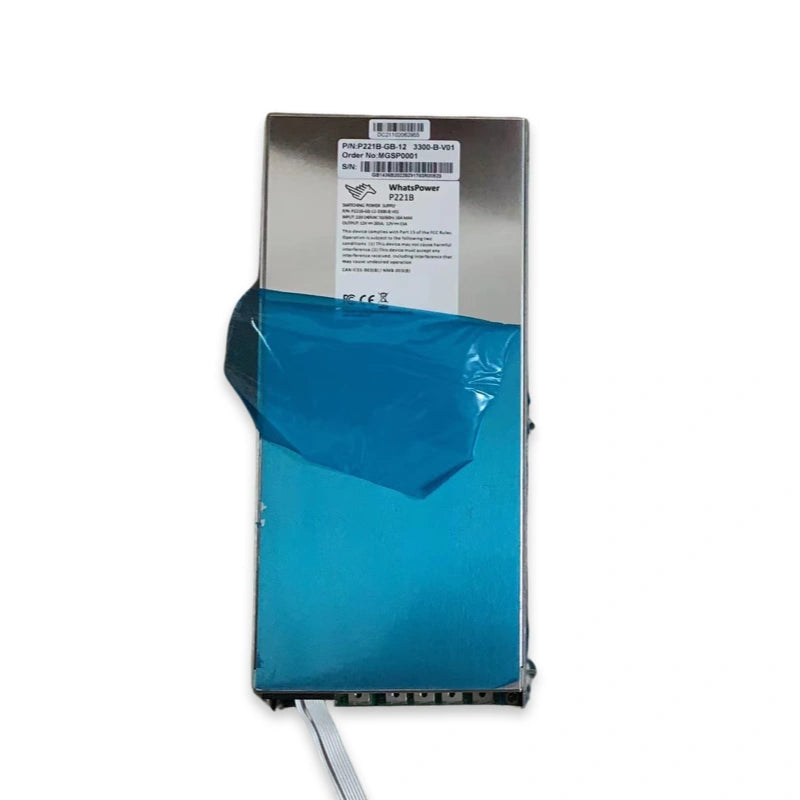
- S19k Pro fan-speed simulator — allows the miner control board to start without the physical fans, useful when bench-testing repaired hashboards.
- Thermal compound rated 5W/mK or higher — required for 24/7 mining loads.
- Hot-air rework station with profile suited to the BM1366 chip package.
- Isopropyl alcohol 99% and lint-free wipes for pad and heatsink cleaning before re-paste.
Diagnostic and Repair Workflow
- Power off and remove the suspect hashboard from the miner — never work on a powered board.
- Visual inspection — look for scorched components, lifted pads, or physical damage from handling.
- Bench-test on the hashboard test fixture — confirm the missing-chip pattern reported by the miner and identify the exact chip positions involved.
- Voltage rail check with a multimeter — confirm the LDOs are delivering correct rail voltages (0.8V, 1.2V, 1.8V) on the boundary of the failing string.
- Thermal imaging under bench load — confirms cold spots match the missing-chip positions and rules out a failed level translator producing a misleading scan result.
- Component replacement with hot air, following the chip's recommended reflow profile and using the S19k Pro stencil for clean pad re-tinning.
- Re-test on the fixture before re-installing in the miner.
- Re-paste the heatsink with 5W/mK or higher thermal compound before reassembly.
- Reinstall and monitor for 24 hours — confirms the board holds full hashrate without temperature anomalies.
When Chip-Level Repair Makes More Sense Than Board Replacement
A full S19k Pro hashboard replacement, when available, typically costs an order of magnitude more than the components needed for a chip-level repair. For farm operators running more than a handful of S19k Pro units, the case for in-house repair is straightforward: a small inventory of BM1366 ASICs, the most common LDOs, plus a hashboard test fixture, turns most dead boards into a one-hour bench job and avoids multi-week RMA windows.
Compatible PSU and Control Board
S19k Pro miners ship with the APW12 series PSU (12–15 V DC dynamic output range, 3250–3600 W). The control board is the S19k Pro AMLogic C76 / A113D control board, with the MAX809REUR voltage monitoring circuit as a frequent failure point on the control side. LYS Shenzhen stocks both the control board and the support ICs alongside the hashboard repair parts above.
FAQ — Antminer S19k Pro Hashboard Repair
How many ASIC chips does an S19k Pro hashboard carry?
A complete S19k Pro miner uses 3 hashboards for a total of approximately 328 BM1366 ASIC chips — roughly 109 chips per hashboard depending on hashrate bin and revision.
Which BM1366 variant is on my S19k Pro hashboard?
The chip revision is printed on the package face of the ASIC itself. S19k Pro hashboards are commonly built with BM1366BS or BM1366BP; some earlier production used BM1366AL. The BM1366AG revision appears primarily on S19xp hashboards rather than S19k Pro and is not directly interchangeable.
Can I mix BM1366 revisions on the same hashboard?
Not recommended. BM1366 chips are typically binned and voltage-matched at the factory by silicon revision, and mixing revisions on the same chain commonly causes inconsistent hashrate or chain instability. Replace dead chips with the same revision wherever possible.
Where do I find the hashboard part number on the S19k Pro?
The hashboard part number is printed on a sticker on the PCB, typically near the connector edge or on the back of the board. S19k Pro hashboards are commonly identified by the BHB56902 model number.
What thermal paste should I use on an S19k Pro hashboard?
Use thermal compound rated 5W/mK or higher. S19k Pro hashboards generate significant continuous heat under 24/7 mining loads, and consumer-grade pastes dry out within months. Application is fastest and most consistent with the model-specific S19k Pro stencil tool.
Sourcing S19k Pro Hashboard Parts
LYS Shenzhen stocks every component listed above for the Antminer S19k Pro hashboard. For parts not currently in our public catalogue (BM1366AL variant, S19k Pro control board, or other revision-specific items), for bulk farm-scale orders, or for sourcing of out-of-stock components, contact our team at contact@lys-sz.com — we operate an on-demand sourcing channel for repair components across the full Antminer line.
Worldwide shipping from our Shenzhen warehouse via DHL, FedEx, UPS, and sea freight. DDP shipping available for US and EU customers; case-by-case for other lanes — request a quote with your shipping country for confirmation.