Antminer S19 Hydro HHB28601 Hashboard Repair Guide & Components List (2026 Update)
The Antminer S19 Hydro entered service as Bitmain's water-cooled high-density variant of the S19 platform — built around the BM1398 ASIC chip family and the HHB28601 hashboard architecture. Two years after the original publication of this guide, the S19 Hydro fleet remains a significant share of liquid-cooled industrial mining capacity, and hashboard-level repair is the most economical path to keep these boards producing. This guide covers the BM1398BB chip, the unique 52-domain × 2-chip topology, the water-cooling cascade failure mode that bricks U4/U5/PIC/BM1/BM2 in sequence, and the complete components list with direct sourcing links for every part.
Why S19 Hydro Hashboard Repair Still Matters in 2026
Hydro-cooled S19 units occupy industrial mining facilities that valued density and noise reduction over pure efficiency. Replacing a complete HHB28601 hashboard is expensive and often constrained by supply — chip-level and component-level repair restores a board to full output at a fraction of the cost. The water-cooling architecture also introduces specific failure modes (water temperature anomalies, sensor cascade burns) that are not present on air-cooled S19 boards, making the right repair workflow essential for Hydro fleet operators.
Antminer S19 Hydro HHB28601 Hashboard Architecture at a Glance
The HHB28601 hashboard is built around the BM1398 ASIC chip family — the same chip generation as the standard S19 Pro, with the BM1398BB being the predominant revision shipped on Hydro boards (the closely related BM1398AC is also encountered).
Each HHB28601 carries 104 BM1398 chips, organised as 52 voltage domains of 2 chips in series each (silkscreen sequence BM1 through BM104). This 52×2 layout is unique to the S19 Hydro and very different from the air-cooled S19 series boards: the wider domain count gives finer per-domain control but introduces more diagnostic surface area to cover when faults appear.
Each BM1398 chip operates at approximately 0.37V. With 2 chips in series per domain, the nominal domain voltage measures around 0.74V at rest under power. Domain voltages decrease in sequence across the board — each domain back from the top measures approximately 0.37V less than the previous.
The S19 Hydro miner is supported by the APW9, APW9+, or APW11 power supply (PSU compatibility is broad across the Hydro generation). The control board ecosystem matches the S19 family and supports the standard U1 FBGA main IC with the OTP one-time-programmable function.
Dual oscillator topology
The HHB28601 is notable for carrying two independent 25 MHz crystal oscillators (Y1 and Y2), each driving half the chain:
- Y1 drives the CLK signal forward from BM1 to BM51 (first half).
- Y2 drives the CLK signal forward from BM52 to BM104 (second half).
- CLK voltage at any healthy chip measures approximately 0.9V.
A failed Y1 will report 0 chips on the first half but the second half will scan normally; a failed Y2 produces the inverse pattern. This split is a useful diagnostic shortcut when scanning a board that reports exactly 51 or 52 chips detected.
HHB28601 power and rail topology
The hashboard runs a two-tier power architecture. The input 19V rail feeds the boost circuit at U9, which steps up to approximately 25V (measurable at test point C62; C76 reads ~28V on the boost intermediate stage). The top 7 domains (positions 46 through 52) are powered from this 25V boosted rail through their local LDOs to deliver 1.8V (PLL supply). Domains 1 through 45 derive their 1.8V supply directly from VDD 18V through LDO. The 0.8V chip core supply is in every case derived locally from the 1.8V rail.
HHB28601 signal directions — critical for chain-fault diagnosis
- CLK: dual oscillator (Y1 + Y2). Y1 → BM1 to BM51; Y2 → BM52 to BM104. Operating voltage ~0.9V.
- TX (CI / CO): enters at pin 7 of the IO interface at 3.3V, passes through level conversion at U2, flows forward from BM1 to BM104. Standby 1.8V; operating 0.6V.
- RX (RI / RO): reverse direction — flows from BM104 back to BM1, returns to pin 8 of the signal cable through U1, then to the control board. Standby 0.3V; operating 1.8V.
- BO (BI / BO): flows forward from BM1 to BM104. Measures 0V on a multimeter at rest.
- RST: enters at pin 3 of the IO interface, passes through D2/R13/R14, flows forward from BM1 to BM104. Standby 0V; operating 1.8V.
Most Common HHB28601 Hashboard Failure Modes
- 0 chips detected at boot — verify 25V at C62 boost output, then check PIC chip (U3) for 3.2V at pin 2, then walk domain voltages.
- EEPROM NG on test fixture LCD — check U6 ATH93702DMCN1937 EEPROM soldering; corrupted or unsoldered EEPROM means the hashboard won't enumerate.
- ASIC INIT NG with abnormal temperature reading — the sensor index maps to specific chip positions: sensor {0, 24, 48, 158, 182, 206} → chip {BM1, BM13, BM25, BM80, BM92, BM104}. Check the sensor chip and its surrounding passives at that position.
- INIT NG WATER_TEMP — water inlet/outlet temperature reading abnormal; check U4 and U5 (water temperature sensors) plus their nearby SMD resistors and capacitors.
- Hashboard indicator LED does not light — go directly to the PIC chip (U3): verify 3.3V is present. If not, reprogram the PIC.
- Exactly 51 or 52 chips detected (instead of 104) — half-chain fault, almost always caused by a failed crystal oscillator (Y1 or Y2 depending on which half is missing).
- Pattern NG with low nonce response — chip die damage or tin-bridging on the affected positions; replace the lowest-responding chip in each affected domain.
- 0 or 1 nonce response from two adjacent chips in the same domain — tin bridge or virtual soldering on those chips; re-solder before replacement.
Critical Components — Function & Failure Behaviour
ASIC Hash Engine (BM1398BB)
The BM1398BB is the dominant ASIC on the HHB28601 (the closely related BM1398AC is also seen). Each chip is QFN-packaged and operates at 0.37V. ESD damage during handling is the most common failure cause, followed by thermal stress from water-cooling plate misalignment or dried thermal grease. A dead BM1398 typically takes both chips in its 2-chip domain offline.
PIC Microcontroller (U3)
The PIC16F1704 microcontroller manages the local hashboard protocol and identification. A failed PIC produces a dark indicator LED and prevents the board from being recognised at boot. The PIC can be reprogrammed in place using PICkit3 + MPLAB IPE with the appropriate hex firmware — a useful first step before deciding to replace the IC.
Water Temperature Sensors (U4 / U5) — Hydro-Specific Cascade Failure
The HHB28601 monitors water inlet/outlet temperature via U4 and U5. This is the most consequential failure path on a Hydro board: abnormal water temperature or restricted cooling-loop flow can burn U4 and U5, which then propagates a short to the PIC (U3), which removes the 1.8V and 0.8V supplies from the first domain, which burns BM1 and BM2. The full burn-out sequence reads: U4 → U5 → U3 PIC → BM1 → BM2 → U1, U2, U177, U178. Always verify cooling-loop flow and water temperature before powering up a recovered Hydro board.
EEPROM (U6)
The ATH93702DMCN1937 EEPROM at U6 stores calibration and chain identification data. A corrupted EEPROM produces "EEPROM NG" on the test fixture LCD and blocks enumeration.
Voltage Regulators (LDOs)
The S19 Hydro uses SGM2036-ADJ (SQ7JK) for the 0.8V rail and TLV74318PDBVR (1D7T) as additional low-dropout regulators. A failed LDO typically takes its entire local 2-chip domain offline.
Power Management & Boost
The SY7302ABC (HMBWA) high-efficiency power management IC supports the rail topology, and the U9 boost stage steps 19V to ~25V for the upper domains. A failed boost stage drops the upper 7 domains' rails simultaneously.
MOSFETs
The T2N7002AK (NJ) small-signal MOSFET and the NTMFS5C604NLT1G (5C604L) high-current MOSFET handle different stages of switching. A shorted high-current MOSFET typically produces a hard short on the input rail that must be cleared before powering up to avoid cascading damage.
Level Translation (U1 / U2)
The SN74AUP1T34DCKR (U2E) level translator and the SN74AUC1GU04DBVR (UU4R) single-inverter gate handle signal level conversion between the 3.3V control side and the 1.8V chip side. U1 and U2 are common casualties when the bench power-on sequence is incorrect.
Temperature Sensors (S75 / NCT218)
The S75 and NCT218 (T2F / T2Y / T2H) digital temperature sensors monitor different chip-array positions. The S19 Hydro carries multiple sensors mapped to specific chip indices (see sensor map above) — a failed sensor reports an implausibly low or high value at its assigned position.
Voltage Monitoring & Protection
The SXE1923 / SGM2201 voltage monitoring chip supervises the rails, and protection diodes SMBJ22A (TVS), B0540W SF (Schottky), and BZT52C15 WJ (Zener) clamp transients and protect against reverse polarity.
Passive Components & Clock
The 330µF 30V SMD and 2R5TPE330M9 (330µF / 2.5V low-ESR polymer) capacitors handle bulk decoupling. The SJK 25.000 25 MHz crystal oscillator (used at Y1 and Y2 positions) provides the dual chain timing reference. The 4.7µH inductor handles boost-stage energy storage.
Antminer S19 Hydro HHB28601 Hashboard Repair Components List
The table below lists every component LYS Shenzhen stocks for S19 Hydro HHB28601 hashboard repair. Each entry links directly to the corresponding part page — contact us at contact@lys-sz.com for bulk pricing or for the 2R5TPE330M9 tantalum or 4.7µH inductor (not currently in our public catalogue).
| Part Number | Component Type | Typical Position / Role |
|---|---|---|
| BM1398BB | ASIC hash engine | SHA-256 chip, 104 per board across 52 domains of 2 |
| ATH93702DMCN1937 | EEPROM | U6 — calibration / chain ID storage |
| PIC16F1704 | Microcontroller | U3 — local hashboard protocol, reprogrammable via PICkit3 |
| T2N7002AK (NJ) | Small-signal MOSFET | Logic-level switching |
| SN74AUP1T34DCKR U2E | Voltage level translator | 3.3V to 1.8V control signalling bridge |
| NTMFS5C604NLT1G (5C604L) | High-current MOSFET | Core voltage switching stage |
| SMBJ22A | TVS diode | Transient overvoltage protection |
| 330µF 30V SMD | Capacitor | Bulk filtering on power-delivery stage |
| S75 | Temperature sensor | Hashboard digital temp sensor |
| SY7302ABC (HMBWA) | Power management IC | Rail supervision and switching |
| B0540W SF | Schottky diode | 40V / 500 mA SOD-123 small signal |
| BZT52C15 WJ | Zener diode | 15V clamp / protection |
| NCT218 (T2F / T2Y / T2H) | Temperature sensor | Secondary thermal monitoring |
| SXE1923 / SGM2201 | Voltage monitoring | Rail supervision IC |
| SGM2036-ADJ (SQ7JK) | LDO regulator | 0.8V chip core rail |
| TLV74318PDBVR (1D7T) | LDO regulator | Low-dropout linear regulator |
| SN74AUC1GU04DBVR (UU4R) | Single inverter gate | Signal inversion stage |
| 2R5TPE330M9 | Tantalum capacitor | 330µF / 2.5V low-ESR polymer — contact us for stock check |
| SJK 25.000 | Crystal oscillator | 25 MHz reference at Y1 and Y2 positions |
| 4.7µH inductor | Inductor | Boost-stage energy storage — contact us for stock check |
Required Repair Tools & Consumables
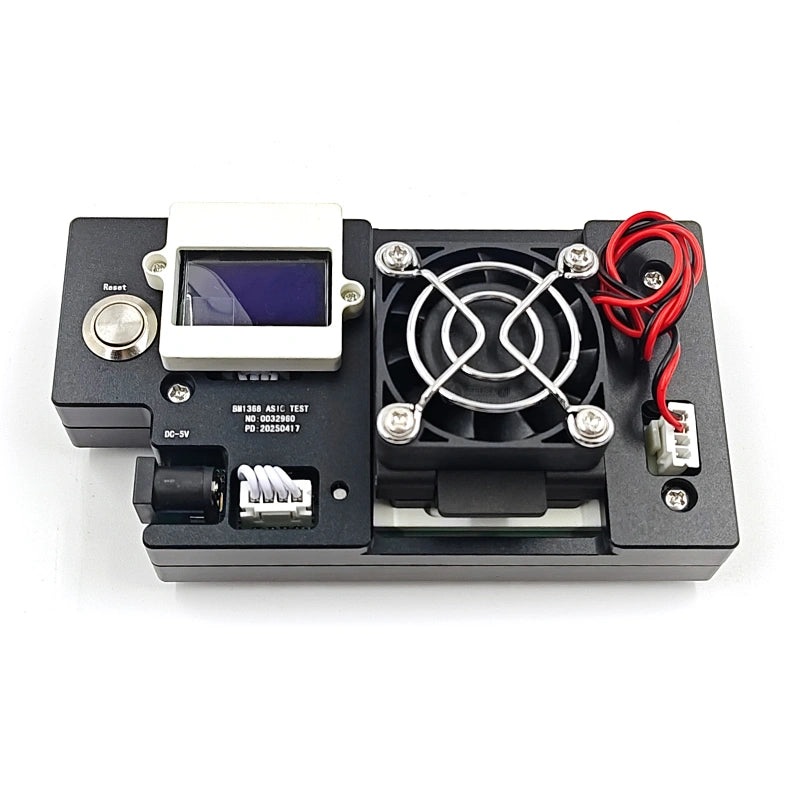
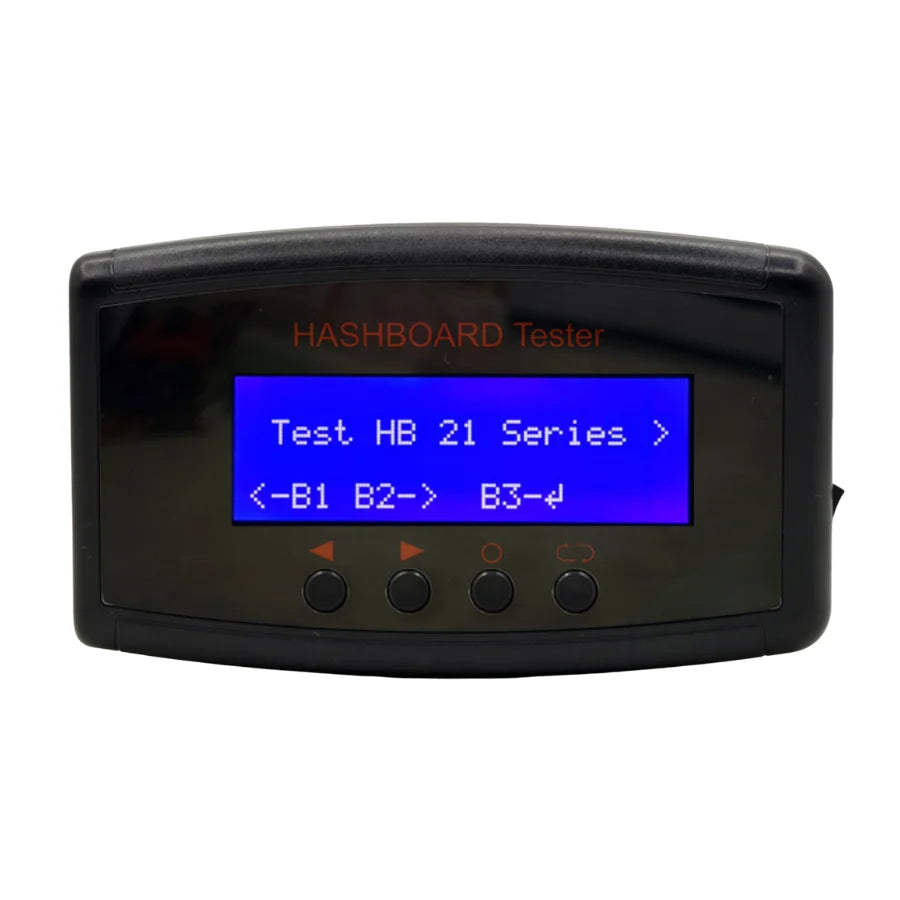
- Universal hashboard test fixture with LCD — runs PT1 (chip detect), PT1+ (chip detect + 50M), and PT2 (functional pattern) tests on a removed S19 Hydro hashboard.
- Constant-temperature soldering iron set to 350–380°C with a pointed tip for SMT work.
- Hot-air BGA rework station for chip removal and placement.
- Solder paste M705 grade, no-clean flux, board washing fluid with anhydrous alcohol.
- Tin balls 0.4 mm diameter for chip ball reattach work.
- Multimeter (Fluke recommended) with welded steel probe needles and heat-shrink sleeves.
- Oscilloscope (Agilent or equivalent) for signal-path verification.
- PICkit3 programmer + MPLAB IPE software for PIC microcontroller reprogramming.
- Thermal compound rated 5W/mK or higher for the water-cooling plate interface.
- Common spare 0402 resistors (0R, 10R, 33R, 100R, 1K, 2K) and 0402 capacitors (0.1µF, 1µF).
- 4 AWG copper wire (under 60 cm) for bench-power leads to the hashboard.
- Modified S19 Hydro test cable (manually adapted) for the test fixture connection.
Diagnostic and Repair Workflow
- Power off and remove the suspect hashboard from the miner — never work on a powered board, and verify the water-cooling plate is fully drained before disassembly.
- Visual inspection — look for scorched components, lifted pads, PCB deformation, or any signs of liquid contamination on the chip side of the PCB.
- Impedance / short-circuit check on every voltage domain before powering. Each domain should rest at approximately 0.37V baseline; a short must be cleared before applying power.
- Power-on the test fixture in the correct sequence: connect the negative copper supply lead first, then the positive copper lead, and finally the signal cable. Reverse this sequence to disconnect.
- Run PT1 chip detection first, then PT1+ (chip detect + 50M), then PT2 functional pattern test once PT1 passes.
- If 0 chips reported, walk the power chain in order: verify hashboard 19V input → check MOS short (resistance pins 1, 4, 8) → measure PIC U3 pin 2 for 3.2V → verify 25V boost at C62 / 28V at C76 → check per-domain LDO outputs (1.8V and 0.8V).
- If the indicator LED is dark, go directly to the PIC: verify 3.3V supply, and reprogram the PIC firmware (PICkit3 + MPLAB IPE + appropriate hex file).
- If exactly 51 or 52 chips detected (half-chain), suspect Y1 or Y2 crystal oscillator failure.
- For ASIC INIT NG with abnormal temperature, consult the sensor index map: {0, 24, 48, 158, 182, 206} → {BM1, BM13, BM25, BM80, BM92, BM104}. Check sensor IC and surrounding passives at that position.
- For INIT NG WATER_TEMP, check U4 and U5 water temperature sensors plus their nearby passives.
- Binary-search fault isolation for incomplete chip detection: short the 1.8V rail to the RO test point between candidate chip boundaries and re-run the chip-find program.
- For chip replacement at 350-400°C hot-air. Pre-tin the new chip pins with M705 paste before placing.
- Re-test on the fixture twice — let the board cool to ambient between runs.
- Re-paste the water-cooling plate with 5W/mK or higher thermal compound before reassembly.
- Re-pressurise and verify cooling-loop flow before powering the repaired board in the chassis.
Operating temperature constraints — water-cooled specifics
The HHB28601 monitoring system trips when miner temperature exceeds 103°C — notably higher than air-cooled S19 series boards (90°C limit). This higher threshold reflects the assumption of active water cooling: never power up a Hydro board on the bench without proper cooling-loop flow or supplemental air cooling, or the cascade failure path (U4/U5 → U3 → BM1/BM2) will trigger within minutes.
When Chip-Level Repair Makes More Sense Than Board Replacement
HHB28601 hashboard replacements are constrained in supply and expensive. For Hydro fleet operators, a small inventory of BM1398BB chips, the most common LDOs (SGM2036-ADJ, TLV74318PDBVR), the power management IC SY7302ABC, plus the water-temperature sensors and the PIC microcontroller covers the majority of repair scenarios. Paired with a hashboard test fixture and the modified S19 Hydro test cable, most dead boards return to full output in under two hours of bench work.
Compatible PSU and Control Board
The S19 Hydro is supported by three Bitmain PSU options: APW9, APW9+, or APW11. LYS Shenzhen stocks the premium APW11 water-cooled power cord and the LP20 aviation plug cable for both APW11 and APW12 connections. The control board ecosystem matches the S19 family and carries the standard U1 FBGA main IC with the OTP one-time-programmable function — a critical detail when flashing firmware via SD card, as a sudden power cut during the 30-second OTP burn permanently bricks the control board.
FAQ — Antminer S19 Hydro HHB28601 Hashboard Repair
How many ASIC chips does an S19 Hydro HHB28601 hashboard carry?
Each HHB28601 hashboard carries 104 BM1398 chips, organised as 52 voltage domains of 2 chips in series (silkscreen sequence BM1 through BM104).
What is the cascade failure mode on the S19 Hydro?
Abnormal water temperature or restricted cooling-loop flow can burn U4 and U5 (water temperature sensors), which propagates to short the PIC chip U3, which removes the 1.8V and 0.8V supplies from the first domain, which burns BM1 and BM2. The full burn-out sequence reads: U4 → U5 → U3 → BM1 → BM2 → U1, U2. Always verify cooling-loop flow and water temperature before powering up a recovered Hydro board.
What PSU does the S19 Hydro use?
The S19 Hydro is supported by three Bitmain PSU options: APW9, APW9+, or APW11. All three are compatible with the HHB28601 hashboard.
What does it mean when an S19 Hydro reports exactly 51 or 52 chips detected?
The HHB28601 uses a dual oscillator topology (Y1 drives BM1-BM51, Y2 drives BM52-BM104). A half-chain detection result almost always indicates failure of Y1 (if the second half is missing) or Y2 (if the first half is missing). Replace the appropriate 25 MHz crystal oscillator.
What is the correct power-on sequence for an S19 Hydro hashboard on the bench?
Connect the negative copper supply lead first, then the positive copper supply lead, and finally plug in the signal cable. Reverse the sequence to disconnect. Wrong order is a common cause of damaged U1 and U2 chips, and on a Hydro board it can additionally trigger the cascade failure path.
Sourcing S19 Hydro HHB28601 Parts
LYS Shenzhen stocks most components listed above for the Antminer S19 Hydro HHB28601 hashboard. For the 2R5TPE330M9 tantalum capacitor, the 4.7µH inductor, or for bulk farm-scale orders, contact our team at contact@lys-sz.com — we operate an on-demand sourcing channel for repair components across the full Antminer Hydro line, including APW11 PSU spares and water-cooling-loop hardware.
Worldwide shipping from our Shenzhen warehouse via DHL, FedEx, UPS, and sea freight. DDP shipping available for US and EU customers; case-by-case for other lanes — request a quote with your shipping country for confirmation.