Antminer S19 Hashboard Repair Guide & Components List (2026 Update)
The Antminer S19 is the original air-cooled SHA-256 workhorse of the BM1398 era — released in 2020 and still hashing across countless industrial operations today. The S19 platform exists in multiple PCB revisions (BHB42801, BHB42821, BHB42831, BHB42841, NBS1902) — most built around the BM1398BB chip, with the later BHB42831 revision transitioning to BM1362AK silicon. This guide focuses on the predominant BM1398-based configuration and covers the full components list with direct sourcing links for every part on the board.
Why S19 Hashboard Repair Still Matters in 2026
The S19 remains one of the most widely deployed BTC miners on the planet. Even five years post-release, large fleets continue running on hosted facilities and in low-cost-power environments where the ~95 TH/s output per unit is still profitable. With full hashboard replacements priced at multiples of component-level repair cost and BM1398 chips widely available on the secondary market, chip-level repair is the most economical path to keep these miners producing — a small bench inventory of the parts below covers the majority of repair scenarios.
Antminer S19 Hashboard Architecture at a Glance
The S19 hashboard is built primarily around the BM1398 ASIC chip family — Bitmain's 7nm SHA-256 hash engine of that generation. The BM1398BB is the predominant revision on most S19 PCB versions, with BM1398AC appearing on some boards.
S19 hashboards exist in several PCB revisions, identifiable by the silkscreen part number on the board:
- BHB42801, BHB42821, BHB42841, NBS1902 — BM1398-based variants (chips per board vary by hashrate bin, typically 76-100 across the production run)
- BHB42831 — later PCB revision that transitioned to BM1362AK silicon, organised as 88 chips across 44 voltage domains of 2 chips each, with a 19V boost stage at chip position U12 supplying the top 8 domains
The S19 ships with the APW12 series PSU (15V output to the hashboard input rail). The control board ecosystem matches the rest of the S19 series and carries the U1 FBGA main IC with the OTP one-time-programmable function — a sudden power cut during the 30-second OTP burn permanently bricks the control board.
Temperature sensing architecture
The S19 hashboard carries two digital temperature sensors mapped to specific positions on the board: an inlet sensor (typically at U7) and an outlet sensor (typically at U10). A failed sensor produces implausible temperature readings — false-high triggers thermal throttling and apparent hashrate loss, false-low can allow the chain to run unsafely hot.
Signal directions on the S19 hashboard
- CLK: generated by the Y1 25 MHz crystal oscillator, flows forward from chip 01 to the final chip. Operating voltage approximately 0.9V.
- RST: enters from the control board, passes through a series resistor voltage divider, flows forward from chip 01 to the final chip. Operating voltage approximately 1.8V.
- CI (TX): enters from the control board, passes through level conversion IC U5, flows forward from chip 01 to the final chip. Operating voltage approximately 1.8V.
- RO (RX): reverse direction — flows from the final chip back to chip 01, returns to the control board through U2.
- BI (BO): flows forward from chip 01 to the final chip.
Most Common S19 Hashboard Failure Modes
- 0 chips detected at boot — walk the power chain: 15V input → 19V boost output → per-domain LDO outputs (1.8V and 0.8V) → chip signal voltages (CLK / CI / RST / RO / BI).
- Cold spots on thermal imaging — one or more chip positions stay cool while neighbours run hot, indicating a non-hashing chip or a localised LDO failure on that domain.
- Hashboard not detected at all — usually a corrupted AT24C02D EEPROM, a dead PIC16F1704 microcontroller, or a missing rail at the connector.
- Hashrate drop with implausible temperature data — frequently a failing LM75A temperature sensor at U7 or U10 triggering thermal throttling. Check the 3.3V supply to the sensor and the surrounding passive components.
- Hard short on a rail — typically a shorted MOSFET (T2N7002AK for small signal or TPHR9003NL for high current); clear shorts before powering up or you will burn additional chips.
- Random reboots under load — usually a degraded bulk capacitor (330µF 30V SMD or 330µF 6240k tantalum) no longer holding rail voltage under transient current draw.
- Boost stage failure — a failed MP1517DR drops the top domains' supply simultaneously and presents as 0 chips detected.
Critical Components — Function & Failure Behaviour
ASIC Hash Engine (BM1398BB)
The BM1398BB is the predominant ASIC on most S19 hashboard PCB revisions (BHB42801, BHB42841, NBS1902). Each chip is QFN-packaged and connected in a series chain — a dead ASIC takes the downstream chips in the same domain offline. ESD damage during handling is the most common failure cause, followed by sustained thermal stress from dried thermal paste. The closely related BM1398AC variant is also encountered on some production runs and is generally compatible.
Microcontroller (PIC16F1704)
The PIC16F1704 microcontroller (despite the article's original label, this is a microcontroller, not an EEPROM) manages the local hashboard protocol and identification. A failed PIC produces a dark indicator LED and prevents the board from being recognised at boot. The PIC can be reprogrammed in place using PICkit3 + MPLAB IPE with the appropriate hex firmware — a useful first step before deciding to replace the IC.
EEPROM (AT24C02D)
The AT24C02D-XHM-T EEPROM (ATH915 marking) stores calibration and chain identification data. A corrupted EEPROM prevents the control board from enumerating the hashboard. Operating voltage 3.3V.
Voltage Regulators (LDOs)
The S19 uses multiple LDOs to derive the various rail voltages: SGM2036-1.8YN5G (SP7KC) for the 1.8V rail, SGM2036-ADJYN5G/TR (SQ7LA) as an adjustable variant, MP2019GN as a 40V adjustable LDO, and LN1134A182MR (4VK4) as a SOT23-5 1.8V regulator. A failed LDO typically takes its entire local domain offline.
Switching Regulator (MP1517DR)
The MP1517DR QFN16 switching regulator provides an adjustable 3.3V output for supporting logic. A failed switcher commonly produces wide-ranging downstream failures because the 3.3V rail is shared across multiple support ICs.
MOSFETs
The S19 uses T2N7002AK small-signal N-channel MOSFETs and TPHR9003NL high-current (30V / 220A) N-channel MOSFETs for the core voltage switching. A shorted high-current MOSFET typically produces a hard short on its drain-source that prevents the PSU from starting the chain.
Temperature Sensor (LM75A)
The LM75A digital temperature sensor (SOP-8 package) is placed at both U7 (inlet) and U10 (outlet) positions on the S19 hashboard. Failures present as missing or implausible temperature readings — first check the 3.3V supply and surrounding passive components before replacing the IC.
Protection Diodes
The MBR0540 Schottky power rectifier (0.5A / 40V SOD-123), B0540W SF Schottky diode (500 mA SOD-123), BZT52C15 (WJ) Zener diode, and 1N4148W (T4) switching diode handle on-board ESD clamping, freewheeling, and signal switching. The MBR0540 specifically appears in the boost stage as a freewheeling diode.
Passive Components
The 330µF 30V SMD aluminium polymer and 330µF 6240k tantalum (KO-CAP) capacitors handle bulk decoupling on the power-delivery stage. The 10µH HPC1050 inductors handle energy storage on the switching stages. Common spare passive inventory should include 0402 resistors (0R, 51R, 10K, 4.7K) and 0402 capacitors (0.1µF, 1µF) for general SMD repair.
Antminer S19 Hashboard Repair Components List
The table below lists every component LYS Shenzhen stocks for S19 hashboard repair. Each entry links directly to the corresponding part page — contact us at contact@lys-sz.com for bulk pricing or for BM1362AK chips if you are repairing the later BHB42831 PCB revision.
| Part Number | Component Type | Typical Position / Role |
|---|---|---|
| 0402 resistors (0R, 51R, 10K, 4.7K) | Resistor spares | General SMD repair stock |
| 0402 capacitors (0.1µF, 1µF) | Capacitor spares | General SMD repair stock |
| BM1398BB / BM1398 | ASIC hash engine | 7nm SHA-256 chip, predominant on most S19 PCB revisions |
| MBR0540 | Schottky power rectifier | 0.5A / 40V SOD-123, boost stage freewheeling |
| B0540W SF | Schottky diode | 40V / 500 mA SOD-123 small signal |
| 10µH (Inductor 100) | Inductor | HPC1050 SMD power inductor on switching stages |
| 330µF 30V SMD | Capacitor | Aluminium polymer bulk filtering |
| 330µF 6240k Tantalum | Tantalum capacitor | Low-ESR polymer KO-CAP, local rail decoupling |
| T2N7002AK | Small-signal MOSFET | Logic-level switching |
| SGM2036-1.8YN5G (SP7KC) | LDO regulator | 1.8V rail supply |
| TPHR9003NL | High-current MOSFET | 30V / 220A N-channel core voltage switching |
| AT24C02D-XHM-T (ATH915) | EEPROM | Calibration / chain ID storage, 3.3V supply |
| PIC16F1704-I/SL | Microcontroller | 8-bit, 7KB Flash, hashboard protocol, reprogrammable |
| MP1517DR | Switching regulator IC | Adjustable 3.3V QFN16 switcher |
| BZT52C15G (WJ) | Zener diode | 15V clamp / protection |
| MP2019GN | LDO regulator | 40V adjustable linear regulator |
| SGM2036-ADJYN5G/TR (SQ7LA) | LDO regulator | Adjustable variant for S17 / S19 / L7 series |
| LN1134A182MR (4VK4) | LDO regulator | SOT23-5, 1.8V fixed output |
| 1N4148W (T4) | Switching diode | 150 mA / 75V high-speed switching |
| LM75A | Temperature sensor | U7 inlet + U10 outlet (2 per board), SOP-8 |
Required Repair Tools & Consumables
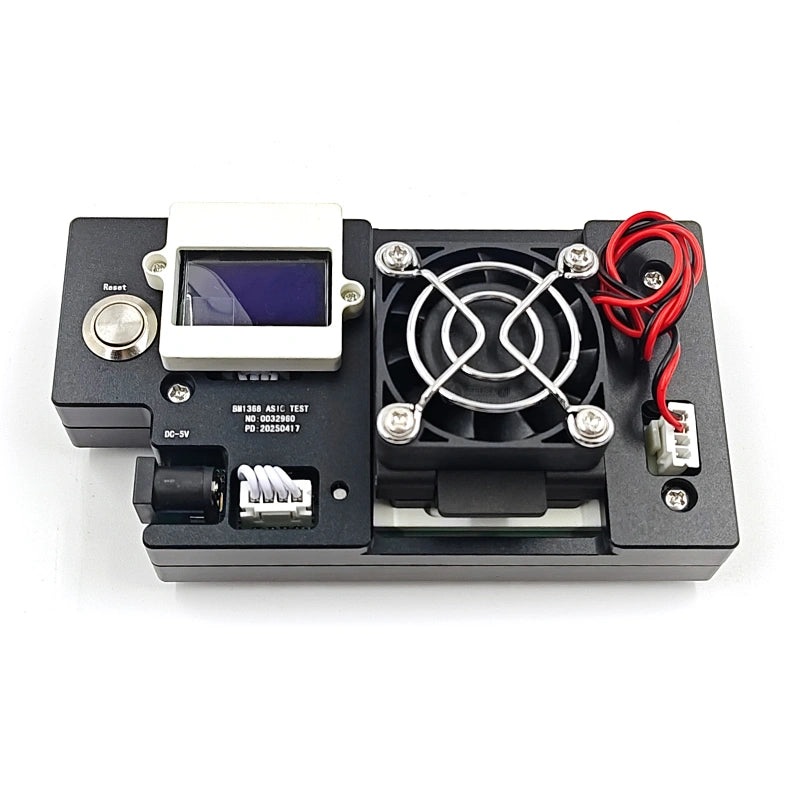
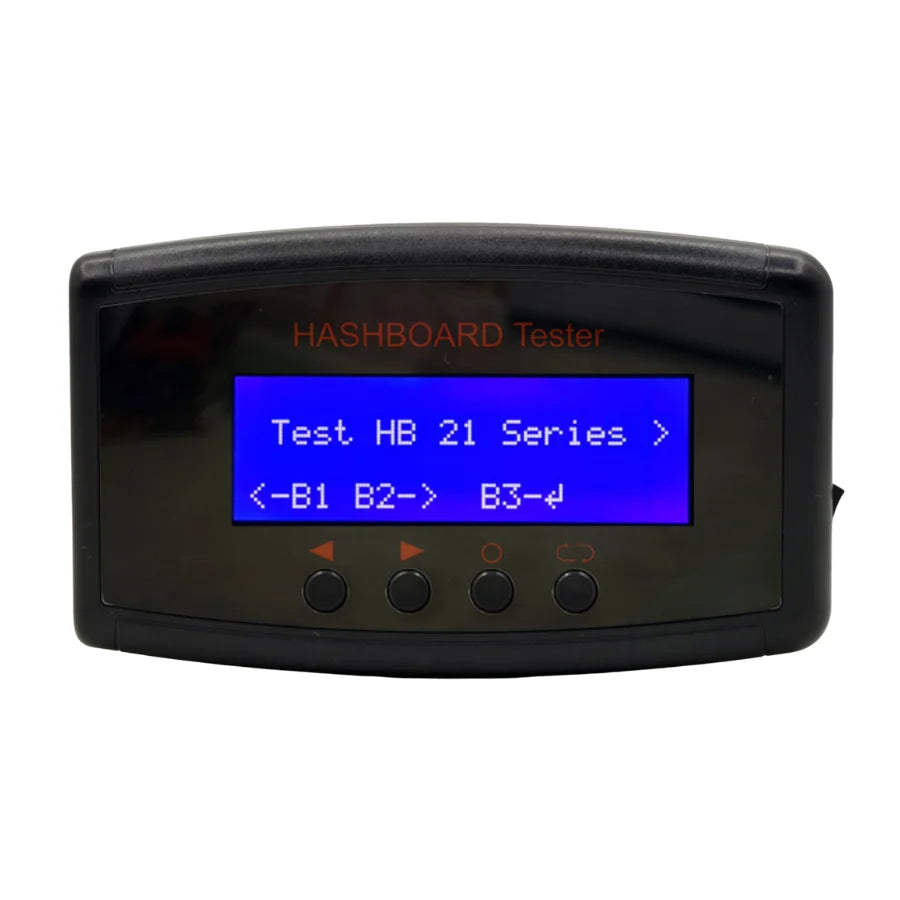
- Universal hashboard test fixture with LCD — runs PT1 (chip detect) and PT2 (functional pattern) tests on a removed S19 hashboard.
- Constant-temperature soldering iron set to 350–380°C with a pointed tip for SMT work.
- Hot-air rework station rated 350–400°C for BGA / QFN chip removal and placement.
- Solder paste M705 grade, no-clean flux, board washing fluid with anhydrous alcohol.
- Tin balls 0.4 mm diameter for chip ball reattach work.
- Multimeter (Fluke recommended) with welded steel probe needles and heat-shrink sleeves.
- Oscilloscope for signal-path verification.
- PICkit3 programmer + MPLAB IPE software for PIC microcontroller reprogramming.
- Thermal compound rated 5W/mK or higher — required for 24/7 mining loads.
- Common spare 0402 resistors (0R, 51R, 10K, 4.7K) and 0402 capacitors (0.1µF, 1µF).
- 4 AWG copper wire (under 60 cm) for bench-power leads to the hashboard.
Diagnostic and Repair Workflow
- Power off and remove the suspect hashboard from the miner — never work on a powered board.
- Visual inspection — look for scorched components, lifted pads, PCB deformation, or impact damage.
- Identify the PCB revision from the silkscreen part number (BHB42801 / BHB42821 / BHB42831 / BHB42841 / NBS1902). If it's BHB42831, the chip is BM1362AK, not BM1398.
- Impedance / short-circuit check on every voltage domain before powering. Each rail short must be cleared before applying power.
- Power-on the test fixture in the correct sequence: connect the negative copper supply lead first, then the positive copper lead, and finally the signal cable. Reverse this sequence to disconnect — wrong order is the most common cause of damaged level-translation and signalling chips.
- Run PT1 chip detection first, then PT2 functional pattern test once PT1 passes.
- If 0 chips reported, walk the power chain: 15V input → 19V boost output → per-domain LDO 1.8V and 0.8V → chip signal voltages (CLK / CI / RST / RO / BI).
- If indicator LED is dark, go directly to the PIC: verify 3.3V supply, then reprogram the PIC firmware via PICkit3 + MPLAB IPE.
- If temperature reading is 0 or implausible, check U7 and U10 LM75A sensor soldering plus the 3.3V supply to each sensor and the nearby passives.
- Binary-search fault isolation for incomplete chip detection: short the local 1.8V rail to the RO test point between candidate chip boundaries and re-run the chip-find program.
- For chip replacement at 350-400°C hot-air. Pre-tin the new chip pins with M705 paste before placing.
- Re-test on the fixture twice — let the board cool to ambient between runs.
- Re-paste the heatsink with 5W/mK or higher thermal compound before reassembly.
- Reinstall and monitor for 24 hours — confirms the board holds full hashrate without temperature anomalies.
When Chip-Level Repair Makes More Sense Than Board Replacement
A complete S19 hashboard replacement, when available, typically costs an order of magnitude more than the components needed for a chip-level repair. For farm operators running multiple S19 units, a small inventory of BM1398BB chips, the most common LDOs (SGM2036-1.8YN5G, MP2019GN, LN1134A182MR), the MP1517DR switching regulator, the AT24C02D EEPROM, the PIC16F1704 microcontroller, and the LM75A temperature sensors covers the majority of bench-repair scenarios. Paired with a hashboard test fixture, most dead boards return to full output in under an hour.
Compatible PSU and Control Board
The S19 ships with the APW12 series PSU (typically the 15V output variant). The control board ecosystem matches the rest of the S19 family and carries the standard U1 FBGA main IC with the OTP one-time-programmable function. A sudden power cut during the 30-second OTP burn permanently bricks the control board — once flashed via SD card, always wait the full 30 seconds before powering off.
FAQ — Antminer S19 Hashboard Repair
What ASIC chip does the S19 use?
The S19 platform primarily uses the BM1398BB ASIC chip (with the closely related BM1398AC also seen on some production runs). The later BHB42831 PCB revision transitioned to the BM1362AK chip — check the silkscreen part number on your board to confirm before ordering chips.
What are the S19 hashboard PCB revisions?
S19 hashboards exist in several revisions: BHB42801, BHB42821, BHB42831, BHB42841, and NBS1902. Most are built with BM1398BB chips; BHB42831 specifically uses BM1362AK organised as 88 chips across 44 voltage domains of 2 chips each. The part number is printed on a sticker on the PCB near the connector edge.
How do I diagnose 0 chips detected on a S19?
Walk the power chain in order: 15V input present → 19V boost output present → per-domain LDO outputs of 1.8V and 0.8V present → chip signal voltages on CLK (~0.9V), CI (~1.8V), RST (~1.8V), and BI in normal range. A break anywhere along this chain localises the fault.
What is the correct power-on sequence for an S19 hashboard on the bench?
Connect the negative copper supply lead first, then the positive copper lead, and finally plug in the signal cable. Reverse this sequence to disconnect. Wrong order is the most common cause of damaged level-translation chips (U2, U5) which then report 0 chips on every subsequent test.
What thermal paste should I use on an S19 hashboard?
Use thermal compound rated 5W/mK or higher. S19 hashboards generate significant continuous heat under 24/7 mining loads, and consumer-grade pastes dry out within months. Re-paste interval depends on environment — 12-18 months in standard hosted facilities, 6-12 months in dusty or hot installations.
Sourcing S19 Hashboard Parts
LYS Shenzhen stocks every component listed above for the Antminer S19 hashboard. For BM1362AK chips (specific to the later BHB42831 revision), for bulk farm-scale orders, or for sourcing of items not currently in our public catalogue, contact our team at contact@lys-sz.com — we operate an on-demand sourcing channel for repair components across the full Antminer line.
Worldwide shipping from our Shenzhen warehouse via DHL, FedEx, UPS, and sea freight. DDP shipping available for US and EU customers; case-by-case for other lanes — request a quote with your shipping country for confirmation.