Antminer S21 Hydro Hashboard Repair Guide & Components List (2026 Update)
The Antminer S21 Hydro is Bitmain's water-cooled flagship of the BM1368 generation — a dramatically denser hashboard than the air-cooled S21, packing twice as many chips per board into the same form factor with active liquid cooling. Two years on, the S21 Hydro fleet is a major share of industrial water-cooled BTC capacity, and the HHB68xxx hashboard repair playbook is materially different from the air-cooled BHB68XXX guide. This 2026 update covers the BM1368PA / PB / AA chip variants, the unique 18-domain × 12-chip topology, the water-cooling cascade failure mode that can burn BM1/BM2 on power-up without proper flow, and the full components list with direct sourcing links.
Why S21 Hydro Hashboard Repair Matters in 2026
Hydro-cooled S21 units occupy industrial mining facilities that prioritise density and noise reduction. With 216 chips per board on the HHB68xxx versus 108 on the air-cooled S21 BHB68XXX, a single dead ASIC has a smaller impact on whole-board hashrate — but a failed cooling loop has a larger impact, because the higher chip density means thermal runaway propagates faster. Component-level repair restores full hashrate at a fraction of board-replacement cost, and the BM1368 chip family used on the S21 Hydro is cross-compatible as repair stock with the rest of the S21 line.
Antminer S21 Hydro Hashboard Architecture at a Glance
The S21 Hydro hashboard is built around the BM1368 ASIC chip family — same chip generation as the air-cooled S21 and T21, with BM1368PA, BM1368PB, and BM1368AA being the predominant silicon revisions in service. The chips are LGA-packaged (6 mm × 8 mm footprint), requiring the same dedicated stencil tool as the air-cooled platform.
Each HHB68xxx hashboard carries 216 BM1368 chips, organised as 18 voltage domains of 12 chips in series each (silkscreen sequence BM1 through BM216). The nominal domain operating voltage is approximately 1.1V at rest. A complete S21 Hydro miner uses 3 hashboards per chassis, for a total of 648 chips across the unit.
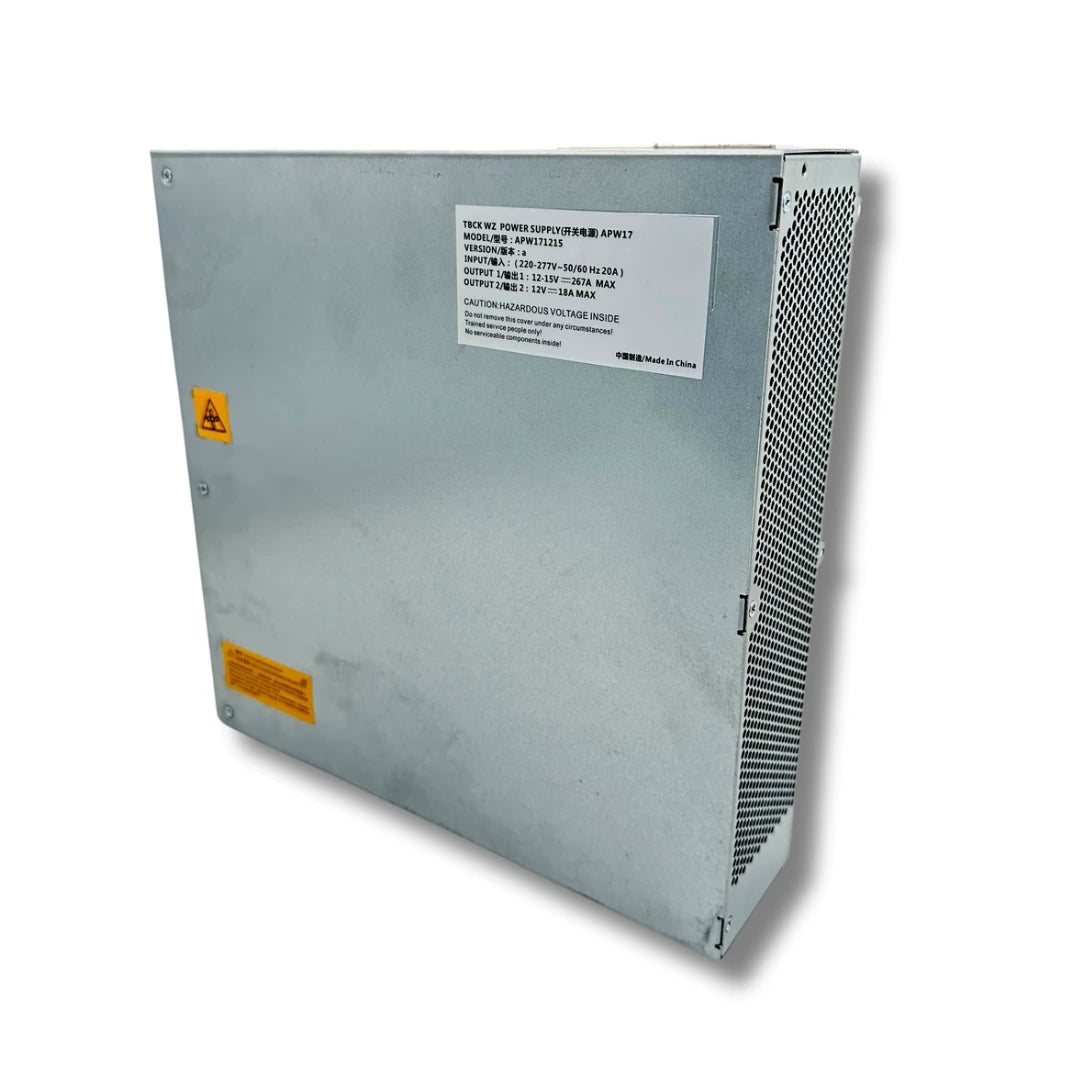
The S21 Hydro ships with the APW111721X PSU — a power-calibrated unit specifically required for PT3 SWEEP testing. PT1 chip detection can be run with the more conventional APW9, APW9+, or APW11 PSU options on the bench, but production PT3 testing requires the calibrated APW111721X.
Per-domain power topology — denser LDO stage than air-cooled S21
The HHB68xxx power architecture is denser than the BHB68XXX air-cooled variant because each domain feeds 12 chips instead of 9:
- Domains 1 to 16 (standard): each domain uses 4 LDOs — one outputting 1.2V (VDDIO) and three outputting 0.8V (chip core). Each 0.8V LDO supplies 4 chips, partitioning the 12-chip domain into 3 sub-groups.
- Domains 17 and 18 (high-voltage): each uses two MP2019 LDOs at positions U310/U307 and U313/U315 to first generate 2V, which then supplies the local 1.2V / 0.8V LDOs. Specifically U311/U312 (1.2V and 0.8V) are powered by U310; U308/U309 are powered by U307; and the remaining MP2019s U313 and U315 supply the additional 0.8V LDOs. A failed MP2019 on either high-voltage domain takes its entire 12-chip domain offline.
Architectural carry-overs and additions vs T21 / S21 air-cooled
The HHB68xxx shares two structural features with the BHB68XXX air-cooled S21/T21:
- No PIC, no MOS circuit — the BM1368 generation integrates what older PIC + MOS chips handled on BM1362 / BM1398 hashboards.
- Level shifters at domain boundaries: 17 op-amps on the HHB68xxx (vs 11 on the air-cooled BHB68XXX), from domain 2 onward. Level shifters 0-7 and 9-13 derive power from the 5-domain stack voltage; level shifters 8, 14, and 15 are powered by a dedicated MP2019 at position U1.
The presence of 17 op-amps versus 11 on the air-cooled platform reflects the higher domain count (18 vs 12). When PT1 or PT3 reports a fault concentrated at a 2-domain handover position, the op-amp at that boundary is the first place to check — exactly the same diagnostic shortcut as on the air-cooled platform.
HHB68xxx boost circuit
The boost stage takes VDD_IN through chip U9 and steps it up to approximately 25V. This boosted rail feeds the level-shifter supplies on the high-voltage end and supports the dual-MP2019 chain for domains 17 and 18.
HHB68xxx signal directions
- CLK: generated by the Y1 25 MHz crystal oscillator, flows forward from BM1 to BM216. Operating voltage approximately 0.58-0.6V.
- TX (CI / CO): enters at pin 7 of the IO interface at 3.3V, passes through level-shifting IC U2, flows forward from BM1 to BM216. Operating voltage approximately 1.1V.
- RX (RI / RO): reverse direction — flows from BM216 back to BM1, returns to pin 8 of the signal cable through U1, then to the control board. Operating voltage approximately 1.1V.
- BO (BI / BO): flows forward from BM1 to BM216.
- RST: enters at pin 3 of the IO interface, passes through R216, flows forward from BM1 to BM216. Operating voltage approximately 1.2V.
Chain numbering: Chain0 = board 1, Chain1 = middle board, Chain2 = board adjacent to the PSU.
Water-Cooling Specifics — and the Cascade Failure Path
S21 Hydro bench operations must meet specific water-cooling parameters to avoid burning the board:
- Water flow rate: 3 to 3.5 L/min per hashboard.
- Water temperature: 32 to 35°C operating range. Below 32°C or above 35°C, PT3 testing will not proceed.
- Cooling required for PT1 too: never run PT1 without the water-cooling plate installed and a working water flow, or chips will overheat and the board will burn within minutes.
- Bench cooling option: where a calibrated water-cooling radiator is unavailable, an external water pump in series with auxiliary air-cooling fans can be used for short test runs. Production calibration always uses the full PT3 water-cooling rig.
Cascade failure path: abnormal water temperature or restricted flow burns U4 and U5 (water temperature sensors), which removes the 1.2V and 0.8V supplies from the first domain, which burns BM1 and BM2. The cascade reads: water temp anomaly → U4/U5 burn → first-domain LDO outputs die → BM1/BM2 burn. Always verify water flow and water temperature before powering up a recovered S21 Hydro board.
Most Common S21 Hydro Hashboard Failure Modes
- 0 chips detected at boot (PT1) — walk the power chain: VDD_IN present → 25V boost output at U9 → per-domain LDO 1.2V and 0.8V → chip signal voltages.
- EEPROM NG on test fixture LCD — check U6 AT24C02C-XHM-T EEPROM soldering. Note this is a different EEPROM variant from the AT24C02C used on the air-cooled S21.
- Sensor NG (sensor=0 or sensor=1) — sensor index maps to U4 (sensor=0, inlet) or U5 (sensor=1, outlet) TMP75 temperature sensor. Note that the air-cooled S21 uses the S75 sensor — the Hydro uses TMP75 specifically. Check sensor IC, adjacent passives, and the 3.3V supply at J1.
- INIT NG WATER_TEMP — abnormal water inlet/outlet temperature reading. Check U4, U5 and their surrounding SMD components.
- P:1 overheating protection on whole-machine test — water temperature too high or flow rate too low. Check cooling-loop integrity before powering up again, otherwise the cascade failure path may trigger.
- JX:1 bad ASIC chip — usually a thermal contact issue first (check water-cooling plate seating), then suspect chip die damage.
- Fault at the 2-domain handover position — almost always the op-amp / level-shifter at that boundary. Check the appropriate level shifter from the 17-shifter array.
- Pattern NG with low nonce response (PT3) — chip die damage, virtual soldering, or bridging on the affected positions.
Critical Components — Function & Failure Behaviour
ASIC Hash Engine (BM1368 family)
The BM1368 family powers the HHB68xxx. BM1368PA is the predominant revision shipped on Hydro boards, with BM1368PB and BM1368AA also in service. Each chip is LGA-packaged with a 6 mm × 8 mm footprint, requiring the dedicated BM1368 stencil for reballing. The BM1368 chip family is cross-compatible across S21, T21, S21 IMM, S21 Hydro, and S21 Pro hashboards — same repair stock covers the full S21 line.
Voltage Regulators (LDOs & high-voltage stage)
The hashboard uses 4 LDOs per standard domain (1× 1.2V + 3× 0.8V), with the high-voltage domains 17 and 18 powered through two MP2019 LDOs each (positions U310, U307, U313, U315) producing 2V. The 0.8V chip-core supplies follow the BA1U / BA2X LDO pattern shared with the rest of the BM1368 line.
Boost Regulator (SY7304DBC)
The SY7304DBC (VIDKB) current-mode boost regulator supports the boost stage at U9. A failed boost drops the upper-domain supplies and the level-shifter rails simultaneously.
Level Shifters / Op-Amps
The SGM8304YTS14 100 MHz high-voltage operational amplifier handles the level-shift and signal-addition operations at the 17 domain-boundary positions. When PT1 or PT3 reports a fault concentrated at a domain handover, this is the first IC to check.
EEPROM (AT24C02C-XHM-T) — Hydro-specific variant
The AT24C02C-XHM-T (02CMPH) EEPROM at U6 stores calibration and chain identification. Note that the air-cooled S21 uses the GT24C02A variant — these EEPROMs share the same I²C protocol but are not necessarily drop-in interchangeable for repair stock; match the original part for consistency.
Temperature Sensor (TMP75) — Hydro-specific choice
Two TMP75 digital temperature sensors at positions U4 (inlet) and U5 (outlet) monitor water/board temperature. The Hydro uses TMP75 specifically — the air-cooled S21 uses the S75 sensor at different positions. Always verify the 3.3V supply at J1 before replacing the sensor IC.
Protection Diode
The DSK24 Schottky diode (2A / 40V) handles freewheeling and reverse-polarity protection.
Passive Components
The 330µF 30V SMD aluminium polymer capacitors and the EEFGX0D471R 470µF SMD capacitor handle bulk decoupling on the power-delivery stage. The 10µH HPC1050 inductors handle the boost-stage energy storage. The 1R80 1206 SMD resistor serves as a current-sense element. Common spare passive inventory includes 0402 resistors (0R, 33Ω±1%, 10K) and 0402 capacitors (1µF, 22µF).
Oscillator (SJK 25.000)
The SJK 25.000 25 MHz crystal oscillator at Y1 provides the chain timing reference. A failed oscillator prevents the chain from initialising entirely — no chips will enumerate without a working clock.
Antminer S21 Hydro Hashboard Repair Components List
The table below lists every component LYS Shenzhen stocks for S21 Hydro hashboard repair. Each entry links directly to the corresponding part page — contact us at contact@lys-sz.com for bulk pricing, for BM1368 chip variants not currently in stock, or for the 1R80 SMD 1206 resistor.
| Part Number | Component Type | Typical Position / Role |
|---|---|---|
| BM1368 PB / PA / AA | ASIC hash engine | 5nm SHA-256, 216 per board across 18 domains × 12 chips (LGA 6×8 mm) |
| MP2019 (SOP8) | LDO regulator | 2V supply for high-voltage domains 17/18 at U310/U307/U313/U315 |
| 1R80 SMD 1206 | Resistor | Current-sense / shunt — contact us for stock check |
| Inductor 100 (10µH) | Inductor | HPC1050 SMD boost-stage energy storage |
| DSK24 | Schottky diode | 2A / 40V freewheeling diode |
| SY7304DBC (VIDKB) | Boost regulator IC | Current-mode boost at U9 → 25V |
| AT24C02C-XHM-T (02CMPH) | EEPROM | U6 — calibration / chain ID storage (Hydro-specific variant) |
| 330µF 30V SMD | Capacitor | Bulk filtering on power-delivery stage |
| SGM8304YTS14 | Operational amplifier | 17 level shifters across domain 2-18 handovers |
| TMP75 | Temperature sensor | U4 inlet + U5 outlet (Hydro-specific vs S75 on air-cooled) |
| SJK 25.000 | Crystal oscillator | 25 MHz reference at Y1 |
| EEFGX0D471R 470µF | Capacitor | Bulk decoupling (Hydro-specific addition) |
Required Repair Tools & Consumables
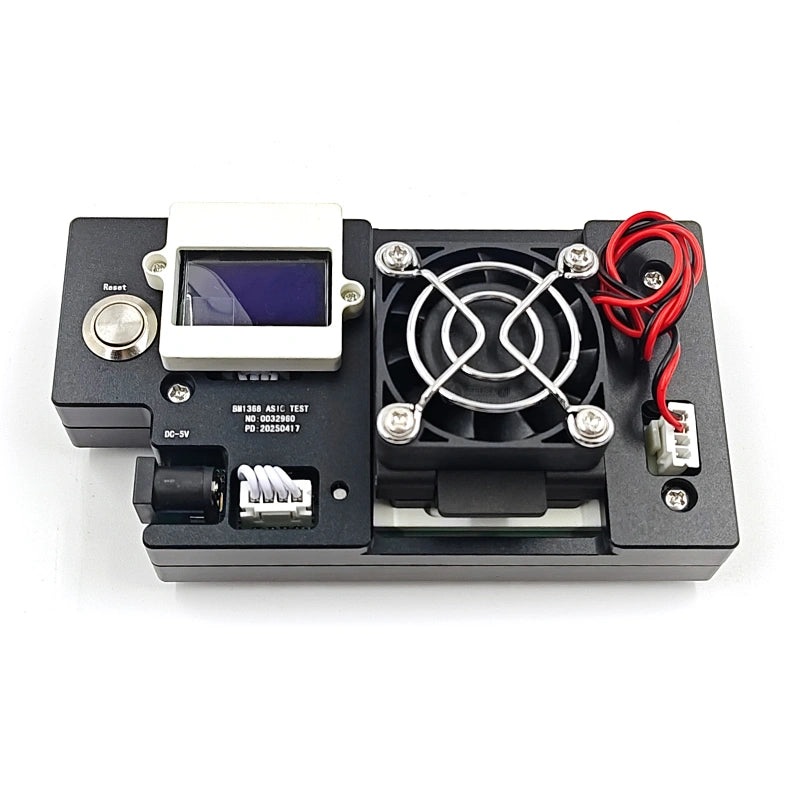
- Universal hashboard test fixture with LCD — supports PT1 and PT3 on HHB68xxx. The 19-series fixture requires the B047 firmware flash for S21 Hydro compatibility.
- BM1368 LGA 6×8 mm tin stencil — dedicated to the BM1368 chip footprint.
- Constant-temperature soldering iron set to 350–380°C with a pointed tip for SMT work.
- Hot-air rework station at 350±10°C for BGA / QFN / LGA chip removal and placement.
- Solder paste M705 grade, no-clean flux, board washing fluid with anhydrous alcohol.
- Tin balls 0.4 mm diameter for chip ball reattach work.
- Multimeter (Fluke recommended) with welded steel probe needles and heat-shrink sleeves.
- Oscilloscope for signal-path verification.
- Water-cooling test rig: water pump (added in series if first-generation radiator is insufficient), 8 mm air-pipe connectors, optional auxiliary air-cooling fans.
- Thermal compound rated 5W/mK or higher for the water-cooling plate interface.
- Common spare 0402 resistors (0R, 33Ω±1%, 10K) and 0402 capacitors (1µF, 22µF).
- 4 AWG copper wire (under 60 cm) for bench-power leads to the hashboard.
Diagnostic and Repair Workflow
- Power off and drain the cooling loop before removing the hashboard from the chassis — never work on a powered or pressurised board.
- Visual inspection — look for scorched components, lifted pads, PCB deformation, water-contact damage, or impact marks.
- Impedance / short-circuit check on every voltage domain and the 3.3V rail. A 3.3V short can cascade and burn U4/U5 sensors on power-up.
- Set up the bench cooling rig: connect water flow at 3-3.5 L/min and verify water temperature in the 32-35°C range before powering. Without proper cooling the board will burn within minutes.
- Power-on the test fixture in the correct sequence: connect the negative copper supply lead first, then the positive copper lead, and finally plug in the signal cable. Reverse the sequence to disconnect.
- Run PT1 chip detection with the heatsink installed (PT1 supports APW9 / APW9+ / APW11 PSU; PT3 SWEEP requires the calibrated APW111721X).
- If 0 chips reported, walk the power chain: VDD_IN → 25V boost output at U9 → per-domain LDO 1.2V and 0.8V → chip signal voltages (CLK ~0.6V, CI ~1.1V, RST ~1.2V).
- If sensor NG, check U4 (sensor=0, inlet) and U5 (sensor=1, outlet) plus the 3.3V supply at J1.
- If P:1 overheating reported, verify water flow and water temperature BEFORE re-powering — the cascade failure path will burn U4/U5/BM1/BM2 if cooling is not restored.
- If fault at a domain handover position, check the appropriate level shifter from the 17-shifter array (op-amps at U1 plus shifters 0-15 across domain boundaries).
- Binary-search fault isolation for incomplete chip detection: short the 1.2V rail to the RO test point between candidate chip boundaries.
- For chip replacement: use the BM1368 LGA stencil to pre-tin the chip pins with M705 paste before placing on the PCBA.
- Re-test on the fixture twice — let the board cool to ambient between runs.
- Re-apply thermal grease to the water-cooling plate before reinstallation. Skipping this step will cause whole-machine thermal anomalies.
- Reinstall, re-pressurise the cooling loop, verify flow, then monitor for 24 hours.
Operating temperature constraints
The HHB68xxx monitoring system enforces a PCB temperature max of 80°C and chip temperature max of 95°C. Above either threshold the firmware alarms and stops the miner. Water outlet temperature exceeding 45°C also triggers thermal anomaly events. The two on-board temperature sensors (U4 inlet, U5 outlet) are the only thermal monitoring points — a single failed sensor can mask a real issue on the other zone.
When Chip-Level Repair Makes More Sense Than Board Replacement
HHB68xxx replacement boards are constrained in supply and priced at multiples of component cost. For Hydro fleet operators, a small inventory of BM1368 chips (PA/PB/AA — same stock as the air-cooled S21 line), the MP2019 LDOs for high-voltage domain repair, the SGM8304YTS14 op-amp modules for level-shifter issues, plus the TMP75 sensors, AT24C02C EEPROM, and standard passives covers the majority of bench-repair scenarios. Paired with a hashboard test fixture and a proper water-cooling test rig, most dead boards return to full output in under two hours.
Compatible PSU
The S21 Hydro production unit uses the APW111721X PSU. PT3 SWEEP testing requires this calibrated PSU specifically. PT1 chip detection can be performed with the conventional APW9, APW9+, or APW11 PSU options on the bench, but the SWEEP functional test will not produce valid results without the APW111721X. LYS Shenzhen stocks the APW11 water-cooled power cord for bench-side connections.
FAQ — Antminer S21 Hydro Hashboard Repair
How many ASIC chips does an S21 Hydro hashboard carry?
Each HHB68xxx hashboard carries 216 BM1368 ASIC chips, organised as 18 voltage domains of 12 chips in series each (silkscreen sequence BM1 through BM216). A complete S21 Hydro miner uses 3 hashboards, for a total of 648 chips — twice the chip count of an air-cooled S21 of the same generation.
Can I use the same BM1368 chips for S21 Hydro and air-cooled S21?
Yes. The BM1368 family (PA, PB, AA, PV, PM) is cross-compatible across S21 Hydro, S21 air-cooled, T21, S21 IMM, and S21 Pro hashboards. The same repair stock covers the full S21 line.
What PSU does the S21 Hydro use?
The S21 Hydro production unit uses the APW111721X PSU. For bench testing, PT1 chip detection can use the conventional APW9, APW9+, or APW11 PSU, but PT3 SWEEP functional testing requires the calibrated APW111721X — the standard PSUs do not produce valid SWEEP test results.
What is the cascade failure mode on the S21 Hydro?
Abnormal water temperature or restricted cooling-loop flow burns U4 and U5 (water temperature sensors), removes the 1.2V and 0.8V supplies from the first domain, and burns BM1 and BM2 chips. Always verify water flow rate (3-3.5 L/min) and water temperature (32-35°C) before powering a recovered Hydro board.
What does it mean when PT1 / PT3 reports a fault at a domain handover position?
The HHB68xxx carries 17 operational amplifiers (level shifters) at the boundaries between each pair of domains from domain 2 onward — two more than the 11 op-amps on the air-cooled BHB68XXX because the Hydro has 18 domains instead of 12. A fault concentrated at a handover position is almost always the op-amp at that boundary.
Sourcing S21 Hydro Hashboard Parts
LYS Shenzhen stocks every component listed above for the Antminer S21 Hydro hashboard. For BM1368 chips in any silicon revision (PA / PB / AA / PV / PM), the BM1368 LGA stencil tool, the 1R80 SMD 1206 resistor, the APW111721X PSU, or for bulk farm-scale orders, contact our team at contact@lys-sz.com — we operate an on-demand sourcing channel for repair components across the full S21 Hydro line, including water-cooling-loop hardware.
Worldwide shipping from our Shenzhen warehouse via DHL, FedEx, UPS, and sea freight. DDP shipping available for US and EU customers; case-by-case for other lanes — request a quote with your shipping country for confirmation.