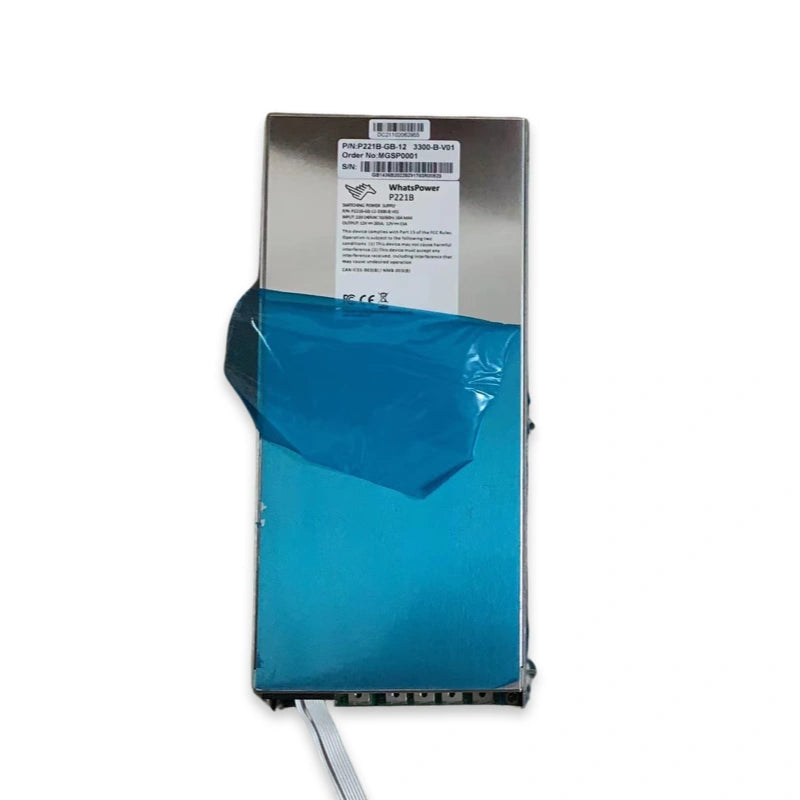
Whatsminer P221C / P222C Power Supply Unit Repair Guide & Components List (2026 Update)
The MicroBT Whatsminer P221C is the modern 220-240V AC PSU powering the Whatsminer M50, M32, M31, M30, M30S, M30S+, M30S++, and M20 series miners — 12V output at 16A rated current, sitting between the older P21 generation and the newer P22x family. The P221C and its higher-power sister P222C (3300W variant for M30S / M30S++ / M50 generation) share architecture but differ in output capacity. This guide covers the P221C / P222C / P221B / P222B replacement workflow, the 10+ critical IC-level components for chip-level repair (SGM48524XS8 dual gate driver, TP1941-TR voltage comparator, SN74AUC2G32DCTR logic gate, OB2268CP / OB2276CP PWM controllers, SLM346 optoisolated gate driver), the M6 conductive copper bar reinstallation procedure, and the full repair playbook with direct sourcing links — complementing our P21 PSU repair guide for full Whatsminer PSU generational coverage.
Why Whatsminer P221C PSU Repair Matters in 2026
The P221C is the volume-deployed PSU for the M50 mining cohort — the largest single Whatsminer fleet currently operating in 2026 at ~110-120 TH/s per miner. When a P221C fails, the symptoms are immediate and unmistakable: cooling fan stops running, miner cannot start, or the hashrate begins fluctuating wildly. Replacement is typically the fastest path back to hashrate, but component-level repair on the failed PSU saves substantial cost for fleet operators carrying spare PSUs as repair stock. A small bench inventory of the P221C BOM — SGM48524XS8 gate driver, TP1941-TR voltage comparator, SN74AUC2G32DCTR logic gate, OB2268CP / OB2276CP PWM controllers, SLM346 / SLM346CK-DG isolated gate drivers, plus the standard bridge rectifiers, capacitors, and MOSFETs — covers the majority of bench-repair scenarios.
Whatsminer P22x PSU Family Cross-Compatibility
The MicroBT P22x PSU family follows a consistent architectural pattern with sub-variants for different output capacities:
- P221B / P221C: 2700-2900W class PSU for the M30S / M30S+ / M31 / M50 miner family. P221B = earlier variant; P221C = current production.
- P222B / P222C: 3300W class PSU for the higher-power M30S++ / M50S / M50S+ / M50S++ / M53 / M60 miner family. P222B = earlier variant; P222C = current production.
- Cross-shared components: many ICs are shared across the P221/P222 family — SLM346 / SLM346CK-DG isolated gate drivers explicitly cover P221B / P221C / P222B / P222C; SLM346 optodriver covers all P221/P222 variants; OB2268CP + OB2276CP PWM controllers cross-apply across the P222B/C generation.
- Whatsminer M50 conductive copper sheet: shared between P221B and P222B output bus connections.
- VF60381BX 6cm fan: shared cooling fan across P221 / P222 family.
This cross-compatibility means a single repair-bench inventory covers the entire Whatsminer M30S / M50 generation PSU lineup. The older P21 PSU uses a different IC family (NCP1399AC LLC controller + STM32F334 MCU + GP47S60X / IPA60R060P7 / JCS12N65FT / STW48N60DM2 / OSG65R069HS MOSFETs) and is covered in its own dedicated guide.
P221C / P222C PSU Architecture at a Glance
The P221C is a PFC-fronted LLC half-bridge switching supply with secondary-side synchronous rectification:
- AC input: 220-240V AC, single-phase, 16A rated input current
- DC output: 12V at the rated wattage (P221C class typically 2700-2900W; P222C class 3300W)
- PFC stage: power factor correction front-end converting AC to DC bus
- LLC half-bridge: PWM-controlled main switching with isolated gate drive (SLM346 / SLM346CK-DG)
- PWM controllers: OB2268CP (current-mode PWM) + OB2276CP (PWM control IC) drive the primary stage on the P222B/C variants
- Gate driver: SGM48524XS8 dual gate driver (P221C-specific) handles the high-current pulses for the primary MOSFETs
- Secondary control: TP1941-TR (C4TG8) voltage comparator + SN74AUC2G32DCTR logic gate (both P221C-explicit components) handle the feedback and protection logic
- Output stage: synchronous rectification MOSFETs feed the 12V output bus via M6 copper bar connections to the hashboard
- Cooling: VF60381BX 6cm fan (shared across P221/P222) for internal airflow
- Output connector: M6 conductive copper bars to the hashboard (no PCIE 6-pin connectors like Bitmain APW7)
Component-level architecture (chip-level repair stock)
- PWM control ICs: OB2268CP current-mode PWM control IC and OB2276CP PWM control IC drive the primary switching on the P222B/C variants.
- Isolated gate drivers: SLM346 optodriver isolated gate driver (full P221/P222 cross-shared) and SLM346CK-DG gate driver (5kV 2.5A) (explicit P221B/P221C/P222B/P222C cross-shared) handle the isolated gate drive between primary and secondary sides.
- Primary gate driver: SGM48524XS8 dual gate driver (P221C-explicit) drives the primary LLC half-bridge MOSFETs.
- Voltage comparator: TP1941-TR (C4TG8) voltage comparator (P221C-explicit) handles voltage-threshold detection on the feedback loop.
- Logic gate: SN74AUC2G32DCTR logic gate (P221C-explicit) handles digital combinational logic on the control circuit.
- Cooling fan: VF60381BX (Q23U / S9H) 6cm fan (P221/P222 shared) handles internal PSU airflow.
- M6 copper bar interface: Whatsminer M50 conductive copper sheet (P221B / P222B) for the output bus connection between PSU and hashboard.
- 4-pin fan simulator: Whatsminer 4-pin fan simulator (P21 / P221 / P222) for bench testing or immersion-cooling deployments where the fan is bypassed.
- Standard repair BOM: capacitors, bridge rectifiers, relays, 4P interfaces, resistors, MOSFETs, silicon AF transistors — typical PSU repair stock (each part typically stocked in batches of 20 per BOM kit).
Complete PSU Replacement Units
When the failure is widespread (multiple ICs damaged, PFC sub-board burned, or operator prefers fast turnaround over chip-level rebuild), complete PSU replacement units are available:
- Whatsminer P222C 3300W PSU (M30S / M31S / M30) — current-production P222C complete unit
- Whatsminer P222B PSU (brand new) — earlier P222B variant complete unit
Both replacement options ship from LYS Shenzhen — contact us at contact@lys-sz.com for the P221C / P221B replacement variants (typically sourced on-demand due to demand variability).
Most Common P221C / P222C PSU Failure Modes
- Cooling fan stops running — the fastest visible failure symptom. The VF60381BX 6cm fan can fail mechanically (bearing wear, blade obstruction) or electrically (fan control circuit). Replace the VF60381BX fan with same spec.
- Miner cannot start (no output voltage) — most common cause is a primary-side failure (input fuse blown, primary MOSFETs shorted, PWM controller IC failure, or PFC stage MOSFET failure). Start diagnostic at the AC input fuse, then work through the PFC and LLC stages.
- Hashrate fluctuating (output voltage instability) — degraded secondary-side filter capacitors or marginal output stage MOSFETs. Output ripple should be measured under load (multimeter in AC mV mode on the 12V output).
- PWM controller failure — failed OB2268CP or OB2276CP stops the primary stage from oscillating. Verify VCC at the PWM IC and gate-drive output on the primary MOSFETs.
- Isolated gate driver failure — failed SLM346 or SLM346CK-DG breaks the gate drive between primary and secondary sides. Diagnostic: primary-side switching waveform present but secondary side dead.
- Primary gate driver failure (SGM48524XS8) — failed SGM48524XS8 dual gate driver on the P221C drops the gate-drive signal to the primary MOSFETs. Check the gate-drive waveform on the primary MOSFETs while powered.
- Voltage comparator drift (TP1941-TR) — degraded TP1941-TR (C4TG8) voltage comparator drifts the threshold detection on the feedback loop, leading to over-voltage or under-voltage trips.
- Logic gate failure (SN74AUC2G32DCTR) — failed SN74AUC2G32DCTR logic gate breaks the control logic chain — depending on the gate's function in the design, the result is no startup, no shutdown, or a stuck protection state.
- Bridge rectifier damage from dust / surge — input bridge rectifiers can short after dust accumulation creating a leakage path between pins. Replace the bridge, install protective bushings on the 4 pins, apply fresh thermal paste between the bridge and heatsink.
- Conductive copper bar loose / oxidised — the M6 copper-bar connection between the PSU output and the hashboard can loosen from thermal cycling. Torque-check the M6 screws at every maintenance interval. A loose copper bar presents identically to a dead PSU on the load side. Replace the Whatsminer M50 conductive copper sheet if visibly oxidised or warped.
P221C PSU Replacement Procedure (Whatsminer M50 example)
When component-level repair is not the right path (multiple ICs damaged, operator needs miner back online fast, or no qualified repair tech available), complete PSU replacement is the most reliable solution. The documented procedure for a Whatsminer M50:
- Power off and disconnect the miner from AC. Wait at least 5 minutes for capacitor discharge before opening the case.
- Disassemble the control board cover: unscrew the cover plate above the PSU, exposing the data cable + power connections.
- Disconnect the data cable connecting the control board to the power supply (note the connector orientation before unplugging).
- Unscrew the M6 conductive copper bars connecting the PSU to the hashboard. Note the positive (+) and negative (-) orientation before separating.
- Unscrew the fixing screws on both sides of the PSU chassis.
- Unplug the fan cable from the air outlet on the PSU.
- Remove the failed PSU from the chassis.
- Inspect the replacement PSU: verify the backup P221C unit is intact, no physical damage, no loose screws or wires.
- Install the replacement PSU: align with the screw holes on the miner case, fix in place with the side screws.
- Plug the fan cable into the air outlet jack on the new PSU.
- Reattach the conductive copper bars: align with the screw holes on the power output end. Connect positive (+) and negative (-) correctly — incorrect polarity will damage the miner. The screw washers fixing the copper bar must be aligned parallel to the edge of the copper bar — otherwise a short circuit can damage the miner. Torque the M6 screws to manufacturer spec.
- Reconnect the data cable from control board to PSU.
- Install the cover plate above the PSU.
- Power on the PSU to start the M50. Verify normal operating status: hashrate ramps to expected nameplate, fan speeds report normal in the web backend, no error codes.
Critical Safety Warnings
- 5-minute capacitor discharge wait before opening the chassis — internal PSU capacitors store lethal high voltage even after AC disconnect.
- Polarity check before powering on — M6 copper bar positive/negative reversed will damage the hashboard and PSU on first power-on.
- Washer alignment check — screw washers MUST be parallel to copper bar edge to avoid short circuit between adjacent terminals.
- Torque check — loose copper bar bolts are a documented failure mode (factory ships at 2.0 N·m, but proper spec for sustained operation is 2.5-3.5 N·m per field data from the P21 generation; verify P221C torque spec with manufacturer documentation if available).
- ESD precautions for chip-level repair on PSU control boards.
- Never bypass the AC input fuse with wire or higher-rated fuse — protects the PSU and your AC distribution.
P221C BOM Repair Kit vs Complete PSU Replacement
Operators have two paths when a P221C fails:
| Approach | When to choose | Cost vs Time tradeoff |
|---|---|---|
| Chip-level repair with P221C BOM kit (capacitors + bridge rectifiers + relays + MOSFETs + PWM ICs + isolated gate drivers + voltage comparators) | Single-component failure identified via diagnostic; operator has bench skill + equipment; multiple PSUs to repair (amortise the BOM kit cost across fleet) | Lower per-PSU cost (~$200 for the BOM kit covers ~20 units per part). Longer time per unit (~2-4 hours bench work). Higher risk of latent failure if repair quality is poor. |
| Complete PSU replacement | Multiple ICs damaged; PFC sub-board burned; operator needs fastest possible turnaround; single PSU fault without fleet | Higher per-unit cost. Faster turnaround (~15 minutes per swap). Manufacturer-tested unit reduces latent-failure risk. Better choice when miner downtime cost > PSU replacement cost. |
FAQ — Whatsminer P221C / P222C PSU Repair
Which Whatsminer miners use the P221C PSU?
The P221C powers the Whatsminer M50, M32, M31, M30, M30S, M30S+, M30S++, and M20 series miners. Input is 220-240V AC at 16A rated current, output is 12V at the rated wattage. The higher-power P222C variant (3300W) covers the M30S++ / M50S / M50S+ / M50S++ / M53 / M60 family.
What is the difference between P221C and P222C?
Both share the same architectural pattern (PFC + LLC half-bridge + secondary sync rectification). The P221C is the 2700-2900W class PSU for the standard M30S / M50 generation; the P222C is the 3300W class for the higher-power M30S++ / M50S family. Many ICs are cross-shared (SLM346 gate drivers, OB2268CP / OB2276CP PWM controllers).
What is the difference between P221B/B and P221C/P222C?
P221B and P222B are the earlier production variants; P221C and P222C are current production. They share the same form factor, M6 copper bar output, fan cable, and most of the IC BOM. The SLM346CK-DG gate driver explicitly covers all four variants (P221B / P221C / P222B / P222C).
Should I repair my failed P221C or replace it?
Depends on operator economics. A single-component failure (one PWM IC drift, one MOSFET short) is well-suited to chip-level repair if you have bench skills + the P221C BOM kit (covers ~20 units per stocked part). Multiple-IC failures, burned PFC sub-board, or operators with no bench tech available should choose complete PSU replacement for fastest miner-back-online. Contact LYS at contact@lys-sz.com for both repair-kit pricing and complete-unit pricing.
My P221C is dead — what should I check first?
Visual check the AC input fuse (blown fuse = primary-side fault downstream). Check the cooling fan — a fan that does not spin on AC power-on usually indicates the PSU's standby supply is dead. Smell test the PSU enclosure for burnt-electronics odour. Check the M6 copper bar connection to the hashboard for looseness or oxidation (mimic a dead PSU on the load side).
Why must I align the copper bar washers parallel to the bar edge?
Misaligned washers can extend beyond the copper bar's footprint and contact the adjacent terminal, creating a short circuit when AC power is applied. The documented installation procedure requires washers parallel to bar edge — this is critical for the M6 conductive copper bar interface between PSU output and hashboard.
Is the VF60381BX fan reusable when I replace the PSU?
Yes — if the fan is mechanically healthy and the bearings are quiet, transfer it to the replacement PSU. The VF60381BX is shared across the P221 / P222 family and the fan typically outlasts the PSU's electronics. If the fan is noisy or shows bearing wear, replace it with a matching VF60381BX during the PSU swap.
Can I bench-test a P221C without connecting to a miner?
Yes — use the Whatsminer 4-pin fan simulator (P21 / P221 / P222) to allow the PSU to start without the miner load. Apply AC, verify the fan spins, measure 12V at the M6 copper bar output terminals with a multimeter. For full-load testing, an electronic load rated for the PSU's full wattage (2700W+ for P221C, 3300W+ for P222C) provides realistic confirmation.
Sourcing P221C / P222C PSU Repair Parts
LYS Shenzhen stocks the full P221C / P222C / P221B / P222B repair BOM including the SGM48524XS8 + TP1941-TR + SN74AUC2G32DCTR P221C-explicit ICs, the OB2268CP + OB2276CP PWM controllers, the SLM346 / SLM346CK-DG isolated gate drivers, the VF60381BX cooling fan, and the M50 conductive copper sheet. Complete P222C and P222B replacement PSUs are also available. For complete miner repair coverage, see our companion P21 PSU repair guide (older generation), M50 hashboard repair guide, and CB4 V10 H6 control board repair guide. Contact our team at contact@lys-sz.com for the P221C BOM repair kit, P221B / P221C complete PSUs, or for bulk farm-scale orders.
Worldwide shipping from our Shenzhen warehouse via DHL, FedEx, UPS, and sea freight. DDP shipping available for US and EU customers; case-by-case for other lanes — request a quote with your shipping country for confirmation.