Thermal Cycling and Solder Fatigue: A Shutdown-and-Restart Protocol for Antminer Fleets
Every time a hashboard powers on, its chips heat up. Every time it powers off, they cool down. The materials in that board (silicon, solder, copper and fibreglass laminate) expand and contract by different amounts, and the solder joints in between take the strain. Run a fleet flat out for years and the cycle count stays low. Curtail, restart, ride out power events and switch machines off when margins turn negative, and it climbs fast.
Our earlier piece on demand response and cycling economics covers the revenue side and the parts budget that goes with it. This article is the maintenance side: what thermal cycling does to a board according to the published reliability literature, what that implies for how you shut down and restart machines, and a practical inspection routine. We separate what the literature quantifies from what we are inferring, because the difference matters when you change your operating practice.
What thermal cycling does to a solder joint
A technical paper titled "Temperature Cycling and Fatigue in Electronics", published in the SMTnet library, describes the mechanism. Materials with different coefficients of thermal expansion (CTE) strain each other when the temperature changes. The paper treats that mismatch as the main cause of electronic failures. It gives copper at about 17.6 ppm per degree Celsius, and a realistic board-level CTE target of 15 to 17 ppm per degree Celsius. Silicon and package materials expand much less than the board they are soldered to, so each heat-up and cool-down shears the joints between them.
The paper describes how damage develops:
- A solder joint forms stress-free at high temperature.
- As it cools, residual stress builds from the CTE mismatch.
- That stress relaxes through creep, which needs elevated temperature, and grains in the solder grow.
- Grain growth opens micro-voids at grain boundaries. They link into micro-cracks and then macro-cracks.
- For a BGA package, where the load is spread across the whole array of joints, damage can occur across a layer of solder at once rather than at a single point.
You cannot see this from outside. A joint can be partly cracked and still conduct, which is why fatigue often shows up first as intermittent behaviour rather than a clean failure.
The two variables that matter most: temperature swing and dwell
According to the same paper, solder joint life under the JEDEC JESD47G standard is modelled by a Coffin-Manson relation in the temperature swing (delta T) with an exponent of 2. In plain terms, the model says the number of cycles to failure falls with the square of the swing. Halve the swing and, in the model, the life for the same joint increases roughly fourfold. That is a model result, not a guarantee for your boards, and it applies to the mechanism, not to a specific Antminer.
The paper also reports, qualitatively, that longer dwell times allow more stress relaxation and cause more damage, and that long dwells at high temperature cause more damage than long dwells at low temperature. The paper does not give a numeric effect for ramp rate.
What these results support, and what they do not:
- Supported by the literature: bigger swings damage joints faster than smaller ones, following a steep power law. Time spent hot also matters.
- Our inference, not a published finding for ASIC miners: a machine curtailed to a low-power state and kept warm sees a smaller swing than one powered fully off and cooled to ambient. If your firmware, contract and site allow it, that is worth testing on a few units before you adopt it fleet-wide. We have no measured miner-specific data to quote, and we will not make up a number.
Why this is becoming a fleet issue
Curtailment is no longer optional for some operators. Texas SB 6, signed on 20 June 2025, applies to large loads of 75 MW or more connecting to the ERCOT grid. According to Utility Dive's reporting at the time, it creates a mandatory programme under which those loads must accept curtailment during firm load shed events, with shutoff equipment required as a condition of interconnection, alongside a voluntary reliability service with at least 24 hours' notice. The Public Utility Commission of Texas is responsible for developing the programmes, so check the current rules rather than relying on a summary. The point for this article is simple: more fleets will see more forced stops and restarts, whether or not their economics ask for them.
A shutdown-and-restart protocol
This is the routine we recommend as a starting point. It is a maintenance practice built on the mechanism above, not a manufacturer procedure.
Before planned shutdowns
- Prefer fewer, longer stops to many short ones if you have a choice. Each cycle adds fatigue damage; a short interruption costs a cycle just as a long one does.
- Where you curtail by choice, test a reduced-power state against a full power-off on a sample of units and compare error trends over time.
- Log the number of power cycles per machine. You cannot manage what you do not count, and some PDUs and firmware logs may already record it.
At restart
- Stagger machine starts across the site to limit inrush on power supplies and distribution. This is standard practice for site electrical load, and it is also gentler on the supplies.
- Watch the first minutes of each restart: fan behaviour, chip counts and temperatures per board. Intermittent faults often appear on the first warm-up.
Inspection triggers
Choose a cycle count threshold that suits your fleet and review it as data builds up. When a machine reaches it, or earlier if its error trend rises:
- Check fan operation and replace weak fans. They are inexpensive and are a common wear item on cycling fleets. See the cooling fans collection.
- Reseat and inspect connectors. Repeated expansion and contraction can loosen contacts over time. See connectors and headers.
- Check thermal interface condition and heatsink contact on boards that are running hotter than their neighbours. Re-paste if needed, following our re-paste guide, with materials from the thermal paste and cooling materials collection.
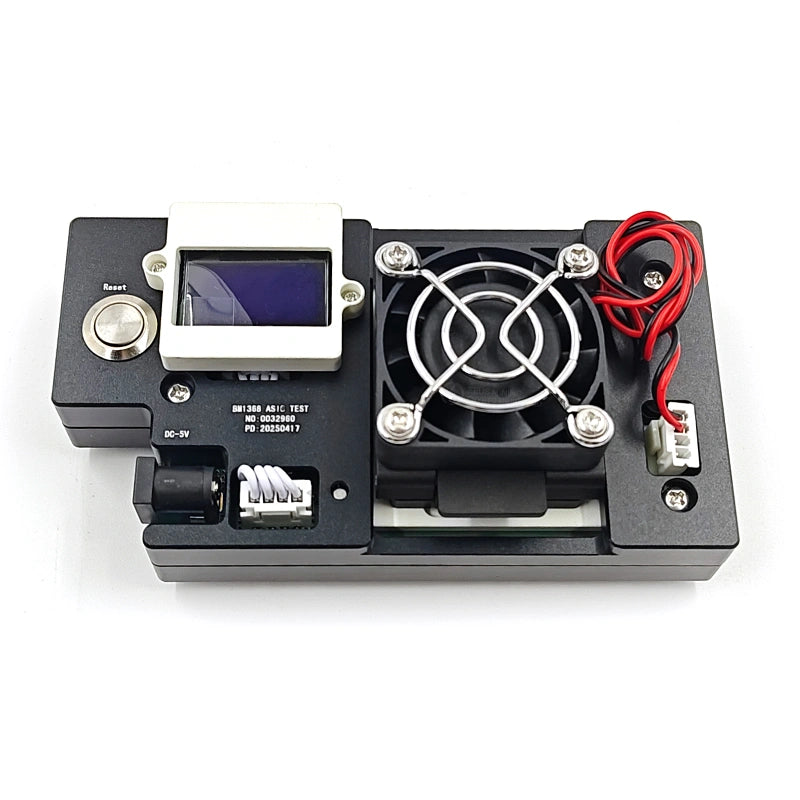
- Pull any board whose chip count or hardware error rate is trending the wrong way and scan it on a test fixture. This is a suggested approach, not a published benchmark: a rising trend on a board with a high cycle count is the signal to look for a marginal joint before it fails outright.
When a joint does fail
BGA rework needs a controlled profile and the right tooling. See the ASIC chip tin tools and the chips and repair components collections. If the fault turns out to be a connection, a supply or a power domain rather than a joint, our cheapest-first diagnosis guide shows the order to check in.
Sites that cycle for other reasons
Heat swings do not come only from power decisions. Sites with big day-to-night temperature differences, or those that struggle with humidity and condensation, add stress of their own. Our tropical mining survival guide covers moisture-driven failures, and the quarterly maintenance checklist is a good base for the routine inspections above.
What to stock for a cycling fleet
Fans first, then connectors and thermal paste, then rework consumables and a test fixture if you repair in-house. Size it to your cycle count and your margins, using the approach in our 12-month standing stock budget template.
FAQ
Is it better to leave machines on than to cycle them?
It depends on the economics. Cycling saves electricity when margins are negative. The fatigue literature says each cycle has a cost in joint life. Weigh the two with your own numbers, and track the failures that follow.
Does a reduced-power state really protect the joints?
The literature says smaller temperature swings reduce fatigue damage. Whether a given miner's low-power state keeps the board warm enough to matter is something you need to test. We do not have published miner-specific data.
Can I see solder fatigue by eye?
Not on a BGA. The joints are under the package. You find it by symptoms and by scanning the board.
Source your parts for a cycling fleet
Tell us how often your machines cycle and which models you run, and we will help you build a fan, connector, paste and rework stock sized to that cadence. Browse the repair tools and instruments or contact us directly.
Email: contact@lys-sz.com
Direct from our warehouses in Shenzhen. Worldwide shipping. DDP available for buyers in the US and the EU. Latam, SE Asia, Middle East, CIS, Africa quoted case by case.