APW12 Bitmain Power Supply Version & Model Identification Instructions
The Bitmain APW12 is the workhorse PSU of the entire Antminer S19, L7 and D7 generation — but the label "APW12" hides three distinct sub-families (APW121215, APW121417, APW12A) with multiple board revisions inside each. Versions are not freely interchangeable: mismatched output voltage will burn hashboard regulators within seconds, and even within the same voltage rating, control-board firmware and voltage-feedback wiring split the lineup into smaller compatible pools. This 2026 update consolidates the official Bitmain version table, our field cross-checks across 1,000+ APW12 units, and the practical rules for ordering, replacing and repairing the correct sub-variant — without bricking the miner on first power-on.
Pair this version guide with the companion Bitmain APW12 PSU Repair Guide & Parts List for the chip-level repair workflow (ICE2QR4765 + NCP1252 + PIC16F1704 architecture, M6 copper-bar bolt diagnostic, I²C test fixture procedure).
Why APW12 Identification Matters
Three independent identification fields determine compatibility:
- Output voltage rating — printed on the label as "1215" (12-15V) or "1417" (14-17V). This is the single most important field. A 12-15V PSU connected to a 14-17V miner under-volts the hashboards and triggers domain regulator failure; a 14-17V PSU connected to a 12-15V miner over-volts and destroys the regulators on the first hashrate ramp.
- Input voltage standard — standard APW12 units accept 200-240V single-phase. The APW12A variant accepts 277V phase-to-neutral input (US data-center 480Y/277V wye grid). They are mechanically interchangeable but electrically incompatible with the wrong grid.
- Board revision letter — printed after the voltage code as a lowercase suffix: a, b, c, d, e, f, g. The suffix changes the voltage-feedback wiring on the secondary, the firmware key inside the PIC supervisor and the harness connector keying.
A miner that boots and shows "PSU detected" on the dashboard but won't ramp hashrate is the classic symptom of a board-revision mismatch — the I²C control link handshakes, but the firmware refuses to lift output beyond the SB rail. This guide tells you which revisions are safe to swap, which can be cross-graded with a firmware update, and which combinations to never mix.
The Three APW12 Families at a Glance
| Family | Output | Input | Rated Current | Board Revisions | Target Miners |
|---|---|---|---|---|---|
| APW121215 | 12V-15V DC | 200-240V AC, 47-63Hz | ~233A @ 220V | a, b, c, d, e, f, g | S19, S19 Pro, T19, S19a, S19a Pro, S19j, S19j Pro, S19j Pro+, S19k Pro |
| APW121417 | 14V-17V DC | 200-240V AC, 47-63Hz | ~182A @ 220V | a, b | L7, D7, S19j (higher-voltage variants), S19JL, S19L, K7, DR7, KA3, KS3, HS3, certain S19 XP revisions |
| APW12A | 12V-15V DC | 277V AC single-phase | ~233A @ 277V | V1.2 (a/b/c sub-revisions) | S19J Pro-A, S19 Pro-A (US 480Y/277V data-center deployment) |
The cardinal rule: the three families are not interchangeable. APW121215 cannot replace APW121417 (voltage too low — hashboards under-perform, then regulators die); APW121417 cannot replace APW121215 (voltage too high — hashboard regulators burn within seconds of power-on); APW12A cannot run on 220V (input under-voltage protection trips, no output); standard APW12 cannot run on 277V (input over-voltage protection trips, PFC stage may take damage on inrush).
APW121215 — Versions a Through g
The APW121215 is the highest-volume APW12 sub-variant by far — it powers the entire S19 family from the original 2020 launch through the S19k Pro refresh. Seven board revisions have shipped over five years of production, splitting into two functionally distinct groups.
Group 1 — APW121215 a / b / c (no voltage feedback)
The earliest production revisions (a, b, c) run an open-loop output control scheme. The PIC16F1704 supervisor receives an I²C voltage setpoint from the miner control board and adjusts the LLC PWM duty cycle by stored calibration, with no closed-loop measurement of the actual output voltage under load. Output regulation in this scheme relies entirely on the inherent regulation of the LLC topology + the cap-bank ESR — adequate for steady-state operation, but slow to compensate for the rapid load steps of a frequency-tuned ASIC.
Cross-compatibility within the group: a, b and c are fully interchangeable. You can pull an "a" out of an S19 Pro that has been running for three years, drop in a "c" pulled from a different unit, and the miner will power-on and ramp hashrate normally. The connector keying and harness layout are identical across all three.
Group 2 — APW121215 d / e / f / g (voltage feedback)
From revision d onward, Bitmain added a dedicated voltage-feedback sense pair on the output bus, routing back into the PIC's ADC. The supervisor now runs closed-loop output regulation, allowing the LLC PWM to compensate for cap aging, harness drop, and load transients in real time. The hashboard sees a tighter +/-1% voltage at the input bus across the entire 0-100% load range — measurable directly as a +0.5-1% efficiency gain at the miner level under sustained full-load tuning.
Cross-compatibility within the group: d, e, f and g are fully interchangeable.
Cross-group replacement rules
This is the rule most often violated in the field:
- d / e / f / g can replace a / b / c — but only after the miner control board firmware is updated to the latest stable release. Older firmware (pre-2022) expected the open-loop calibration table and will report communication errors when paired with a voltage-feedback PSU. After firmware update, the miner control board switches into closed-loop mode and operates the newer PSU correctly.
- a / b / c CANNOT replace d / e / f / g — under any circumstances. Once a miner has been provisioned with closed-loop-aware firmware, dropping in an older open-loop PSU triggers a permanent I²C handshake error: the supervisor reports back "no voltage feedback" and the miner will not lift the output above the SB rail (12V standby, no hashboard power).
Practical implication for fleet stocking: standardise spares on APW121215 d, e or f (with g as the latest current production). They cover every S19-generation miner regardless of firmware vintage. Pulling old a/b/c units back into service requires firmware downgrade — operationally painful and often impossible on modern S19k Pro / S19j Pro+ control boards that never shipped with the older firmware.
Identifying the revision letter on the unit
The board revision is printed on the white label on the side of the chassis, immediately after the voltage code, in the format APW121215a through APW121215g. On heavily soiled units, the letter may be partially obscured — alternative identification points include:
- Output harness connector colour — the d/e/f/g group adds a small white auxiliary sense connector on the secondary, absent on a/b/c.
- Internal PCB silkscreen — the main board carries a "VER:" silkscreen marking near the LLC controller (visible after removing the top cover).
- PIC firmware version — readable via the I²C test fixture; firmware version strings in the 8x-9x range are typically a/b/c, 100+ are d/e/f/g.
Replacement units shipped from our Shenzhen warehouse are labelled with the revision letter on the outer carton — if you're ordering for a specific fleet, tell us your miner generation and we'll match the revision automatically. See our drop-in APW12 PSU 12-15V (1215 series) for Antminer S19, S19 Pro and T19 generic listing for the most common a-f sub-revisions.
APW121417 — Version a vs Version b
The APW121417 is the higher-voltage sibling, designed for miners whose hashboards run on a 14-17V input rail rather than the 12-15V S19 standard. The voltage step-up reduces I²R losses in the harness for the same hashboard wattage, which is why Bitmain reserved this output family for the L7 (Scrypt), D7 (X11) and several higher-density S19 derivatives.
Version a (APW121417a)
Original production revision. Primary 14-17V output rated at 182A at 220V input, plus a secondary 12.3V at 18A output dedicated to the control board (the "OUT2" channel). Power factor exceeds 0.99 at full load, ripple stays below 1% on both channels. Force-air cooling at 45 dBA. Stock available as our APW121417a PSU — Antminer L7 / D7 / S19j / S19L.
Version b (APW121417b)
Refresh revision with updated internal protection circuits — the OCP threshold range was tightened to 260-340A (vs the wider 240-360A window of revision a), and the I²C handshake protocol added an extra verification step on PSU detection. Same form factor, same harness, same primary/secondary outputs, same 200-240VAC input window. Stock available as our APW121417b PSU — Antminer L7 / D7 / S19j / S19L.
Cross-compatibility rules
- b can replace a — the b revision is backwards-compatible with a-firmware miners. Drop it in, miner detects PSU, ramp proceeds normally.
- a CANNOT replace b — on miners shipped from factory with b-firmware (typically late-2022 production onward), the older a revision fails the extra handshake step and the miner refuses to lift output above SB rail.
As with APW121215, fleet stocking discipline: standardise on APW121417b — it covers every L7/D7/S19j/S19JL/S19L/K7/DR7/KA3/KS3/HS3 regardless of vintage.
APW12A — The 277V Variant
The APW12A is mechanically and visually identical to the APW121215 — same chassis, same output harness, same hashboard compatibility — but the input stage is rebuilt for 277V AC single-phase input instead of the 200-240V standard. This is the variant deployed at scale in US data centers running 480Y/277V three-phase wye distribution, where each PSU is wired between one phase leg and neutral (277V phase-to-neutral) instead of phase-to-phase.
The 277V input has two operational advantages at large-fleet scale: it reduces input current by ~25% versus 220V at the same wattage (smaller copper, less voltage drop in panel feeds), and it eliminates the need for buck-down step transformers that would otherwise be required between a 480V utility entrance and a 220V miner-PDU rack. Both factors compound across a 10,000-miner site into meaningful CAPEX and OPEX savings.
Bitmain ships the APW12A primarily for the S19J Pro-A and S19 Pro-A SKUs (the "-A" suffix denotes the 277V variant of the parent model). The current production revision is labelled APW12A_12V-15V_V1.2 (277V Customized) on the chassis sticker.
Critical cross-compatibility rule
APW12A and standard APW121215 are NOT interchangeable, even though the output side is electrically identical:
- Connecting an APW12A to a 220V single-phase outlet triggers under-voltage lockout — PFC stage won't start, no SB rail, no output. No damage, but no operation either.
- Connecting a standard APW121215 to a 277V circuit pushes the PFC bulk capacitor toward its 400V rating limit. The C bulk + GBJ rectifier bridge may survive briefly, but inrush damage to varistor + bridge + bulk cap is the common failure mode. Do not test this — it destroys the unit.
The two variants can be visually distinguished by the front-label voltage range printed alongside the model number (200-240V on standard units, 277V on the A variant) and by the larger varistor + thicker bulk capacitor visible through the side ventilation grille on the A variant.
The "Read the Label" Procedure
Every Bitmain APW12 carries a printed white label on the side of the chassis with all the identification fields you need. Read in order:
- Model line — confirms family. Look for "APW121215", "APW121417" or "APW12A" as the leading string.
- Voltage line — "12V-15V" (1215 series + A variant) or "14V-17V" (1417 series). Cross-checks the model line.
- Revision letter — lowercase a-g suffix on 121215; a-b suffix on 121417; V1.x suffix on A variant.
- Input voltage line — "200-240V~ 50/60Hz" for standard, "277V~ 50/60Hz" for A variant. Catches the 277V/220V mismatch before plug-in.
- Date code — typically printed as YYWW or YYYY-MM-DD. Useful for warranty assessment and for identifying production batches with known cap-failure clusters.
If the side label is missing or unreadable (oil, dust, sun-fade in container deployments), the alternative is to read the silkscreen on the internal PCB after opening the chassis — the PCB part number near the LLC controller carries the same identification string.
Field Replacement Decision Matrix
| Original Unit Failed | Safe Replacement | Conditional Replacement | DO NOT Replace With |
|---|---|---|---|
| APW121215a / b / c | Any APW121215 a-c | APW121215 d-g (after firmware update on miner) | APW121417 (any), APW12A, APW9/9+, APW7, APW3++ |
| APW121215d / e / f / g | Any APW121215 d-g | — (do not downgrade to a/b/c) | APW121215 a-c, APW121417 (any), APW12A, APW9/9+, APW7 |
| APW121417a | APW121417a or APW121417b | — (no firmware constraint) | APW121215 (any), APW12A, APW9/9+, APW7 |
| APW121417b | APW121417b | APW121417a only on a-firmware miners (rare) | APW121215 (any), APW12A, APW9/9+, APW7 |
| APW12A (277V) | APW12A V1.x | — (electrical isolation required) | Standard APW121215, APW121417, APW9/9+ (all 220V — wrong input) |
Bench-Test Fixture Workflow Before Field Install
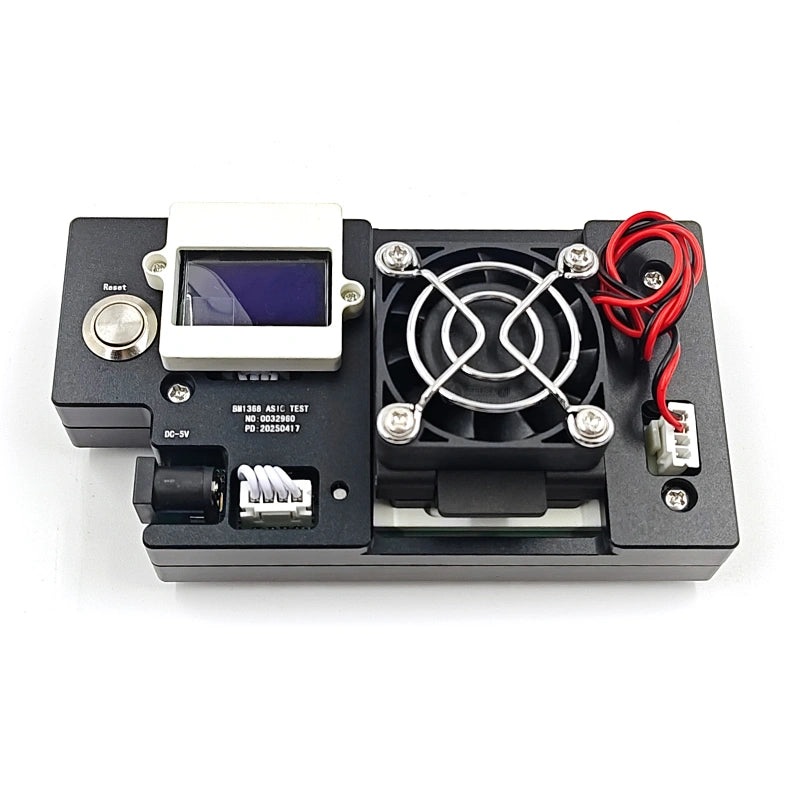
Before deploying any replacement APW12 into a hashboard load, verify the unit on a dedicated bench fixture. Our APW12 PSU Test Fixture (APW121215 a/b/c/d/e Repair) simulates the miner I²C handshake, lifts the main rail through the start-switch protocol, and displays output voltage on an LED panel — without exposing a hashboard to a misidentified unit. The bench-test step adds ~3 minutes per PSU and prevents the most expensive failure mode in the field: dropping a wrong-voltage APW12 into a live miner and destroying three hashboards at $400-800 replacement cost each.
The fixture also serves as the IIC start signal source during chip-level repair — see the companion APW12 PSU Repair Guide & Parts List for the four-step internal diagnostic workflow.
Procurement Guidance — Ordering the Right Unit
When sourcing APW12 replacements for a fleet, supply us with three pieces of information and we'll match the correct sub-variant from stock in Shenzhen:
- Miner model — for example S19 Pro vs S19j Pro vs S19j Pro+ vs L7 vs D7. Determines the family (1215 vs 1417).
- Original APW12 label — photo of the side-chassis sticker, or just the model line text. Determines the revision letter to match.
- Input grid standard — 220V single-phase (default) or 277V (US data-center wye). Determines whether you need standard or A variant.
Common sub-variant stock at our Shenzhen warehouse:
- APW12 12-15V (1215 series) — generic a/b/c/d/e/f for S19/S19 Pro/T19
- APW121417a — L7/D7/S19j/S19JL/S19L (revision a)
- APW121417b — L7/D7/S19j/S19JL/S19L (revision b)
- APW12 PSU Test Fixture (APW121215 a/b/c/d/e bench fixture)
- APW17 1215a — newer S21 / S19j XP generation (not interchangeable with APW12, listed for awareness)
For high-volume orders (50+ units), specify whether you need them pre-tested on our bench fixture before dispatch — adds 24-48 hours to lead time but eliminates DOA risk on arrival. APW12A 277V units ship case-by-case from our Shenzhen warehouse — confirm grid standard with your facility electrical contractor before ordering.
Common Identification Mistakes in the Field
| Mistake | What Happens | Prevention |
|---|---|---|
| Confusing "1215" with "1417" on a dirty label | 14-17V PSU on a 12-15V miner — hashboard regulators (U13/U238 boost ICs, LDO chains) burn within 30 seconds of ramp-up; 12-15V PSU on a 14-17V miner — hashrate falls 30-40% below nameplate, regulators stress-cycle and fail within 2-6 weeks | Wipe label clean before reading; cross-check with miner model; bench-test on fixture before field deployment |
| Dropping a-c into a d-g miner after firmware update | Miner powers up, SB rail comes on, dashboard shows "PSU communication error" or "voltage feedback fault", main rail never lifts, no hashrate | Always replace d-g with d-g; standardise spare stock on d/e/f/g |
| Plugging APW12A into 220V rack PDU | Input under-voltage lockout, no SB rail, no output. No damage but miner stays dead. | Check input voltage label and PDU rating before plug-in; APW12A only on 277V circuits |
| Plugging standard APW121215 into 277V circuit | PFC bulk cap stress (rated for 200-240V × 1.414 + margin = ~340-380V peak; 277V × 1.414 = 392V exceeds margin). Varistor may clamp once then fail short. Inrush kills bridge rectifier. | Standard APW12 ONLY on 200-240V; APW12A required for 277V deployment |
| Ignoring the V1.2 / V1.x suffix on APW12A | Within the A family revisions are smaller (mostly internal component cost-down), but always match V1.x suffix when possible | Same as 1215 series — fleet-standardise on latest V1.x revision |
FAQ
Can I use an APW121215 to replace an APW121417 if my miner is "close enough" on voltage?
No. The 2V output difference (12-15V vs 14-17V nominal) is not a margin tolerance — it's a target voltage that the hashboard boost converters expect at the input bus. An APW121215 on a 14-17V hashboard delivers ~13.5V where 15-16V is expected, leaving the on-board boost converters running at higher duty cycle to compensate, dissipating extra heat and stress-cycling into early failure. Conversely, an APW121417 on a 12-15V hashboard delivers ~16V where 13-14V is expected, over-volting the input regulators and burning them within seconds of full ramp.
How do I know if my miner firmware is "old" (a/b/c-compatible) or "new" (d/e/f/g-compatible)?
Check the firmware build date in the miner web dashboard under "System > Firmware Upgrade". Any firmware built from 2022 onward natively supports voltage-feedback PSUs and is in the d-g compatibility window. Firmware from 2020-2021 may require an upgrade before deploying a d-g unit. In practice, every miner produced in the past three years has shipped with d-g-compatible firmware; the only edge cases are early-production units that have never been firmware-updated since deployment.
What's the difference between APW12 and APW17?
The APW17 is the next-generation Bitmain PSU designed for the S21 family (S21, S21 Pro, S21 XP, S21+ Hydro, S21 Hyd, S19j XP, S19 XP Hyd, S19 Hyd). It uses a different chassis form factor, different harness connectors, and different control protocol from the APW12. The two are not mechanically or electrically interchangeable. APW17 sub-variants follow a similar naming pattern (APW171215a, APW171417, APW111721X for S21 Hydro) — when you see "APW17" on a label, you're holding a different generation, not a higher-revision APW12.
My APW12 label says "APW12A_12V-15V_V1.2" — is this 277V or 220V?
The "A" suffix in the family designation is the 277V variant. The "12V-15V" is the output rating (same as standard APW121215 on the output side). The "V1.2" is the internal board revision within the A family. Net: this is a 277V-input PSU, do not plug into a 220V circuit.
Can I open the chassis and identify the revision from internal silkscreen if the outer label is destroyed?
Yes. After capacitor discharge (wait minimum 5 minutes after unplug, verify with multimeter on bulk cap terminals), remove the top cover. The main PCB carries a silkscreen identifier near the LLC controller IC (ICE2QR4765 area) in the format "PCB: APW12xxxxxR
How do APW12 units age in the field — what's the typical failure cluster?
The dominant failure pathway is electrolytic cap aging on the secondary side (output bulk caps + auxiliary rail caps), accelerated by heatsink-adjacent thermal load. Typical failure cluster onset is at 18-30 months of 24/7 operation in a 35-40°C ambient mining environment; sites running at 25-30°C ambient extend the cluster to 36-48 months. Failure manifests as PSU communication errors first (PIC sees voltage drift outside calibration window), progressing to hashrate instability under load, then full output drop-out. The companion APW12 PSU Repair Guide covers the chip-level repair workflow including cap replacement procedure, M6 copper-bar bolt re-torque protocol, and I²C test fixture verification.
Related Reading
- Bitmain APW12 PSU Repair Guide & Components List (chip-level repair workflow)
- Bitmain APW9 / APW9+ PSU Repair Guide (S17 generation predecessor)
- Bitmain APW8 PSU Repair Guide (S15/T15 generation)
- Bitmain APW7 PSU Repair Guide (S9/L3 generation)
- Bitmain APW3++ PSU Repair Guide (legacy S9/L3/T9)
- Antminer S19 Hashboard Repair Guide (matched APW12 1215 series)
- Antminer L7 Hashboard Repair Guide (matched APW12 1417 series)
- Antminer D7 Hashboard Repair Guide (matched APW12 1417 series)
Order APW12 Replacements with the Right Sub-Variant
Identifying the correct APW12 sub-variant before ordering is the single highest-leverage step in keeping a mining fleet's PSU spares programme efficient — mis-matched units burn hashboards, mis-matched grid input burns the PSU itself, and mis-matched firmware leaves miners dead on the rack with no error message in the dashboard. Read the label, cross-check with the miner model, and bench-test on the fixture before field deployment.
For volume APW12 1215 / 1417 / APW12A orders, fleet-matched dispatch, pre-tested units, or bulk pricing across mixed sub-variants, contact us at contact@lys-sz.com. We ship APW12 replacements worldwide from our Shenzhen warehouse, with DDP shipping available as the primary option for US and EU destinations.